



Hour Care vs Overnight Care vs Live-In Care: What Mississauga Families Should Ask
If you are working out how much help your mother or father needs at night, you will meet three phrases: 24-hour care, overnight care and live-in care. They sound like three levels of one service. They are not. Each describes a different staffing arrangement, and providers may use the labels differently. The comparison that helps is who is in the home, for which hours, and whether that caregiver stays awake.
Key Takeaways
- Home-care providers may use 24-hour, overnight and live-in care differently, so the label alone does not establish the hours, staffing pattern or awake coverage.
- In Ontario long-term care, access to 24-hour nursing and personal care is distinct from the province-wide target for average daily direct-care hours.
- The same phrase can mean someone is present, or that someone can respond quickly. Both are legitimate. They are not the same thing.
- Nights bring most families to this question. Late-day confusion is thought to affect as many as 66 percent of people with dementia.
- Ask any provider for the three facts that actually differ: who is there, for which hours, and whether that person is awake.
- Our own answer, so you have it up front: we provide 24-hour and overnight care in Mississauga, our overnight caregivers are awake, and we do not offer live-in care.
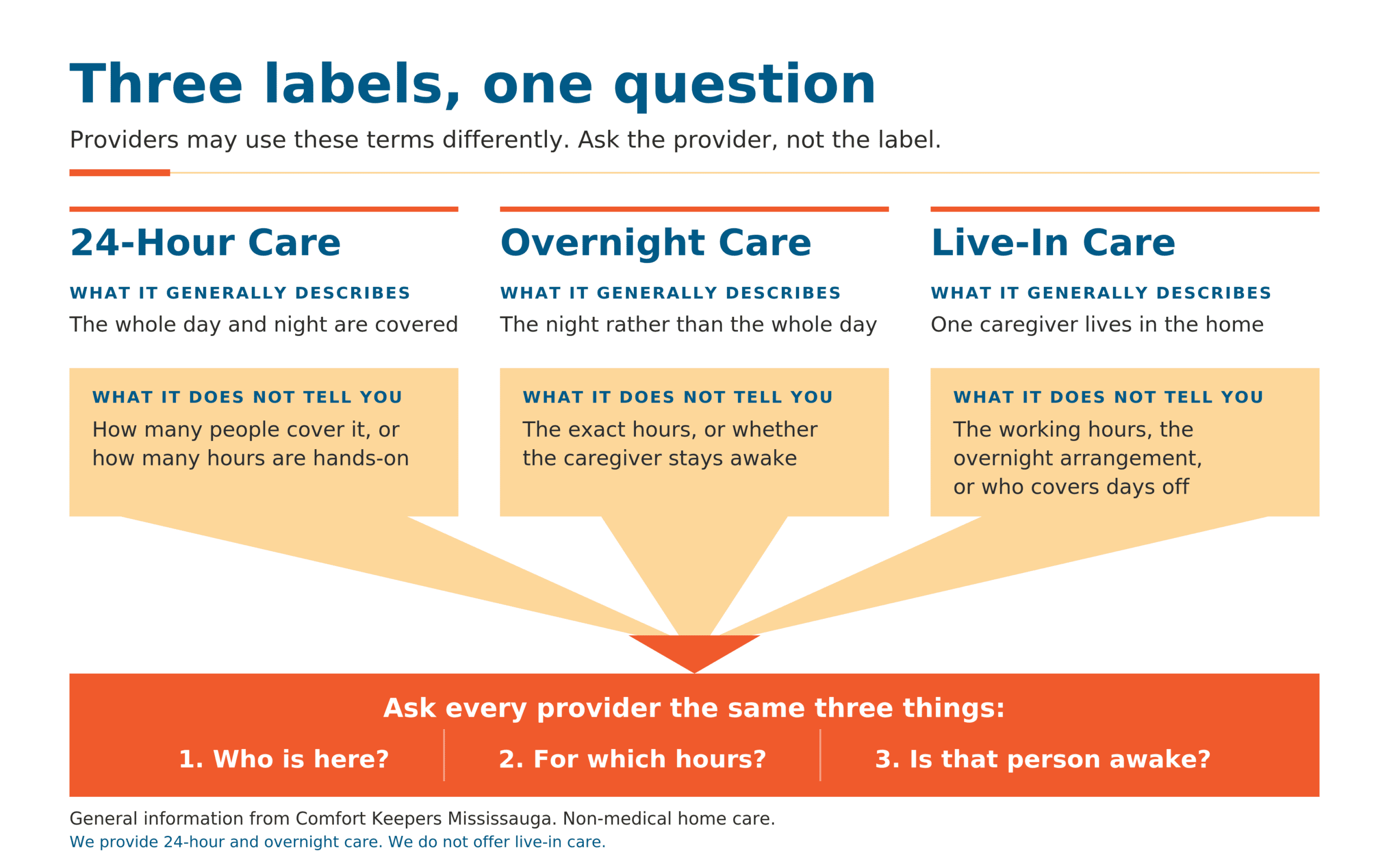
Infographic 1. Three labels, one question.
The Short Answer: What Each Term Usually Means

Ask three home care providers what 24-hour care means and you can get three answers, all of them honest. Home-care providers may organize and describe these schedules differently. That is why the useful comparison is not the label alone, but who is there, for which hours, and whether that person is awake.
Here is what each term does tell you, and what it leaves open.
| The term | What it generally describes | What it does not settle |
| 24-hour care | Support arranged so the whole day and night are covered | How many caregivers cover it, how the hours are divided, and how many of those hours are hands-on |
| Overnight care | Support focused on the night, not the whole day | When the shift begins and ends, whether the caregiver is awake, and who covers the morning |
| Live-in care | One caregiver living in the home | The working hours, the overnight arrangement, time off, and who employs the caregiver |
What 24-Hour Care Can Mean
Twenty-four hours describes the span being covered. It says nothing about how many people cover it, or how many of those hours involve someone actively helping.
In private home care, providers may structure around-the-clock coverage in different ways. Some build it from a team working set shifts. Others spread it across a wider roster, or cover parts of the day differently from the night. That choice shapes how many familiar faces your parent sees in a week, and who is awake at four in the morning.
Ontario uses the same phrase in a very different way. In the province’s own guidance, 24-hour language belongs to long-term care homes, which offer access to 24-hour nursing and personal care. Separately, Ontario sets a province-wide target of an average of four hours of direct nursing and personal support care per resident, per day. Access around the clock and average daily direct-care hours are two different measures, and holding them apart is the single most useful habit to bring into any conversation about a schedule.
The phrase shifts again in publicly funded community programs. Reviewing Ontario’s Assisted Living Services, the Auditor General of Ontario describes the program’s distinguishing feature as the potential for clients to receive 24/7 unscheduled service visits, where someone can respond when the client needs immediate support and cannot wait for a scheduled visit. Here, 24/7 is a promise about how quickly someone can reach you, not about someone already being in the house.
Each of these settings is describing something real. They are simply describing different things with the same words, which is why the word on a quote tells you less than it appears to.
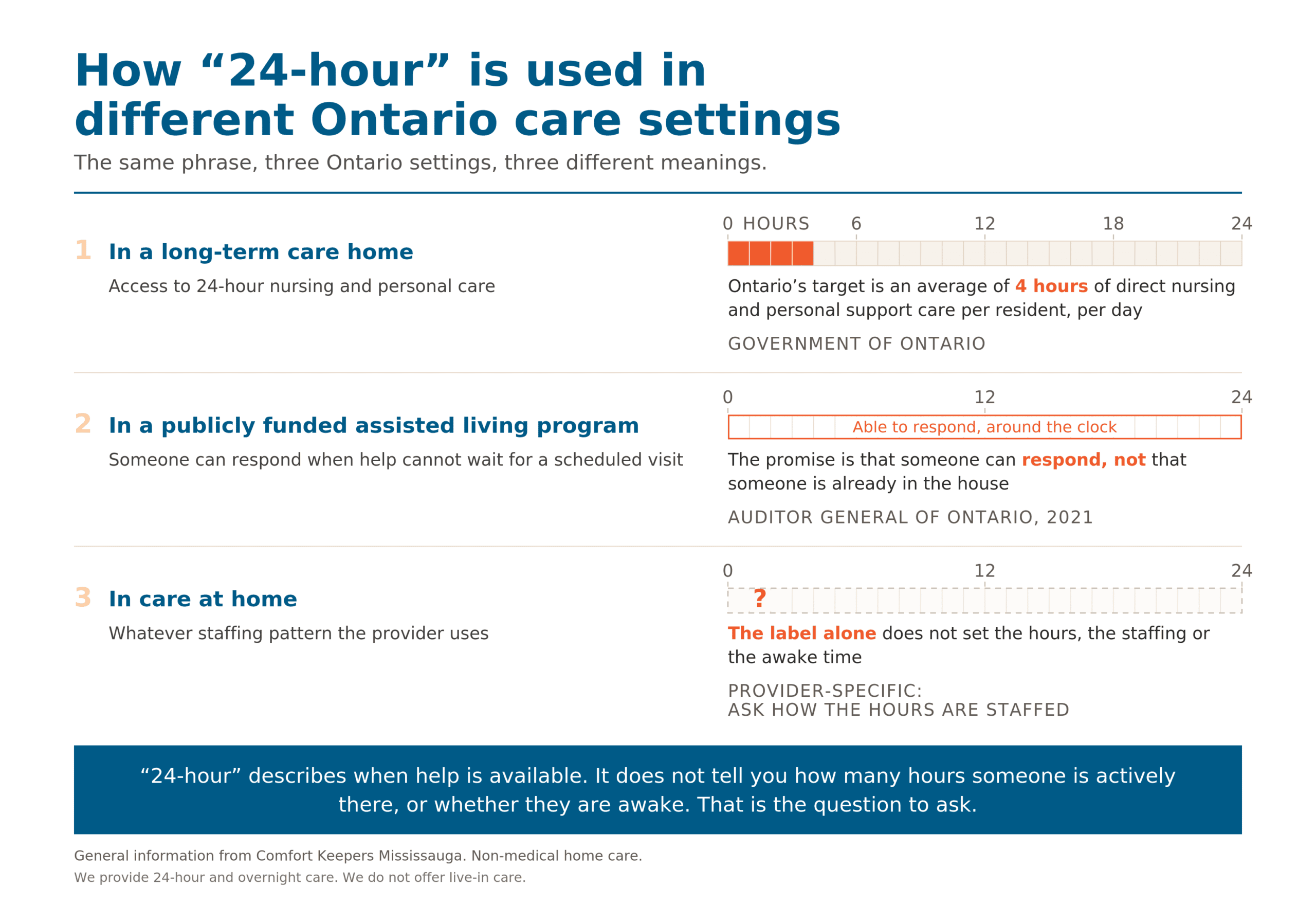
Infographic 2. How “24-hour” is used in different Ontario care settings.
What Overnight Care Can Mean
Overnight care narrows the question to the night. For many families that is the part that has become unmanageable, and covering it is often enough. Bringing someone in at night is not giving up on keeping a parent at home. For most families it is the thing that makes staying at home possible.
The variable that decides almost everything is also the one least often written down: whether the caregiver stays awake through the night, or sleeps and is woken when needed. That question gets its own section below.
The rest is practical. When does the shift begin, and when does it end? Is the caregiver still there for the morning routine, or does the family pick that up? And what is the caregiver actually doing while everyone is asleep?
Ontario does use the word in places. One example is the eShift model, which places specially trained personal support workers in the home to provide overnight care, with a registered nurse supporting them from a remote office. That is one named program for patients at end of life, and it does not set a standard for anyone else using the word. Which is why the shift hours, and whether they are awake hours, are worth pinning down with any provider before the first night.
What Live-In Care Can Mean
Live-in care generally means a caregiver resides in the home during the assignment. Families who choose it are usually looking for continuity, which is a reasonable thing to want and is worth asking every provider about, whatever model they run.
The label itself does not tell you the caregiver’s working hours, whether overnight hours are awake hours, how days off are covered, or who employs the caregiver. Those are the things to ask about.
That last question carries more weight than families expect. If you arrange care privately, you may be considered the caregiver’s employer depending on the working relationship, and the Canada Revenue Agency sets out the responsibilities that can follow. With Comfort Keepers Mississauga, our caregivers are our employees, so the payroll and the paperwork sit with us. Both routes are used by families in Mississauga. It is worth knowing which one you are choosing before anyone moves in.
Questions About Awake Time, Staffing and Handoffs
Once you know how a service is staffed, the comparison largely makes itself. These are the questions that get you there.
Is the Caregiver Awake Through the Night?
This is the one we would ask first. A caregiver who is awake and on hand all night is doing a different job from a caregiver who sleeps and is woken, so ask what each arrangement involves and what each one costs. If your parent gets up often or moves around the house at night, that distinction can matter quickly. Ask it directly, and ask for the answer in writing. Providers use the word overnight to describe different arrangements, so it is the one thing never to assume. Ask us, and ask anyone else you are considering.
How Are the Hours Actually Staffed?
Find out how many caregivers are involved and how a week is put together. One person covering long stretches and a team working shorter shifts feel different to your parent, and they behave differently when something changes. Then ask what happens when the regular caregiver is unavailable. That answer tells you how steady the support will be on an ordinary Tuesday.
What Happens at a Shift Change?
Where care is shared across a team, the handover is what protects continuity. Ask what gets passed between caregivers, how a new caregiver learns the routines that matter, and how the family hears about changes. Consistent routines can be helpful for many people living with dementia, and a well-run handover is how a team keeps those routines steady from one shift to the next. It is fair to press on exactly how a provider does it.
How Dementia and Nighttime Needs Affect the Decision

Most families do not arrive at this comparison because of the days. They arrive because of the nights, and often because of dementia.
Late afternoon and evening can be the hardest stretch. The Alzheimer Society of Canada notes that it is thought late-day confusion, sometimes called sundowning, can be a problem for as many as 66 percent of people with Alzheimer’s disease or other dementias, showing up as confusion, anxiety or restlessness that settles in as the light goes. Tiredness at the end of the day, low lighting and more shadows, a disrupted sleep and wake pattern, and a quiet afternoon can all feed it.
Sleep changes too. The Society describes difficulty staying asleep, waking more often than usual, and more trouble falling back to sleep, and notes that when a person is awake they may wander, be restless or call out, which disrupts the caregiver’s sleep as well. That last part is why so many families start looking at overnight support. The person who is not sleeping is rarely the only one.
Safety belongs in this picture too, and it deserves a straight answer. Six in ten people who live with dementia are at risk of getting lost, the Society reports. That risk is not specific to the night, though it is part of why families think about night-time support. The Society also says two things we repeat to every family: people living with dementia have the right to move about as freely and independently as possible, and no device or system can guarantee that a person will not get lost or that they will be found. No schedule removes risk, and we would not suggest otherwise. What an awake caregiver through the night can do is respond when your parent gets up or needs help, which means a family member does not have to stay awake through the night themselves.
One boundary matters more than any scheduling decision, and it is not ours to draw. The Alzheimer Society of Canada advises families to seek medical evaluation for illness, infection, bowel impaction, urinary tract infection and similar causes when behaviour changes, and recommends a full medical assessment to rule out infections and treatable conditions and to review medications. In Ontario you can speak with a registered nurse day or night by calling 811, and for an emergency call 911. Once a doctor has ruled out or treated a medical cause, the question of help at home comes back, and by then it has usually sharpened into something more useful than a choice between three labels: how many hours is someone awake and with your parent, and what happens in the hours nobody is there.
How Comfort Keepers Mississauga Answers These Questions
Here are our own answers to those questions, so you do not have to ask us for them.
We provide 24-hour and overnight home care in Mississauga. It is non-medical care: help with washing, dressing and toileting, meals, medication reminders, getting around the house safely, and company through the long parts of the day and night. It works alongside your parent’s own doctors.
Our overnight caregivers work a shift and are awake and on hand, ready to help if your parent gets up, needs the bathroom, or wakes unsure where they are. Our 24-hour care is built from a team working in shifts, for example two 12-hour shifts or a combination of shorter ones, so no one person is covering every hour.
Continuity is what families ask us about most, and it is a fair thing to press any team-based provider on. We build each schedule around a settled group of caregivers, we introduce them before they start, and we pass the routines between them so your mother or father is not starting again at every shift change. The scheduling, the cover when someone is away and the employment paperwork are ours to carry, not yours.
We do not offer live-in care. It is not the model we run, and we would rather be clear about that now than have you find out in week two.
We serve families across all Mississauga neighbourhoods, including Port Credit, Streetsville, Erin Mills, Cooksville, Meadowvale, Clarkson and Malton. We build the plan with you and go back over it as needs change, whether that means adding hours through a hard stretch or easing off when things settle. If you want to talk any of this through, our office is on (905) 671-4004. There is more detail on our 24-hour and overnight home care page, on dementia care, and on respite care if the days are wearing you down as much as the nights.
Questions to Ask the Mississauga Team
Take this list to any provider you are considering, including us.
| Question to ask | Why it matters | What you want written down |
| Is the overnight caregiver awake through the night? | One word covers two quite different services | The exact hours, and whether those are awake hours |
| How many caregivers cover the schedule, and how are the shifts divided? | It shapes continuity, and how alert the support is at three in the morning | The number of caregivers and the shift pattern across a week |
| What exactly is covered by the hours you have quoted? | Coverage and hands-on help are two different measures | What the quoted hours include, so two quotes can be compared |
| What gets passed between caregivers at a shift change? | It is how continuity survives a team | How routines and changes travel from one shift to the next |
| What happens when our regular caregiver is unavailable? | Absence cover is what makes support steady week to week | The cover arrangement, agreed before you need it |
| What is included, and what is not? | It prevents wrong assumptions about daily tasks and about medical care | The task list, including what falls outside it |
| How does this fit with our doctor and any public home care? | Everyone does better when the boundaries are clear from day one | Where home support ends and health care begins |
| How does the schedule change as needs change? | Needs move, and a plan should be able to move with them | How hours are added or reduced, and how quickly |
Next Steps in Mississauga

You do not have to decide anything to take the next step, and you do not need the answers to every question above before you call. Most families who ring us are partway through a hard month and are not sure what they need yet. That is a normal place to start from.
A first call is a conversation, not an assessment. You tell us what the days and nights look like, we ask about the parts that have become hardest, and we tell you what we could put in place and what it would cost. There is no cost and no obligation.
Call our Mississauga office at (905) 671-4004, or reach us through our contact page. Our office is at 57 Village Centre Place, Unit 201, Mississauga.
Compare Care Options With Our Team
Already leaning one way? Explore 24-Hour and Overnight Care
Local Review by Brenda Rosati
Written by the Comfort Keepers Canada Editorial Team. Reviewed by Brenda Rosati, Director of Operations and Owner, Comfort Keepers Mississauga. Last reviewed: [add date after review].
Brenda leads our local team and reviews the service information on this page for local accuracy, so that what we describe here matches how our Mississauga office schedules and staffs care. She does not give medical advice, and this article is general information rather than a diagnosis, a treatment plan or a recommendation about any individual’s care.
Sources
- with its “it is thought” and “as many as” hedges intact, and the “six in ten at risk of getting lost” phrasing against the live pages. Note that alzheimer.ca currently resolves both /en/help-support/ and /en/help-information/ paths; confirm both in a browser at build time.
- Do not clone this article for Brampton, Oakville, Toronto or any other location by swapping the city name. Google’s spam policies name “having multiple domain names or pages targeted at specific regions or cities that funnel users to one page” as doorway abuse. Each location needs its own confirmed operating model, local reviewer, local links and local phone and address.
- Assets: 2 native tables (full gridlines, shaded header row) and 2 brand-palette infographics built from the verified figures and embedded in this document.
Frequently Asked Questions
Does publicly funded home care in Ontario cover overnight or around-the-clock support?
It comes down to the assessment. The Government of Ontario states that “Based on your assessed needs and the services that are available in your community, the case manager or care coordinator will determine what home care services you are eligible to receive from Ontario Health atHome”. Your needs are reassessed if your circumstances change. So put a specific question to the care coordinator: what does this plan include overnight? Ontario Health atHome can be reached at 1-833-515-1234, seven days a week.
How do I compare quotes when two providers describe the same thing differently?
Put every quote into the same three numbers before you look at price, and compare those instead of the wording. Ask each provider to put the hours, the number of caregivers and the awake time on paper. Written out that way, you can see whether the two quotes are offering the same amount of care, and any difference in price is much easier to make sense of.
What if my parent does not want anyone in the house?
That is one of the most common things families tell us, and it is rarely the end of the conversation. Most people accept help with one specific thing, a hand at bedtime or someone there overnight so the family can sleep, more easily than the idea of a caregiver in general. Start small and specific, involve them in the choice, and give a new face time to become familiar. Our article on how to talk to a parent about getting help at home goes through it in more detail.
Can we start with a few nights a week instead of every night?
Starting with the hardest two or three nights is a common way in, and it can be enough to break a bad stretch while everyone works out what is really needed. Whether a particular pattern can be covered depends on the care plan and on availability, so that is a question worth putting to any provider, along with their shortest booking and how much notice they need to change a week. Tell us what your week looks like and we will tell you plainly what we can arrange.