



What Are Respite Care Services in Ontario, and How Do You Arrange Them?
Respite care is temporary, planned support that gives a family caregiver a break while the person they care for keeps getting help, usually at home. In Ontario, there are two ways to set it up. One is publicly funded and coordinated through Ontario Health atHome, where an assessment decides who qualifies. The other is arranged privately with a provider and paid for by the family. This guide walks through what respite looks like, how the public and private options compare, and how to set one up. It is general information, not medical or funding advice.
Key Takeaways
- Respite care is temporary relief for a family caregiver. In Ontario it can happen at home, at an adult day program, or during a short stay in a long-term care home, according to the Government of Ontario.
- Publicly funded respite is arranged through Ontario Health atHome after an assessment, and eligibility is decided case by case rather than granted automatically.
- Respite is not paid for by OHIP. A valid Ontario health card is one of the eligibility requirements, while publicly funded home care itself is funded through Ontario Health atHome.
- In-home respite is fully covered only if the person you care for qualifies. Adult day programs charge a daily fee, and a short stay in a long-term care home covers the care but not room and board.
- Families who do not qualify, or who want more hours, timing, or continuity, can arrange respite privately instead.
- To look into publicly funded respite, call Ontario Health atHome at 1-833-515-1234. If you are in Mississauga and would rather arrange private respite, our team can help through our respite care services in Mississauga.
What Respite Care Can Look Like

Respite is built around the caregiver rather than a single task. Someone steps in to look after your family member for a while so you can step away, whether that is for a few hours, a regular weekly visit, or a longer stretch. The Government of Ontario describes it as relief caregiving provided while you are away, and it is meant for anyone caring for a person with a health condition, a disability, or care needs that come with aging.
In Ontario, respite can take place in three settings. At home, a caregiver or health professional supports your family member in their own surroundings. An adult day program brings people together for structured, supervised activities during the day. And a short stay in a long-term care home covers longer breaks, such as a holiday or a hospital stay of your own. When respite happens at home, the help tends to cover three things: personal care such as bathing, dressing, mobility, and medication reminders; homemaking such as meals, laundry, and light cleaning; and professional care such as nursing or physiotherapy where it is needed.
The table below sets out the three settings side by side so you can see which one fits the break you are looking for.
| Setting | What it usually involves | Good to know |
| At home | Personal care, homemaking such as meals and light cleaning, and professional care like nursing or therapy where needed | The person stays in familiar surroundings, and the hours available vary by service and situation |
| Adult day program | Structured, supervised group activities, often with transportation, a meal, and personal care during the day | A referral from Ontario Health atHome is needed for publicly funded programs, and most charge a daily fee |
| Short stay in a long-term care home | Round-the-clock care in a care home for a defined period | Used for longer breaks; the stay is time-limited (up to 60 days at a time, and no more than 90 days in a calendar year) |
Publicly Arranged and Private Respite Options
Most families in Ontario are choosing between two paths, and it helps to see them plainly before deciding. They suit different situations rather than competing, and can be used together.
Publicly funded respite is arranged through Ontario Health atHome, the provincial organization that coordinates home and community care. When the person you care for is assessed as eligible, the province funds the support, though eligibility is decided case by case and some options carry a fee. Privately arranged respite works differently. You pay a provider directly, which gives you more say over the hours and who comes, and it does not depend on an eligibility decision. The table below compares the two.
| Publicly arranged (Ontario Health atHome) | Privately arranged | |
| How you access it | An assessment through Ontario Health atHome | A direct call to a provider |
| Eligibility | Decided case by case after the assessment | No Ontario Health atHome assessment required, subject to the provider’s scope and availability |
| Who pays | Funded by Ontario Health atHome when eligible; some services involve a fee or co-payment | The family, on a plan that suits its budget |
| Flexibility | Set by the assessed care plan and what is available | Greater control over requested hours and caregiver continuity, subject to provider availability |
| Best for | Assessed needs and publicly funded support | Flexible, ongoing help and filling the gaps |
Who Pays for Respite Care in Ontario, and Is It Covered by OHIP?
This is one of the most common questions we hear, and the short answer is no. Respite care is not billed to OHIP. OHIP, the Ontario Health Insurance Plan, covers services like visits to doctors, hospital stays, and lab testing, not home or community care. Publicly funded respite is funded separately through Ontario Health atHome for people who qualify. A valid Ontario health card still matters, because it is one of the minimum eligibility requirements for in-home respite, but the card itself is not what pays for the care.
Who qualifies for publicly funded respite care in Ontario?
Eligibility is based on the needs of the person you care for, and it is confirmed through an Ontario Health atHome assessment rather than decided in advance. For respite at home, the person must have a valid Ontario health card and a home that is properly equipped for the services needed. A short stay in a long-term care home has its own conditions, such as being at least 18 and covered by OHIP. Because it is assessed case by case, the surest way to know is to contact Ontario Health atHome and ask.
What it costs depends on the type of respite. In-home respite is fully covered by Ontario Health atHome when the person you care for qualifies for it, and arranged for a fee through other organizations when they do not. Adult day programs generally charge a fee for each day attended. A short stay in a long-term care home covers the personal support and nursing care, while the family pays the accommodation costs, meaning room and board. Across home and community care more broadly, the province notes that some services are government funded, some involve a client co-payment, and others are offered privately for a fee. So it is best to check your own situation, because the cost of respite is rarely all or nothing.
| Respite option | What public funding covers | What a family may pay |
| In-home respite | Fully covered by Ontario Health atHome when the person qualifies | A fee through another organization if they do not qualify |
| Adult day program | The publicly funded program, once referred | A daily fee for each day attended |
| Short stay in a long-term care home | Personal support and nursing care during the stay | Accommodation costs, meaning room and board |
Some families may also qualify for tax relief, though these credits do not automatically cover respite care. The Ontario Seniors Care at Home Tax Credit applies to eligible medical expenses, which can include certain attendant-care costs, while the federal Canada Caregiver Credit is available in some circumstances to people supporting a dependant with a physical or mental infirmity. Eligibility varies, so check the current government rules before counting on either one.
How to Arrange Respite Care
Getting started is simpler than it sounds, and the first step is the same whichever path you choose. You describe your situation to someone who can help.
For publicly funded respite, the route is Ontario Health atHome. You can call them at 1-833-515-1234 from anywhere in Ontario, and you do not need a doctor to refer you, since anyone can make a referral, including yourself. A care coordinator talks through what the person you care for needs, arranges an assessment to confirm eligibility, and, if they qualify, helps put a care plan in place. The number of hours and the exact services depend on that assessment and on what is available.
For privately arranged respite, you contact a provider directly. You talk through who you care for, what a typical day looks like, and the kind of break you are hoping for, then agree on a schedule and get started. Because it does not require an Ontario Health atHome eligibility approval, private respite may be arranged more quickly, subject to the provider’s availability. Private respite may suit families that want a specific routine, particular hours, or greater caregiver continuity.
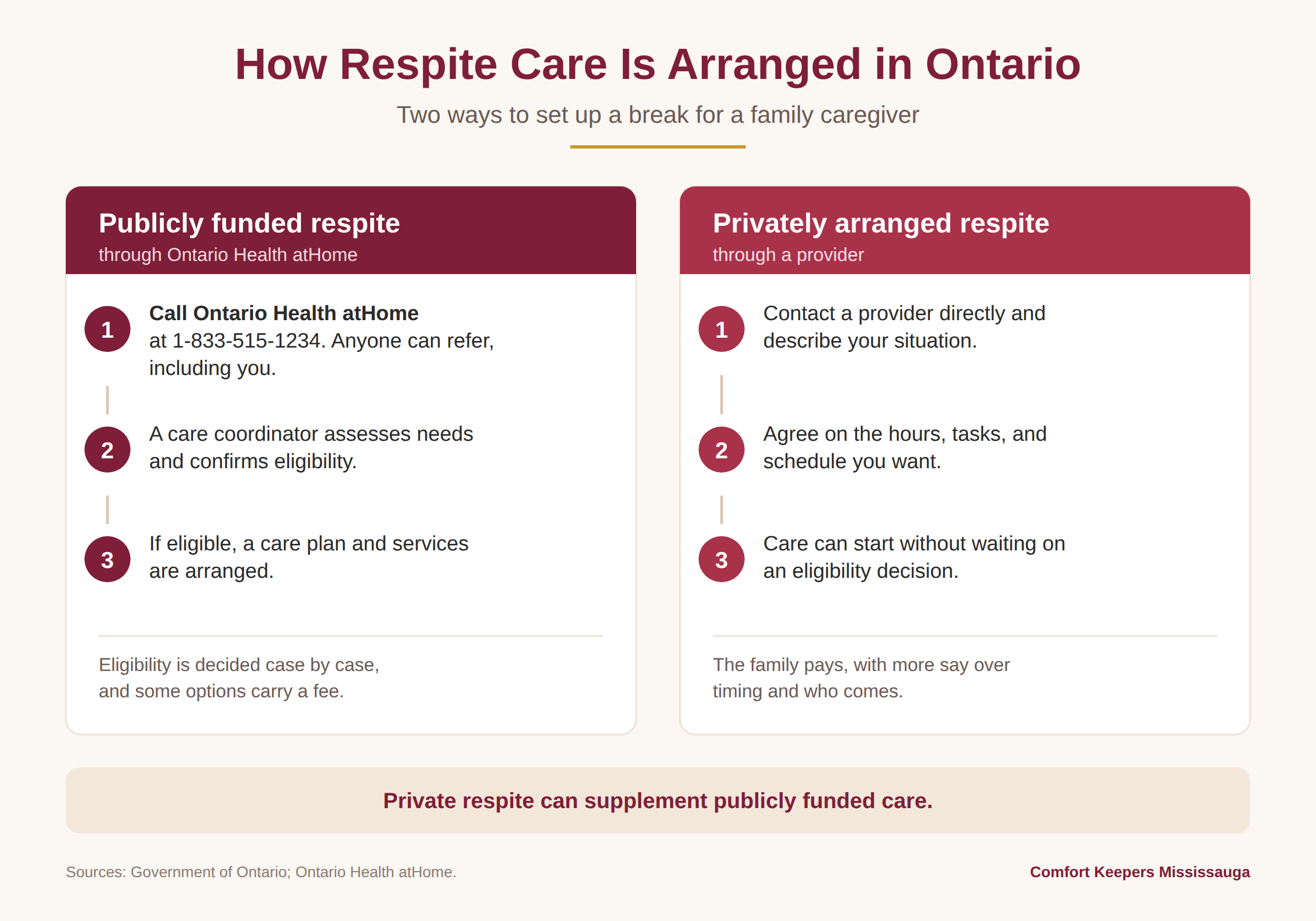
How respite care is arranged in Ontario: the public and private paths.
Questions to Ask a Respite Provider
Public route or private, a few questions will quickly tell you if a provider is the right fit. It is worth asking them before anyone starts.
- How do you match a caregiver to the person’s needs, personality, and language or cultural preferences?
- What happens if the match is not right, and how quickly can we ask for a change?
- Exactly which tasks are covered, such as personal care, mobility, meals, medication reminders, and companionship, and which are not?
- How do you handle short-notice, overnight, weekend, or regular recurring visits?
- Will the same caregiver come each time, or does it rotate?
- How are your caregivers screened, trained, supervised, and insured?
- Is there a written care plan, and how will you keep me updated or raise a concern?
- What is the rate, what does it include, and what is the cancellation policy?
- What is the backup plan if a scheduled caregiver is unwell or unavailable?
Good providers will welcome these questions and answer them plainly. If the answers feel vague, that tells you something too.
When Families Consider Respite

Every family arrives at respite for its own reason, and there is no wrong one. Some are caring for a parent while holding down a job and need dependable cover during the day. Some are looking after a spouse and have their own appointments, errands, or sleep to catch up on. Others have a trip booked, a family event to travel to, or a run of broken nights that is catching up with them.
Plenty of people look into respite before anything goes wrong. They have been managing well and want to keep it that way by building in a regular break. Reaching out early is a sensible part of caring for someone over months and years, not a sign that you are falling behind. If you are feeling worn down, or you want to recognize the warning signs before they arrive, our guide to caregiver burnout and family caregiver relief is a good place to start. For support beyond respite itself, the Ontario Caregiver Helpline offers free, confidential information and referrals to caregivers across the province at 1-833-416-2273, 24 hours a day. It is not a crisis line. If you or someone you know is in immediate danger, call 911. If you or someone you know is thinking about suicide, call or text 988.
Respite Care in Mississauga
Here in Mississauga, our team arranges private respite around each family. Before the first visit, we take time to learn how the day usually flows, from meals and rest to the walk or the show your family member looks forward to, and then we keep to it. This is part of what we call Interactive Caregiving, where our caregivers do things with your loved one rather than only for them, so the day still feels like theirs while you get a real break. Our support is non-medical, and when a family needs care around the clock we provide it through caregivers working in shifts rather than a single live-in caregiver.
If you would like to see how this works and what it would involve for your family, our respite care services in Mississauga page explains it in full, and you are always welcome to talk it through with us first. There is no cost to talk and no obligation to go ahead. Call our Mississauga office at (905) 671-4004, or reach us through our contact page, and a local team member will get back to you. You will find us at 57 Village Centre Place, Unit 201, Mississauga. For more guides like this one, visit our Information Centre.
Explore Respite Care in Mississauga
H2: Local Review by Brenda Rosati
This page was written by the Comfort Keepers Canada Editorial Team and reviewed by Brenda Rosati, Director of Operations and Owner of Comfort Keepers Mississauga. Brenda leads our local team and has spent years helping Mississauga families arrange respite and other care at home. She reviews our care information so it reflects how we actually work here and what local families need to know. Brenda does not give medical advice, and this page is general information rather than a diagnosis or a care recommendation.
Written by the Comfort Keepers Canada Editorial Team. Reviewed by Brenda Rosati, Director of Operations and Owner, Comfort Keepers Mississauga. Last reviewed: [add date after review].
Sources
- Ontario Health atHome. Home and community care coordination and referrals. Accessed August 27, 2026.
Respite Care in Ontario FAQs
A few questions come up often when families first look into respite. Here are straight answers.
Does the person I care for have to leave home to get respite?
No. With in-home respite, a caregiver comes to your family member, so the day and the surroundings stay the same. That can matter a great deal for someone who finds unfamiliar places unsettling. An adult day program or a short stay in a long-term care home are there if a change of setting suits you better, but staying home is a perfectly normal choice.
Can we arrange respite for just a few hours at a time?
It depends on the path. At Comfort Keepers Mississauga, privately arranged in-home respite can be scheduled by the hour, so a few hours at a time is an option and you do not have to commit to an ongoing schedule. Publicly funded respite depends on the assessment, the program, and what is available, so the amount is set through Ontario Health atHome rather than chosen freely.
Can we use publicly funded and private respite together?
Yes. Publicly funded care covers what the person is assessed to need, and privately arranged respite can supplement it with extra hours or particular timing. Combining the two is one way to cover what an assessed care plan does not reach.
Is respite care only for people caring for an aging parent?
No. It is just as much for someone caring for a spouse, an adult child, a sibling, or a friend as it is for an adult child looking after a parent. What matters is that you are the one providing regular care, not your relationship to the person.