



You’re standing at a crossroads, facing one of the most significant decisions a family can make. A loved one is navigating the challenges of dementia or Alzheimer’s, and the responsibility of ensuring their safety, happiness, and dignity rests on your shoulders. Here in North Vancouver, you have options, but they often feel overwhelming: should you choose a specialized memory care facility or embrace the familiarity of in-home care?
This isn’t just a logistical choice; it’s an emotional one. You’re weighing the structured environment of a facility against the deep comfort of home. You’re balancing the need for professional support with the desire to keep your family together.
The goal of this guide is to cut through the noise. We’ll provide a clear, data-driven framework to help you compare these two paths, empowering you to make a decision that feels right not just for your loved one, but for your entire family.

Understanding the Two Paths: Facilities vs. Home
Before we compare, it’s important to understand what each option truly entails.
Memory Care Facilities are specialized, secured wings within larger assisted living communities or standalone residences designed specifically for individuals with cognitive decline. They offer a structured, group-oriented environment.
Pros of Memory Care Facilities:
- 24/7 Supervision: Staff are on-site around the clock.
- Structured Activities: Scheduled social events and therapies designed for cognitive engagement.
- Peer Socialization: Opportunities for residents to interact with others facing similar challenges.
- Provincially Regulated: Residential care facilities in British Columbia are licensed, providing a baseline of operational standards.
The Hidden Concerns: While facilities offer a structured solution, many families worry about the loss of individuality. Common concerns often revolve around high staff-to-resident ratios, which can lead to impersonal care and slow response times. The transition to an unfamiliar environment can also be disorienting and stressful for someone with dementia, potentially accelerating cognitive decline.
The Power of Familiarity: Specialized In-Home Dementia Care
The alternative is bringing specialized care into the one place your loved one knows best: their own home. Research confirms a strong preference for aging in place, with over half of Canadian seniors with dementia residing in their community. This approach focuses on a one-to-one relationship between a caregiver and your loved one.
Pros of In-Home Dementia Care:
- Comfort of Home: Remaining in familiar surroundings reduces confusion, anxiety, and agitation.
- One-on-One Attention: A dedicated caregiver ensures personalized care that adapts to your loved one’s changing moods and needs throughout the day.
- Maintained Routines: Daily rhythms – from mealtimes to favourite TV shows – can continue uninterrupted, providing a powerful sense of stability.
- Greater Family Involvement: Care is a collaborative process, making it easier for you to stay connected and involved.
Navigating an Unregulated Landscape with Confidence
It’s a critical fact that families in British Columbia need to know: private in-home care agencies are not provincially licensed in the same way facilities are. This can feel daunting, but it also creates a clear distinction between basic providers and truly elite ones.
Without government oversight, the responsibility falls on the agency to create its own gold standard of excellence. This is where credentials become non-negotiable. Comfort Keepers North and West Vancouver, for example, voluntarily underwent a rigorous evaluation by Accreditation Canada and was awarded the “Accredited with Exemplary Standing” seal – the highest certification available for home care in the country. This independent validation of our commitment to safety, quality, and clinical excellence provides the peace of mind that provincial licensing alone cannot.
The Factor No One Talks About Enough: Your Well-Being
The decision about care is not just about your loved one; it’s about the health of your entire family system. Research shows that unpaid family caregivers for someone with dementia spend an average of 26 hours per week on care tasks – far more than for other conditions.
This immense effort leads to higher rates of distress, depression, and burnout. Critically, this caregiver stress can inadvertently worsen the cognitive decline of the person they are trying to help.
Professional in-home care is not a replacement for your love and support. It’s a partnership that lifts the immense logistical and emotional weight from your shoulders. It provides you with essential respite care services, allowing you to be a daughter, son, or spouse again, rather than just a caregiver. This shift allows for more positive, meaningful interactions that benefit everyone.
A Clear Framework for Your Decision
To help you weigh your options, here is a direct comparison of the key factors you’re likely considering.
The Financial Reality: Comparing Costs
At first glance, the costs can be confusing. Memory care facilities typically charge a high, all-inclusive monthly fee, whether your loved one uses all the services or not.
In-home care offers a more flexible and often more cost-effective model. You pay for the specific hours and types of in-home care services you need. In the earlier and middle stages of dementia, this can result in significant savings while providing a higher degree of personalized attention. As needs evolve, you can scale the services up or down, ensuring you are always paying for exactly the support your family requires.

Frequently Asked Questions from North Vancouver Families
We speak with families like yours every day. Here are honest answers to the most common questions we hear.
Q1. How do I know I can trust a caregiver in our home?
A1. This is the most important question you can ask. Trust is built on a foundation of rigorous standards. It starts with comprehensive screening, including police record checks and reference verification. At Comfort Keepers North & West Vancouver, it extends to ensuring every caregiver is bonded and insured. But most importantly, it’s about the quality of the individual and their training. Our caregivers are chosen for their empathy and are extensively trained in our unique philosophy of Interactive Caregiving™, which transforms routine care activities into opportunities for meaningful connection and engagement.
Q2. My loved one is starting to wander. Isn’t a facility safer?
A2. Wandering is a serious concern, but a secure facility isn’t the only solution. The one-on-one supervision inherent in professional in-home care is a powerful safety measure. When combined with a thorough home safety assessment and simple modifications, you can create a secure and comfortable environment. We can help you with a safety checklist to prepare your home, ensuring peace of mind without sacrificing the comfort of home.
Q3. How does Interactive Caregiving™ specifically help with dementia?
A3. Instead of simply “doing for” a client, our caregivers “do with” them. For a person with dementia, this is transformative. Folding laundry, preparing a simple meal, or looking through a photo album are not just tasks; they are activities that stimulate the mind, engage the body, and provide a sense of purpose and accomplishment. This approach, practiced in the familiar setting of their own home, has been shown to reduce agitation and improve overall quality of life. It’s the core of our specialized dementia and Alzheimer’s care program.
Your Next Step Is a Conversation, Not a Commitment
Choosing the right path for dementia care is a journey, not a single decision. The best choice is one that honours your loved one’s desire for dignity and comfort while providing your family with support and peace of mind. While a facility offers a structured solution, the personalized, one-on-one support of in-home care provides a level of compassion and familiarity that can make all the difference.
You don’t have to have all the answers right now. Let’s talk about your unique situation. We can help you understand the options and build a plan that truly fits your family’s needs.
Schedule a complimentary, no-obligation in-home assessment with one of our North & West Vancouver care experts today.
The Best Senior Home Care in North and West Vancouver is Comfort Keepers®
Our senior home care agency offers in-home care focusing on aging in place. Our services include dementia care, end-of-life care, post-surgery care, and palliative care. Comfort Keepers can assist seniors with living transition services, personal care, companionship care, and more!
Quality and Accredited Elderly Care: Happier, Healthier, and at Home with 24/7 Senior Care Opportunities!
Do you need a home care solution for yourself or a loved one? Have you been thinking about retirement homes and their alternatives as a solution? Comfort Keepers® enables seniors to maintain happy, healthy lives in the comfort of their own homes. In-home care services are available in North Vancouver, West Vancouver, and the surrounding areas.
Comfort Keepers® is a Senior Care Agency That Can Make a Difference with Interactive Caregiving™
Our in-home caregivers ensure our senior clients have the best quality of life. The Interactive Caregiving™ program ensures that a senior’s safety, nutrition, mental well-being, and everyday needs are met. This program brings joy and good health to each client’s home.
Comfort Keepers® North Vancouver and West Vancouver Can Help with In-Home Elderly Care Services!
If you are concerned about the health and well-being of a loved one we can help! Comfort Keepers offers 24-hour care and delivers top-quality and compassionate care for seniors. We are dedicated to safety technology solutions that foster independence and enhance well-being.
Locally Owned and Operated Home Health Care Agency
Our care centers around companionship for seniors. Empathetic care originates from the soul and allows us to meet our client’s requirements. The seasoned in-home caregivers employed by Comfort Keepers are carefully chosen based on their empathetic qualities.
Contact the Comfort Keepers® North Vancouver and West Vancouver office at (604) 998-8806 to learn more about our unique in-home care solutions for seniors.
Comfort Keepers is an Accredited Senior Care Agency in North and West Vancouver, BC
Accreditation is a rigorous process that involves industry experts evaluating an organization’s processes, policies, and procedures. Comfort Keepers® North and West Vancouver has been awarded Exemplary Standing by Accreditation Canada. This achievement recognizes that Comfort Keepers® meets or exceeds the stringent quality standards for Home Care companies established by Accreditation Canada.
Beyond the Sidelines: Why Active Engagement is the Best Defence in Early Dementia

It started subtly. Your loved one, always so vibrant and involved, begins to retreat. They might watch more television, participate less in conversations, or seem content to just sit and observe. As a family member, your first instinct is to protect them – to make life easier by taking over tasks they find challenging.
But what if the most protective thing you could do isn’t to help them do less, but to find new ways to help them do more?
Many families believe that a diagnosis of early dementia marks the beginning of an inevitable decline into passivity. The truth, however, is far more hopeful and scientifically profound. Passive supervision, while well-intentioned, can inadvertently speed up cognitive decline. The real key to preserving function and quality of life lies in a simple, powerful concept: active engagement.
This isn’t just about keeping someone busy. It’s about intentionally stimulating the brain to build resilience against the changes dementia causes.

The Surprising Truth About the Brain and Dementia
To understand why engagement is so critical, it helps to think of the brain not as a fragile object, but as a living, adaptable network.
Think of a bustling city. A healthy brain has countless roads and highways connecting different neighbourhoods (brain regions). When a few roads are closed due to dementia, traffic can still get through by taking alternative routes. This network of alternate routes is what scientists call “cognitive reserve.”
Research published in prestigious journals like The New England Journal of Medicine and The Lancet consistently shows that a lifetime of intellectual, social, and physical activity helps build a richer, more complex network of these neural roadways.
Even after a diagnosis, the brain retains a remarkable ability called neuroplasticity – the capacity to form new connections. Every time your loved one engages in a conversation, works on a simple craft, or takes a walk, they aren’t just passing the time. They are actively maintaining existing neural pathways and even creating new ones, effectively strengthening their cognitive reserve and finding detours around the damage caused by dementia.
The Hidden Cost of “Doing For” Them: Why Passive Supervision Isn’t Enough
When we see a loved one struggle, our instinct is to step in. We might answer questions for them, finish their sentences, or take over a chore they’re fumbling with. This is passive care – it keeps them safe, but it sidelines their brain.
Imagine that city again. If you stop using certain roads, they fall into disrepair. The same is true for the brain. When a person is left to sit passively, the neural pathways associated with communication, problem-solving, and motor skills get weaker from disuse. Studies on passive behaviours in dementia show that this lack of stimulation can accelerate the decline in cognitive function.
Active Interaction vs. Passive Supervision: What’s the Difference?
- Passive: Sitting together watching TV in silence.
- Active: Watching the same show and asking, “That reminds me of our trip to the coast. Do you remember that little restaurant we found?”
- Passive: Bringing your loved one a folded pile of laundry.
- Active: Sitting together and folding towels, even if the folds aren’t perfect, while sharing a simple chat.
The active approach transforms mundane moments into opportunities for cognitive exercise, emotional connection, and a renewed sense of purpose.
Building a More Resilient Brain: The Three Pillars of Engagement
A strong engagement plan doesn’t require expensive gadgets or complicated therapies. It’s built on three fundamental pillars that work together to stimulate the entire brain.
Mental Stimulation: More Than Just Puzzles
While puzzles and games are great, mental stimulation is really about encouraging the brain to think, remember, and solve problems. The goal is gentle exercise, not a stressful test.
- Reminisce: Look through old photo albums and ask open-ended questions. “Tell me about this day.”
- Engage the Senses: Play their favorite music from their youth or bake a familiar recipe together, focusing on the smells and textures.
- Discuss Current Events: Read a short, positive article from the newspaper aloud and ask for their opinion.
Social Connection: The Power of Presence
Socializing is one of the most complex workouts for the brain. It requires listening, processing language, reading non-verbal cues, and accessing memories. Research from NIH has confirmed that consistent social activity can significantly reduce the risk of dementia progression. Meaningful companionship services are about more than just having someone in the room; they are about creating these vital moments of connection.
- One-on-One Time: Set aside time for focused, distraction-free conversation.
- Small Group Activities: A family dinner or a visit with a close friend can be wonderfully stimulating.
- Community Links: Explore local seniors’ groups or clubs centered around a beloved hobby.
Physical Activity: Moving the Body to Mend the Mind
The link between physical health and brain health is undeniable. As confirmed by an extensive NIH study, regular physical activity increases blood flow to the brain, reduces inflammation, and can even promote the growth of new neurons.
- Gentle Walks: A slow walk around the block or in a garden engages the senses and works the body.
- Chair Exercises: Simple stretches and movements can be done while seated.
- Purposeful Movement: Activities like gardening, sweeping the patio, or dancing to music combine movement with a sense of accomplishment. Professional Personal Care Services often include helping individuals move safely to keep them active.
From Theory to Practice: How to Start Engaging Today
Knowing why engagement works is the first step. Here’s how to put it into practice.
Start with Their Story
The most successful engagement is deeply personal. What did they love to do before their diagnosis?
- A former accountant? Ask them to help sort coupons or organize a junk drawer.
- A lifelong baker? Mix a simple batch of cookies together.
- A passionate gardener? Work together to pot a single indoor plant.
Adapt, Don’t Abandon
The key is to modify activities to match their current abilities, not to eliminate them. If they can no longer follow a complex knitting pattern, they might still enjoy winding a ball of yarn. If a full game of cards is too much, maybe they can simply sort the cards by suit or colour.
Focus on the Process, Not Perfection
Let go of the need for a perfect outcome. The goal is the interaction itself. If the paint gets messy, the song is off-key, or the story wanders, that’s okay. What matters is the shared moment of connection and the effort of a brain hard at work.
What If You Need More Support?
For family caregivers, providing consistent, creative, and patient engagement can feel like a full-time job on top of an already full plate. It’s easy to feel overwhelmed or guilty when you can’t do it all.
This is where understanding interactive caregiving models becomes so important. Professional caregivers trained in this philosophy don’t just supervise; they actively participate with your loved one. They are dedicated to finding those moments of connection, adapting activities to the good days and the bad, and ensuring the brain stays as active and engaged as possible. For those who need support around the clock, specialized 24-Hour Care ensures that these principles of engagement and safety are applied continuously.
Frequently Asked Questions About Dementia and Engagement
Q: What’s the difference between normal age-related memory loss and early dementia?
A: Normal aging might involve occasionally forgetting a name or misplacing keys. Early dementia involves memory loss that disrupts daily life, such as forgetting common words, getting lost in familiar places, or having difficulty with planning and problem-solving.
Q: My loved one resists activities. What should I do?
A: Resistance can stem from fear of failure, fatigue, or depression. Try approaching the activity at a different time of day. Break it down into very small steps. Start by simply doing the activity alongside them without pressure, which can often spark curiosity and a desire to join in.
Q: How can we measure if our efforts are working?
A: Look for small improvements rather than big ones. Success can be a brighter mood, a longer period of engagement, a spontaneous smile, or a moment of shared laughter. These are all signs that you are enhancing their quality of life.
Q: Is there a “best” activity for slowing cognitive decline?
A: The “best” activity is one your loved one genuinely enjoys and can participate in successfully. Variety is key. A mix of mental, social, and physical stimulation will always be more effective than focusing on just one type of activity.
Q: What is Cognitive Stimulation Therapy (CST)?
A: CST is an evidence-based approach involving themed group activities and conversations designed to stimulate thinking, memory, and social skills. While formal CST is done with trained professionals, its principles – like using reminiscence, discussing current affairs, and playing games – can easily be adapted for use at home.
Your Journey Starts with a Single Interaction
Moving from a passive to an active approach to care can feel daunting, but it doesn’t have to be. It begins with a single question, a shared song, or a simple walk together.
Every moment of engagement is an act of defiance against dementia. It’s a powerful declaration that you are focused not just on what has been lost, but on preserving and celebrating the vibrant person who remains. You now have the knowledge to help your loved one build a more resilient mind, one interaction at a time.
The Best Senior Home Care in North and West Vancouver is Comfort Keepers®
Our senior home care agency offers in-home care focusing on aging in place. Our services include dementia care, end-of-life care, post-surgery care, and palliative care. Comfort Keepers can assist seniors with living transition services, personal care, companionship care, and more!
Quality and Accredited Elderly Care: Happier, Healthier, and at Home with 24/7 Senior Care Opportunities!
Do you need a home care solution for yourself or a loved one? Have you been thinking about retirement homes and their alternatives as a solution? Comfort Keepers® enables seniors to maintain happy, healthy lives in the comfort of their own homes. In-home care services are available in North Vancouver, West Vancouver, and the surrounding areas.
Comfort Keepers® is a Senior Care Agency That Can Make a Difference with Interactive Caregiving™
Our in-home caregivers ensure our senior clients have the best quality of life. The Interactive Caregiving™ program ensures that a senior’s safety, nutrition, mental well-being, and everyday needs are met. This program brings joy and good health to each client’s home.
Comfort Keepers® North Vancouver and West Vancouver Can Help with In-Home Elderly Care Services!
If you are concerned about the health and well-being of a loved one we can help! Comfort Keepers offers 24-hour care and delivers top-quality and compassionate care for seniors. We are dedicated to safety technology solutions that foster independence and enhance well-being.
Locally Owned and Operated Home Health Care Agency
Our care centers around companionship for seniors. Empathetic care originates from the soul and allows us to meet our client’s requirements. The seasoned in-home caregivers employed by Comfort Keepers are carefully chosen based on their empathetic qualities.
Contact the Comfort Keepers® North Vancouver and West Vancouver office at (604) 998-8806 to learn more about our unique in-home care solutions for seniors.
Comfort Keepers is an Accredited Senior Care Agency in North and West Vancouver, BC
Accreditation is a rigorous process that involves industry experts evaluating an organization’s processes, policies, and procedures. Comfort Keepers® North and West Vancouver has been awarded Exemplary Standing by Accreditation Canada. This achievement recognizes that Comfort Keepers® meets or exceeds the stringent quality standards for Home Care companies established by Accreditation Canada.
Beyond the Checklist: Why an Interactive Approach to Dementia Care Changes Everything
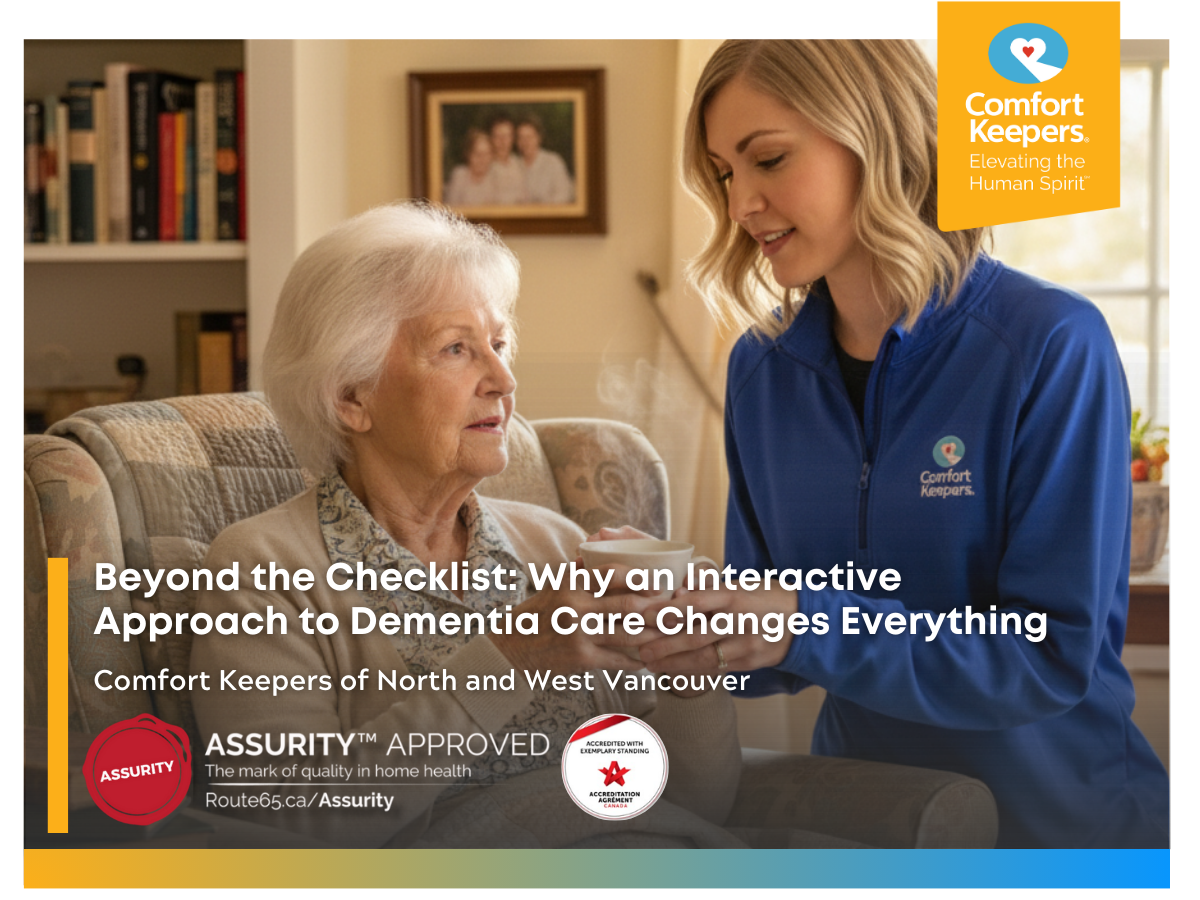
You’ve likely read a dozen articles listing activities for seniors with dementia. You’ve bookmarked ideas for puzzles, music, and memory games. Yet, a nagging feeling remains: is simply keeping a loved one busy the same as helping them live well?
This is the critical question that many families face when evaluating care options. The search for quality dementia care often gets bogged down in checklists of services, but the most significant factor in your loved one’s well-being isn’t the list of things a caregiver does – it’s the philosophy that guides how they do them.
The truth is, not all care models are created equal. While one approach can lead to passivity and withdrawal, another can unlock moments of joy, connection, and purpose. The difference lies in engagement, and the science is clear: meaningful interaction doesn’t just improve mood; it can fundamentally alter the course of cognitive decline. Research shows that frequent social engagement can delay the onset of dementia by an average of five years and is linked to a 38% reduction in dementia risk.
Understanding this distinction is the first step to making a truly confident decision for your family.
The Two Paths of Dementia Care: A Framework for Evaluation
When you look closely, most dementia care falls into one of two distinct models. Recognizing them is key to choosing a path that promotes dignity and quality of life.
The Passive Model: Activity-Based Care
This is the traditional, task-oriented approach. It’s driven by a schedule and focuses on completing a list of duties: mealtime, bath time, and activity time. The caregiver “does for” the client, often with the best intentions of efficiency and safety.
- Focus: Task completion and supervision.
- Dynamic: The senior is a passive recipient of care.
- Typical Scene: A caregiver prepares lunch and serves it while the senior watches television. The task is done, but an opportunity for connection is lost.
- Outcome: While physical needs are met, this model can inadvertently lead to feelings of loneliness, helplessness, and a faster decline in cognitive and physical abilities.
The Engaged Model: Person-Centered Care
This modern approach puts the individual first. It’s built on understanding the person’s history, preferences, and remaining abilities. The goal isn’t just to complete tasks, but to use them as opportunities for collaboration and connection. The caregiver “does with” the client.
- Focus: Emotional well-being and relationship building.
- Dynamic: The senior is an active participant in their own life.
- Typical Scene: The caregiver and senior prepare lunch together, perhaps washing vegetables or setting the table, sharing stories along the way.
- Outcome: This model is proven to reduce agitation and depression while improving overall quality of life. It fosters a sense of purpose and preserves independence for as long as possible.
The Gold Standard: Introducing Interactive Caregiving™
At Comfort Keepers North & West Vancouver, we’ve built our entire dementia care program on the engaged model, refining it into a proprietary philosophy we call Interactive Caregiving™. It’s a holistic approach that transforms everyday routines into opportunities to stimulate the mind, body, and spirit.
The core principle is simple but powerful: shared activity is a tool for connection. Whether it’s preparing a meal, folding laundry, or looking through a photo album, our caregivers are trained to turn these moments into meaningful interactions that enrich our clients’ lives. We focus on what they can do, not what they can no longer do.
The Four Pillars of Interactive Caregiving™ in Action
Our philosophy is grounded in four pillars that work together to support a person’s whole health.
1. Mental Stimulation and Cognitive Engagement
An active mind maintains sharper cognitive function. High engagement in cognitive activities is shown to have a strong protective effect, reducing dementia risk with a hazard ratio of 0.58. We go beyond generic puzzles and integrate mental stimulation directly into daily life.
- Instead of just listening to music: We encourage clients to share memories associated with favorite songs or sing along, sparking emotional and cognitive recall.
- Instead of just looking at photos: We use them as conversation starters to discuss family history, past careers, and cherished life events, reinforcing their sense of identity.
- Instead of just reading a book: We might read aloud together from a newspaper and discuss current events or stories, promoting engagement with the world.
2. Physical Activity and Mobility
Physical activity helps maintain strength, balance, and mood. Our approach integrates movement safely and naturally throughout the day.
- Doing with: We invite clients to join in light housekeeping tasks like folding towels or sweeping, which provides a sense of contribution and gentle exercise.
- Getting outdoors: A short walk in the garden or to the mailbox isn’t just exercise; it’s a chance to discuss the changing seasons, see neighbours, and enjoy fresh air.
- Following their lead: If a client enjoys gardening, we’ll help them tend to indoor plants. If they loved to dance, we’ll put on their favourite music.
3. Emotional Support and Dignity
Dementia can be a confusing and frustrating experience. Our caregivers are trained to provide consistent emotional support, build trust, and preserve our clients’ dignity at every turn.
- Effective Communication: We use proven techniques for someone living with dementia, such as maintaining eye contact, speaking clearly, and using non-verbal cues to offer reassurance.
- Validating Feelings: We acknowledge and validate emotions, rather than dismissing or correcting them, which helps reduce anxiety and agitation.
- Promoting Independence: We empower clients by offering choices whenever possible, from what to wear to what to eat, reinforcing their sense of control.
4. Shared Routines and Home Safety
Consistent routines create a predictable and secure environment, which is especially comforting for someone with dementia. We make clients active partners in these daily rhythms.
- Meal Preparation: Helping to plan a menu or wash vegetables provides purpose and stimulates the senses.
- Home Safety: We collaborate on tasks like tidying up pathways, turning it into a shared goal rather than a caregiver’s chore. This fosters a sense of ownership over their environment.
Your Evaluation Checklist: 7 Questions to Ask Any Care Provider
Choosing a care partner is a major decision. Use these questions to look beyond the sales pitch and understand the core philosophy of any provider you consider.
- Can you describe your specific care philosophy for clients with dementia? Is it documented?
- How do you train your caregivers to engage with clients, not just supervise them?
- How do you learn about my loved one’s personal history, hobbies, and preferences to build a care plan?
- Can you provide examples of how you turn daily tasks into interactive moments?
- How do you measure success and quality of life for your clients?
- How do you support a client’s emotional well-being and help manage challenging behaviors like agitation or confusion?
- Is the goal of your care to “do for” my loved one or “do with” them?
Frequently Asked Questions
My loved one is in the later stages of dementia. Can they still benefit from Interactive Caregiving™?
Absolutely. While the activities may be adapted, the philosophy remains the same. Engagement in later stages might focus more on sensory stimulation – the feel of a soft blanket, the sound of a familiar song, the scent of a favorite food, or the comfort of a hand to hold. The goal is always to connect and provide comfort and dignity, regardless of cognitive ability.
How are Comfort Keepers caregivers trained in this specific philosophy?
Every caregiver completes extensive training in our Interactive Caregiving™ methodology, which includes specialized modules on Alzheimer’s and dementia care. This training is ongoing and covers communication techniques, activity planning, and strategies for managing dementia-related behaviors with empathy and respect. It’s a core competency, not an add-on.
What does Interactive Caregiving™ look like on a typical day?
It looks like life, just with gentle support. It might start with the caregiver and client choosing an outfit for the day together. They might then collaborate on preparing breakfast, chatting while they work. Later, they could spend time looking through a photo album, going for a short walk, or listening to classic radio shows. The day is a fluid blend of meeting essential needs – like personal care and nutrition – and creating moments of connection and joy.
Choosing the right care is about finding a partner who sees the person, not just the diagnosis. It’s about ensuring your loved one feels safe, respected, and connected to the life they’ve lived. The philosophy of care is the foundation for everything else.
To learn more about how our accredited, award-winning approach can make a difference for your family, explore our website and see how we bring Interactive Caregiving™ to life for seniors in North & West Vancouver.
The Best Senior Home Care in North and West Vancouver is Comfort Keepers®
Our senior home care agency offers in-home care focusing on aging in place. Our services include dementia care, end-of-life care, post-surgery care, and palliative care. Comfort Keepers can assist seniors with living transition services, personal care, companionship care, and more!
Quality and Accredited Elderly Care: Happier, Healthier, and at Home with 24/7 Senior Care Opportunities!
Do you need a home care solution for yourself or a loved one? Have you been thinking about retirement homes and their alternatives as a solution? Comfort Keepers® enables seniors to maintain happy, healthy lives in the comfort of their own homes. In-home care services are available in North Vancouver, West Vancouver, and the surrounding areas.
Comfort Keepers® is a Senior Care Agency That Can Make a Difference with Interactive Caregiving™
Our in-home caregivers ensure our senior clients have the best quality of life. The Interactive Caregiving™ program ensures that a senior’s safety, nutrition, mental well-being, and everyday needs are met. This program brings joy and good health to each client’s home.
Comfort Keepers® North Vancouver and West Vancouver Can Help with In-Home Elderly Care Services!
If you are concerned about the health and well-being of a loved one we can help! Comfort Keepers offers 24-hour care and delivers top-quality and compassionate care for seniors. We are dedicated to safety technology solutions that foster independence and enhance well-being.
Locally Owned and Operated Home Health Care Agency
Our care centers around companionship for seniors. Empathetic care originates from the soul and allows us to meet our client’s requirements. The seasoned in-home caregivers employed by Comfort Keepers are carefully chosen based on their empathetic qualities.
Contact the Comfort Keepers® North Vancouver and West Vancouver office at (604) 998-8806 to learn more about our unique in-home care solutions for seniors.