



Caregiver Burnout Symptoms: Signs and Support in Mississauga
Caregiver burnout is the deep physical and emotional exhaustion that can build up when you look after someone you love for a long time and the demands start to outweigh your rest and support. Common signs, like constant tiredness, a shorter temper, or pulling away from people, can be a signal that you need more help. They are not a personal failing. This page is general information to help you notice those signs and know what to do next in Mississauga. It is not a medical diagnosis.
Key Takeaways
- Caregiver burnout is prolonged exhaustion from the demands of caregiving. Its signs are a signal to get more support.
- Ontario has about 4.2 million caregivers, and 69% told the Ontario Caregiver Organization in 2025 they feel too burnt out to be sure they can keep going.
- Caregiver burnout is not a formal medical diagnosis, so treat this page as general information; if signs persist, a doctor can check whether something else is contributing.
- Signs tend to show up in three areas: physical, emotional, and behavioural. When they persist or get worse, it is worth talking with your doctor.
- Practical support is available, including respite care that gives you a break. Talk with a health professional or our Mississauga team about a plan that fits.
What Is Caregiver Burnout?
Caregiver burnout is a state of physical and mental exhaustion that builds when caring for someone leaves too little time to rest and recover. It usually builds slowly. Sleep gets shorter, your own needs slide down the list, and fatigue starts to feel normal. Many families we meet in Mississauga have been managing this way for a long time before they name it.
It helps to be clear about one thing early. Caregiver burnout is a commonly used term for this kind of prolonged exhaustion, and it is a real and common experience, but it is not a formal medical diagnosis in itself. This page is here to help you recognize it and act on it. It cannot diagnose you, and if exhaustion, low mood, anxiety, or other symptoms persist, a health professional can help assess whether another condition may also be contributing.
How Common Is Caregiver Burnout in Ontario?
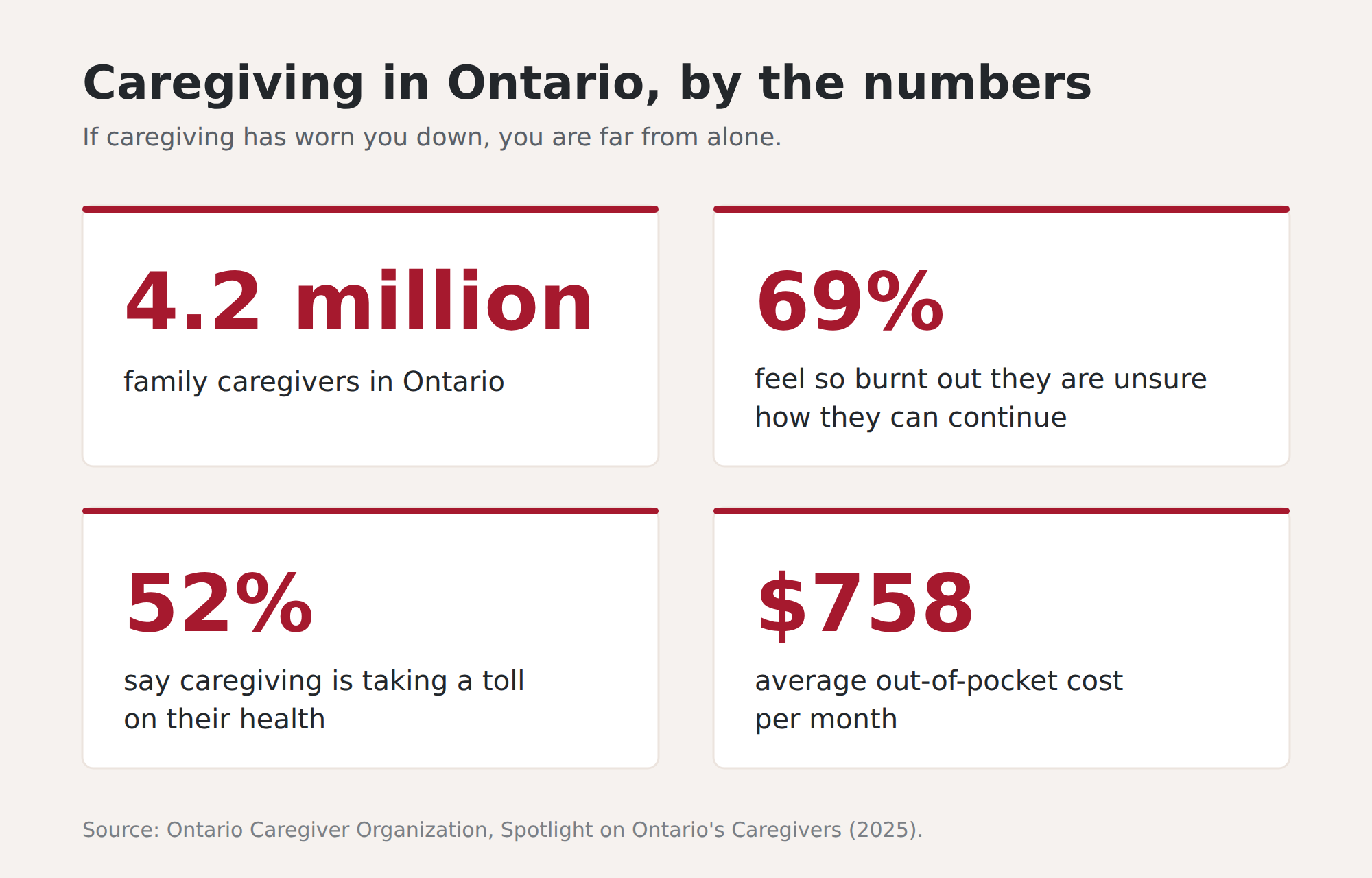
If caregiving has left you exhausted, you are far from alone, and the numbers show it. In its 2025 report, the Ontario Caregiver Organization estimated there are about 4.2 million caregivers in Ontario, with 69% saying they feel so burnt out they are not sure how they can continue, even though they know they will. The same 2025 report found that 38% now provide more than 10 hours of care a week, that 52% say caregiving is taking a toll on their health, and that caregivers spend an average of $758 a month out of their own pockets.
The pattern holds across the country. Statistics Canada reported that 13.4 million Canadians aged 15 and older, about 42%, provided unpaid care to children or care-dependent adults in the previous 12 months, and roughly three in four of those caring for an adult reported at least one negative effect on their physical health and well-being. An earlier release found that 56% of caregivers felt tired, 44% felt worried or anxious, and 37% felt overwhelmed. Among people caring for a family member or friend receiving long-stay home care, the Canadian Institute for Health Information reports that more than two in five experience distress. These numbers are not here to alarm you. They show how common this strain is, and that reaching for support is an ordinary, sensible step.
Common Physical, Emotional and Behavioural Signs
Burnout rarely announces itself. It shows up in small changes across your body, your mood, and your habits, and it is easy to explain each one away on its own. Seeing them together is what makes them useful. The signs below draw on recognized caregiver-stress guidance, including the Alzheimer Society of Canada, which advises talking to your doctor if they appear. Use the table to check in with yourself. It is not a test to pass or fail.

| Physical signs | Emotional signs | Behavioural signs |
| Feeling tired or worn out most of the time | Feeling overwhelmed, worried, or anxious | Pulling back from friends, family, and activities you used to enjoy |
| Sleeping too much or too little, or broken sleep | Becoming easily irritated, impatient, or angry | Letting your own appointments or personal care slide |
| Changes in appetite or weight | Feeling sad, low, or hopeless | Having no time to exercise or eat well |
| Frequent headaches, body aches, or getting sick more often | Losing interest in things that once mattered to you | Leaning more on alcohol or other substances to cope |
Caregiver burnout usually reflects sustained strain rather than one particularly difficult week. What matters is the overall pattern: several signs appearing together, persisting, or becoming harder to manage. If several sound familiar, it is worth taking seriously.
Burnout vs Ordinary Caregiver Stress
Every caregiver feels stress. A stretch of poor sleep before an appointment, a frustrating call with a pharmacy, a hard afternoon. Ordinary stress like this rises and falls, and it usually eases once the pressure passes or you get a proper rest. Burnout is what can develop when that stress stays high for a long time without enough relief. A useful way to tell the two apart is to ask whether the exhaustion lifts or keeps building. One bad day is normal. A pattern of exhaustion that keeps building, and that rest does not seem to ease, is the one to watch.
| What to notice | Ordinary caregiver stress | Signs of burnout |
| How long it lasts | Comes and goes with the situation | Persists rather than resolving as the immediate pressure eases |
| Effect of a break | A rest or a good night’s sleep helps you bounce back | Rest may provide less relief than it normally would |
| Energy | Dips, then recovers | Persistently low, hard to get going |
| Mood | Frustrated in the moment, then settles | Ongoing low mood, irritability, or feeling numb |
| Outlook | Still able to see the rewarding parts | Hopeless or detached about caregiving |
This comparison is a general guide to help you reflect, not a diagnostic tool. If you find yourself sitting in the right-hand column more often than not, that is a signal to bring in more support and to speak with a health professional.
What to Do When Caregiving Is Becoming Unsustainable

Noticing the signs is the hard part. What comes next can be practical and manageable, and you do not have to do all of it at once. A few steps tend to help most.
Start by saying it out loud to someone you trust. Naming the strain takes some of its power away and makes the next steps easier. Then look at where the load can be shared. A sibling could take on appointments, a neighbour could help with errands, or a service could cover a few regular hours each week. Protect your own basics too: keep your own medical check-ups, and try to guard a little time for sleep, movement, and the people you like being around.
It also helps to know the supports built for caregivers in Ontario. The Ontario Caregiver Organization offers a helpline, peer support, and free education. Ontario Health atHome, the province’s publicly funded access point for home and community care, can arrange an assessment and help coordinate services. Financial supports may also be available, depending on your circumstances. Eligible caregivers may qualify for the federal Canada Caregiver Credit, while eligible Ontario seniors may be able to claim the Ontario Seniors Care at Home Tax Credit for certain medical expenses. Ontario also provides job-protected caregiver leaves for eligible workers, set out in its guide to programs and services for families and caregivers. And if the signs are not lifting, make an appointment to talk with your own doctor.
H2: How Respite Care Can Fit Into a Support Plan
Respite care is one of the most direct ways to build a real break into your week, and it is worth knowing how it works. Respite care gives you, the family caregiver, time away while a trained caregiver looks after your loved one, usually right at home. The Government of Ontario describes respite as relief that lets a caregiver take a break, whether that is a few hours, a regular weekly visit, or cover while you are away. It supports you. It is not a treatment for burnout or any medical or mental-health condition, and it works best as one part of a wider plan alongside the steps above.
Here in Mississauga, our team arranges respite around each family. We take time to learn how the day usually flows, from meals and rest to the walk or the show your family member looks forward to, and we keep to it. This is part of what we call Interactive Caregiving, where our caregivers do things with your loved one rather than only for them, so the day still feels like theirs while you get genuine time off. You can read more on our respite care in Mississauga page.
When to Speak With a Health Professional
This page is educational, and there are moments when the right step is to talk with a professional rather than read another article. Reach out to your doctor if the signs above persist or get worse, if they are disrupting your sleep or daily life, or if you are feeling hopeless. You do not need to wait until things reach a breaking point to ask for help. If you are ever worried about your own safety or someone else’s, the resources below are there for you at any hour.
| Where to turn | When to use it | How to reach it |
| 9-1-1 | A life-threatening emergency or immediate danger | Call 9-1-1 |
| 9-8-8 Suicide Crisis Helpline | Thoughts of suicide or a mental-health crisis | Call or text 9-8-8 |
| Health811 | Non-urgent health advice from a registered nurse, any time | Call 811 |
| ConnexOntario | Mental health, addiction, or gambling support and referrals | Call 1-866-531-2600 |
| Ontario Caregiver Helpline | Caregiver support and help finding services (not a crisis line) | Call 1-833-416-2273 |
The Government of Canada’s mental health “get help” page confirms the first two: call 9-1-1 if you are in immediate danger or need urgent medical support, and call or text 9-8-8 for a suicide or mental-health crisis. For non-urgent questions, a registered nurse is available through Health811, and ConnexOntario connects people to mental health and addiction services around the clock. The Ontario Caregiver Helpline is there for caregiver questions and help finding services, though it is not a crisis line.
Next Steps for Mississauga Families
If you have read this far, you are already doing something right by looking for support. The best next step is a simple conversation. Tell us what is happening at home, and we will help you understand your options and put together a plan that works for your loved one and for you. There is no cost to talk and no obligation to go further.
Call our Mississauga office at (905) 671-4004, or reach us through our contact page, and a local team member will get back to you. You will find us at 57 Village Centre Place, Unit 201, Mississauga.
Local Review by Brenda Rosati
This page was written by the Comfort Keepers Canada Editorial Team and reviewed by Brenda Rosati, Director of Operations and Owner of Comfort Keepers Mississauga. Brenda leads our local team and has spent years helping Mississauga families arrange respite and other care at home. She reviews our care information so it reflects how we actually work here and what local families need to know. Brenda does not give medical advice, and this page is general information rather than a diagnosis or a care recommendation.
Written by the Comfort Keepers Canada Editorial Team. Reviewed by Brenda Rosati, Director of Operations and Owner, Comfort Keepers Mississauga.
Sources
The general guidance on this page draws on the official sources below. Details about our own service reflect how our local Mississauga office works. Statistics are rechecked when this page is reviewed.
- The Ontario Caregiver Organization. Spotlight on Ontario’s Caregivers 2025. Published December 2025.
Caregiver Burnout FAQs
A few questions come up often when families first look into caregiver burnout. Here are straight answers.
Is caregiver burnout a medical diagnosis?
No, and that matters in a practical way. There is no single test for caregiver burnout, so the signs and your own sense of how you are coping are what to go by. It also means that if the signs are persistent, it is worth seeing your doctor, who can look at the whole picture and check for other causes of exhaustion that an article never could.
Is it selfish to take a break from caregiving?
Not at all. Rest is what lets you keep caring well over months and years. A caregiver who is rested tends to have more patience and more energy, and planning a break before you are running on empty is one of the kinder things you can do for both of you. Taking time for yourself is part of good caregiving, not a step away from it.
How is respite care different from other home care?
Most home care is planned around the person receiving it. Respite care is planned with the family caregiver in mind as well, so that you get time to step back while your loved one is looked after at home. The hands-on support can look similar, with help around personal care, meals, and company, and the purpose is to give you a real break. Many families use respite alongside other care.
What if the person I care for does not want outside help?
This is one of the most common worries we hear, and it often comes from a wish to stay independent rather than any problem with the help itself. It often works to start small, with a short, regular visit introduced as company or a hand with one task rather than as care, and to let your family member meet the caregiver first. When the same familiar person keeps turning up and the day still feels like theirs, hesitation tends to ease. We are glad to talk through how to introduce support gently.