



Can Someone Living With Dementia Continue Living at Home? A Guide for Oakville Families
Yes, many people living with dementia continue living at home, especially in the earlier stages and when there is steady support around them. It is not the right answer for everyone, and it does not stay settled forever. Whether home works depends on the stage of the condition, how safe the home is, and how much help is in place. All of those things can change over time. This page walks through the factors we help Oakville families weigh, so the decision is a clear one instead of a worried guess.
Key Takeaways
- About 61% of seniors with dementia in Canada live at home with support (Canadian Institute for Health Information, “Dementia in home and community care,” 2015–2016 data). Home is common, though not right for everyone.
- Whether home keeps working depends on stage, home safety, and support, and dementia “gets more severe over time” (Public Health Agency of Canada, “Dementia: Overview”), so needs change.
- Non-medical caregivers can support routine, supervision and personal care, and may assist with medications when trained and directed; clinical tasks follow the care plan (College of Nurses of Ontario, “Working With Unregulated Care Providers”).
- Caring for a person with dementia is demanding: 45% of their unpaid caregivers report distress, versus 26% for other seniors (CIHI, “Unpaid caregiver challenges and supports”).
- Nights are often hardest; “confusion between night and day” is recognized (PHAC, “Dementia: Symptoms and treatment”), which is where overnight support tends to help most.
- Next step: talk with the care team, and if it helps, request an Ontario Health atHome assessment at 1-833-515-1234 or ask us about dementia care at home.
The Short Answer, and What It Depends On

Many people with dementia can and do live at home, and a diagnosis is not an instant loss of independence. As the Public Health Agency of Canada puts it, “each person experiences dementia and its impacts on daily life differently,” and a person “may still be able to remain active and engaged in [their] work, home life and other responsibilities after getting a diagnosis” (Public Health Agency of Canada, “Dementia: Overview”). The numbers reflect that. About 61% of seniors with dementia in Canada live at home rather than in long-term care, and they need support to do it (Canadian Institute for Health Information, “Dementia in home and community care,” 2015–2016 data).
The honest other half of the answer is that home is not automatically the right place for everyone, and what works today may need to change. Dementia is “a chronic condition that gets more severe over time” (PHAC, “Dementia: Overview”), so the support that keeps someone safe and comfortable has to keep pace. It also helps to hold onto this: dementia, while more common after 65, “is not an inevitable part of ageing” (World Health Organization, “Dementia”). In the Oakville homes we support, home usually works because of a few things together: the right routine, a home set up for safety, help with the tasks that have gotten hard, and enough hands that no one person is stretched past their limit. The rest of this page looks at each of those in turn.
Factors That Affect Safety and Support
No single factor decides whether home can work. Families are weighing several at once, and the same diagnosis looks different from one household to the next depending on the person, the home, and the support around them. Here are the ones we watch most closely. Think of each as something to notice and plan around, not a verdict.

Stage and progression. Because dementia grows more severe over time (PHAC, “Dementia: Overview”), the honest answer to “can home work?” is “it can, and it may need to change.” Early on, help might be light, such as reminders, companionship and a hand with complex tasks. Later, supervision and personal care usually matter more.
Searching, wandering and getting lost. PHAC notes that people with more advanced symptoms “may feel confused about where they are as the condition progresses,” which “often leads to searching (sometimes called wandering) or getting lost, even in familiar places” (PHAC, “Dementia: Symptoms and treatment”). Whether this is manageable at home depends a lot on supervision and how the home and doors are set up.
Home, kitchen and fire safety. Everyday hazards carry more weight when memory and judgment change. Government home-safety guidance for seniors is a good baseline: never cook in loose-fitting clothing, keep a fire extinguisher mounted in the kitchen away from the stove, use appliances with an automatic shut-off, secure throw rugs so they cannot slip, and set hot water to 49°C (120°F). The bathroom and stairs are “particularly hazardous” (PHAC, “The Safe Living Guide: A Guide to Home Safety for Seniors”).
Falls and mobility. Dementia itself can bring “loss of coordination,” “weak and stiff muscles” and “trouble standing, sitting or walking” (PHAC, “Dementia: Overview”), and falls are already the leading cause of injury among older Canadians, with 20 to 30% of seniors falling each year (PHAC, “You CAN Prevent Falls!”). A home that was fine a year ago can become a fall risk as mobility changes.
Medication safety. Managing medicines gets harder as memory changes, and seniors often carry a long list of prescriptions to keep straight. Getting the daily routine right, and knowing which parts of it need a nurse, is where small mistakes carry the most weight. More on where the clinical line sits below.
Driving. Driving is a safety factor with a legal side in Ontario. Under section 203 of the Highway Traffic Act, physicians and nurse practitioners must report drivers with functional impairments, including conditions that affect “impaired judgment, problem-solving, planning and sequencing,” and the Ministry can suspend or restrict the licence, with a right of appeal (Government of Ontario, “Reporting a driver for medical review”). It is a hard conversation, and it is often one of the first safety questions a family faces.
Behaviour and mood changes. PHAC describes “responsive behaviours” such as “agitation, irritability, hallucinations, sleep disruptions” and searching, along with mood changes like “anxiety, depression, loss of interest in activities they used to enjoy,” often triggered by feeling “afraid or unsafe” or “overwhelmed or rushed” (PHAC, “Dementia: Symptoms and treatment”). How settled or distressed a person tends to feel at home is part of the picture too.
Is it safe for someone with dementia to live alone?
Some people in the earlier stages live alone safely with light support, such as check-ins, meal help and reminders. As dementia advances, the need for supervision grows, because confusion and getting lost tend to appear “as the condition progresses” (PHAC, “Dementia: Symptoms and treatment”). So living alone safely depends heavily on how much support is in place and how quickly it can scale up. Rather than a fixed rule, this is the kind of question a professional assessment answers well, by looking at the specific person and home.
Daily Routines and Personal Care
A steady, familiar routine and the right hands-on help with everyday tasks are often what make home workable day to day. PHAC lists “being in familiar settings (avoid changing the location of objects or furniture in the home),” “keeping an active social life,” “having a variety of activities to take part in” and “meaningful engagement, such as continuing favourite activities” among the approaches “often used before choosing medication” (PHAC, “Dementia: Symptoms and treatment”). In our experience, keeping the day in a person’s own familiar order helps: waking, meals, a walk, the activities they know. When the shape of the day stays the same, they can see what is coming next, and that is settling.
The tasks that slip usually go in a recognizable order. Complex activities tend to become difficult first: PHAC notes that “familiar tasks such as grocery shopping, cooking, using the television remote, and keeping track of payments may become more challenging.” Basic self-care is affected later, as coordination declines, with “difficulties with activities such as: eating, bathing, dressing, using a phone, pouring a drink, using buttons or zippers,” and the hard part for families to see is that “even if they understand and know what they want to do, they might not be able to do it” (PHAC, “Dementia: Symptoms and treatment”).
| Everyday area | What families may notice | How support at home can help |
| Meals and cooking | Grocery shopping and cooking get harder; eating drops off; weight can slip | Shared, unhurried meals, grocery and meal prep, and gentle reminders to eat and drink |
| Money and appointments | Trouble keeping track of payments, dates and appointments | Help organizing bills and calendars, reminders, and rides to appointments |
| Bathing and dressing | Difficulty with bathing, dressing, buttons and zippers as coordination declines | Respectful, step-by-step personal care that protects dignity |
| Moving around the home | Trouble standing, walking and moving safely | A safer home setup and a steady hand to help prevent falls |
| Staying engaged | Loss of interest in favourite activities | Familiar routines, company, and activities the person still enjoys |
Meals are worth their own mention, because eating often falls off quietly. General guidance for seniors is that “eating with others is great for the company and it can also be good for [your] health,” that changed taste can be met with “different spices and herbs … instead of salt,” and that older adults “still need to drink regularly whether [they] feel thirsty or not” (Health Canada, “Healthy eating for seniors”). Beyond the nutrition it provides, a shared, unhurried meal is one of the steadiest, most reassuring points in a person’s day.
How you communicate matters as much as what you do. PHAC’s guidance is to “always assume that a person living with dementia is aware and listening,” to use short sentences “that make one point each,” to “be patient and give time to respond,” to make eye contact, and to avoid raising your voice, which can cause distress (PHAC, “Dementia: Tips on how you can help”). Our caregivers work this way by habit, and it is often the difference between a task that goes smoothly and one that ends in frustration for everyone. Through all of it, we try to help the person do what they still can for themselves and keep their day their own, instead of quietly taking tasks over. Staying “active and engaged” after a diagnosis is possible (PHAC, “Dementia: Overview”), and protecting that is part of good care.
Medication and Clinical Oversight Boundaries
Non-medical home care can do a great deal to keep someone with dementia safe and settled at home, and part of doing it well is being clear about who does what with medications. It is a common assumption that a non-medical caregiver can only ever give reminders. The real answer is more nuanced, and it depends on the task, the caregiver’s training, the individual care plan, and the provider’s policies. Ontario’s own respite-care guidance lists “assistance with medications” among personal support tasks, alongside oral care, bathing and dressing (Government of Ontario, “Respite care”). The College of Nurses of Ontario is clear that a nurse “can teach a [unregulated care provider] to administer oral medications” when the circumstances are right, meaning the person’s condition is stable and predictable, the caregiver’s competence has been confirmed, and clear policies and support are in place (College of Nurses of Ontario, “Teaching an unregulated care provider”; College of Nurses of Ontario, “Working With Unregulated Care Providers”). Medication administration and other clinical tasks should always follow the individual care plan and the direction of the appropriate regulated health professional.
Getting this right matters more with dementia, because the medication load is already high. With 1 in 4 seniors prescribed 10 or more drug classes in 2021 (CIHI, “Drug use among seniors in Canada”), a missed or doubled dose is a real risk, and PHAC’s advice is to keep one written list every doctor and pharmacist knows about, and to use a single pharmacy so interactions get caught (PHAC, “The Safe Living Guide: Keeping track of your medicine”). Diagnosis and clinical oversight stay with the health-care team; PHAC’s own figures count “only … people who have had a formal diagnosis from a health care provider” (PHAC, “Dementia: Overview”).
| What non-medical caregivers can do | What a regulated health professional directs or does |
| Keep a familiar daily routine, with companionship and supervision | Diagnose dementia and provide clinical oversight |
| Help with bathing, dressing, eating, toileting and grooming | Set, adjust and review the medication plan |
| Give reminders and, when trained and directed, assist with medications | Teach, delegate and supervise medication tasks done by caregivers |
| Prepare meals, and do light housekeeping and laundry | Wound care, injections and other clinical or nursing tasks |
| Provide overnight and 24-hour supervision, and coordinate the plan | Assess and adjust the overall clinical care plan |
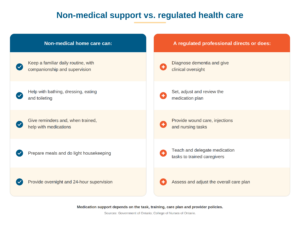
In practice, we set this up carefully with each family. What our caregivers do with medications follows the care plan and their training, and we coordinate closely with the family doctor, the pharmacist and any nurses involved, including our own nursing services where clinical care is needed. The goal is a plan where everyone knows who does what, so nothing falls through a gap.
Family Caregiver Capacity
Whether home works is not just about the person with dementia. It leans just as heavily on the family caregiver, and dementia asks more of caregivers than almost any situation we see. The research bears that out: “more than 4 out of 10 caregivers (45%) of seniors with dementia exhibit symptoms of caregiver distress,” almost twice the 26% seen among caregivers of other seniors, and they provide “an average of 26 hours of care each week,” well above the 17 hours for other caregivers (CIHI, “Unpaid caregiver challenges and supports,” 2015–2016 data). Hours matter: caregivers “providing more than 20 hours of care each week had nearly 3 times higher odds of reporting distress” (CIHI, “Unpaid caregiver challenges and supports”).
Often the person carrying that load is an adult son or daughter. Caring for a parent is the most common caregiving situation in Canada, at 53% of those who care for a care-dependent adult, and caregivers frequently report feeling tired and feeling worried or anxious (Statistics Canada, “The Daily: More than half of women provide care to children and care-dependent adults, 2022”). Here is the point we most want families to hear: a caregiver reaching the edge of what they can manage is a valid reason to add support. Reaching that point is human, and it is often the moment help does the most good. Bringing in help, even a few hours a week, is often exactly what lets someone keep caring for a parent without losing themselves in it. Our respite care exists for that reason, to give the family caregiver a real break while the person they love stays well cared for at home.
Overnight and 24-Hour Support
Nights are often the hardest part of dementia at home, and overnight or around-the-clock support is frequently what lets a family keep someone safe at home rather than move them sooner than they want to. PHAC recognizes the pattern: “confusion between night and day” is one reason a person may search or wander, “sleep disruptions” are a common responsive behaviour, and dementia “can affect the internal clock that keeps us on a regular eating and sleeping schedule” (PHAC, “Dementia: Symptoms and treatment”). When someone is up, disoriented and moving around the house at 3 a.m., a family that has to work the next day cannot safely carry that alone for long.
There is no single official definition of “24-hour home care,” so it helps to think in terms of supervision instead of a fixed package. Support scales from a few hours up to constant presence; Ontario’s own rules recognize a person who needs “constant supervision as a result of a cognitive impairment” (Government of Ontario, “Home and community care”). Our overnight and 24-hour support is built around what actually happens through the night: gentle redirection when someone wakes confused, help to the bathroom to prevent a fall, a calm presence that settles the house, and rest for the family. For many households, covering the nights is what makes the rest of home care sustainable.
When Other Settings May Be Considered
Sometimes the safest and most supportive choice is a move to a setting with more care, and choosing it well can be one of the most protective things a family does. The trigger to reassess is usually safety. Government guidance is direct: “Is the person’s home safe? If not, contact home care for an in-home assessment,” and, when planning ahead, “start to consider modifications to the existing home, assisted living and long-term care facilities,” keeping in mind that “many housing options have waitlists and only some are publicly funded” (Government of Canada, “Care options, choosing the best plan”).
In Ontario, long-term care is for people who “require 24-hour nursing care and personal care” and help with the activities of daily living, and applications are “arranged by Ontario Health atHome organizations,” with a care coordinator assessing needs (Government of Ontario, “Explore your care options”; Government of Ontario, “Apply for long-term care”). The important thing is that the decision is individual and based on need and safety, not a fixed timeline, and that home is often still the answer. As Ontario notes, “you may be able to stay in your own home with supports in your community, such as personal support worker visits” (Government of Ontario, “Apply for long-term care”). We help Oakville families think this through without pressure, and we coordinate the plan whichever way it goes.
When is it no longer safe for someone with dementia to live at home?
No single moment applies to everyone, but a handful of signs appearing together suggest it is time to reassess the setting with the care team. The common ones are repeated wandering or getting lost, especially away from the home; serious home-safety risks that cannot be managed, such as fire or stove hazards; frequent falls or injuries; a need for supervision through the night that no one can safely keep up; and a family caregiver who can no longer provide enough support safely, for any reason. One of these on its own is usually a prompt to add support. Several together, or any one that puts the person at immediate risk, is the point to talk seriously with the care team about whether more help at home or a move to a different setting is the safer choice.
Questions to Ask the Care Team
The fastest way from worry to a clear plan is to ask the right questions and, when it helps, get a professional assessment. Questions worth asking include: What stage are we looking at, and what changes should we expect next? Which tasks need help now, and which are becoming unsafe? What here is non-medical support, and what is a nursing task? What happens overnight? What are the signs it would be time to reassess the setting? And how do we start an assessment?
You should not have to answer all of these alone. You can work through them with the people whose job is to help: a family doctor, a home-care assessor, and our own care team. The table below shows where to turn in Ontario, and the steps after it show how to begin.
| Where | Contact | What it is for |
| Ontario Health atHome | 1-833-515-1234 | A home-care assessment, eligibility and a public care plan; anyone can refer |
| Health811 | 8-1-1 | Free, confidential registered-nurse advice, 24 hours a day |
| Family doctor | Your clinic | Assessing memory concerns, diagnosis and referrals |
| Comfort Keepers Oakville | Contact our team | A free care conversation and a practical, adjustable plan at home |

A conversation with our team is a good first step too. Our care consultation is free and carries no obligation, and it is where we translate what a family has noticed into a practical, adjustable plan, coordinating around any public services already in place. You can ask us about dementia care at home whenever you are ready.
How do I get a dementia home-care assessment in Ontario?
Contact Ontario Health atHome at 1-833-515-1234. You can refer directly yourself, ask a family doctor to refer, or self-refer with consent. A care coordinator then assesses the person’s needs and eligibility and may visit the home to see the situation firsthand (Ontario Health atHome, “Home care”). For free nurse advice while you decide what to do, call Health811 at 8-1-1, any time of day (Government of Ontario, “A guide to programs and services for seniors: Health and well-being”).
Talk to Our Oakville Care Team
Many families make home work with the right support, and when the time comes to reassess, that choice deserves the same respect. Wherever you have landed in that thinking, you do not have to work it out on your own. Our team can talk through what you are seeing, help you weigh the factors on this page, and put a practical plan in place, at home for as long as home is right.
Ask us about dementia care at home, or reach our Oakville team through our contact page. If you would like to talk it over now, we are glad to help.
About This Article
Author: Comfort Keepers Oakville. Reviewed by: Brenda Rosati, Director of Operations and Owner. This article is drawn from official Canadian and Ontario sources and reflects our own experience supporting families in Oakville. It is general information, not medical advice, and it is not a diagnosis. For a diagnosis or clinical guidance, speak with a health-care provider.
About the reviewer
Brenda Rosati is the Director of Operations and Owner of Comfort Keepers Oakville, where she leads the local team that supports seniors and their families across Oakville and reviews the office’s care information for local accuracy. You can learn more about our local leadership on our About Comfort Keepers Oakville page.
Sources
Frequently Asked Questions
Is dementia home care in Ontario publicly funded, or do we pay for it?
Both routes exist. Ontario has publicly funded home care through Ontario Health atHome for people assessed as eligible, covering things like nursing, personal support and homemaking (Government of Ontario, “Home and community care”). It does not always cover everything a family needs, such as ongoing overnight or around-the-clock supervision, so private care is often used to add hours or fill the gaps. We are glad to walk you through what tends to be covered and what is not.
Can we combine publicly funded home care with private support?
Yes, and many families do. Public services from Ontario Health atHome can be the base, with private hours added where they help most, often overnights, weekends or extra days (Ontario Health atHome, “Home care”). When we come into a home that already has public support in place, we build our schedule and care plan around it so the two fit together instead of overlapping.
What if my parent with dementia refuses help?
This is common, and pushing rarely works. We usually start small and familiar, leading with companionship and a steady routine instead of “care,” and letting trust build before adding more. A low-pressure assessment, or a first visit built around something the person enjoys, often opens the door. If you are stuck, talk with our Oakville team and we will help you find a gentle way in.