


Prepare for ‘The Incident’: Why Canadian Families Must Plan for “Failure to Cope” Now
In the Canadian healthcare system, there is a specific, often dreaded term found on hospital charts: “Failure to Cope.“
It is the clinical label for “The Incident” – the fall, the wandering episode, or the sudden medical emergency that renders an aging parent unable to return home safely. For thousands of Canadian families, this moment triggers a crisis. Without a plan, your parent may be designated as an Alternate Level of Care (ALC) patient, stuck in a hospital bed while waiting weeks or months for the first available long-term care bed, often in a facility they never would have chosen.
Preparing for this reality requires moving beyond casual chats and familiar comforts. It demands a strategy based on their best interests, financial reality, and legal foresight.

The “Failure to Cope” Crisis: Why You Cannot Wait
Waiting until a crisis forces your hand is the most dangerous strategy for an aging parent. In Canada, when a senior is admitted to the hospital and deemed unsafe to discharge home, they enter the limbo of Alternate Level of Care (ALC).
- The Hospital Trap: ALC patients occupy approximately 15-25% of acute care beds in many Canadian hospitals. While safe, these environments are designed for acute treatment, not living. Seniors in ALC beds often experience “deconditioning” – a rapid loss of muscle mass and mobility due to prolonged bed rest (Source: Canadian Institute for Health Information).
- Loss of Choice: If your parent cannot return home, the provincial health authority may place them in the first available long-term care bed. This facility could be far from family, lack preferred amenities, or be culturally unfamiliar.
- The Waitlist Reality: Wait times for a preferred long-term care home can range from months to years depending on the province (e.g., 50+ days in Regina, longer in major metros).
Proactive Solution: To avoid the ALC trap, families must assess care needs early. Comfort Keepers Regina can deploy a “safety net” of in-home care that prevents the initial “failure to cope” admission, keeping your parent out of the hospital system entirely.
Recognizing the Signs: Denial, Memory Loss, and “Right to Risk”
Why is My Parent in Denial About Their Memory Loss or Declining Health?
Denial is rarely about stubbornness; it is about fear. For many seniors, acknowledging memory loss or frailty feels like admitting they are no longer a competent adult. This is often a defense mechanism to preserve their dignity and autonomy.
- Fear of “The Home”: Many Canadian seniors equate “getting help” with being “put away” in a nursing home.
- The “frog in boiling water” effect: Decline often happens slowly. A parent living in the situation daily may not notice the gradual accumulation of unwashed laundry, expired food, or unexplained bruises that are obvious to an adult child visiting after a few months.
What Do I Do When My Parents Refuse to Acknowledge They Need Help?
Legally, in Canada, a competent adult has the “Right to Risk” (or “Right to Folly”). They are allowed to make bad decisions, such as refusing care or living in an unsafe home, provided they understand the consequences.
- Actionable Step: Do not argue with their reality. Instead, document specific incidents (e.g., “Mom, the stove was left on yesterday”) and focus on *your* feelings to lower defenses (“I am terrified I will find you hurt”).
- Legal Preparation: Ensure you have a Power of Attorney (POA) for both Personal Care and Property in place *before* capacity is lost. Once a parent can no longer understand the document, it is too late, and you may face a costly guardianship application.

The Financial Reality: Home Care vs. Senior Living in Canada (2025 Data)
Is Home Care Better? Breaking Down the Costs
Many families assume a facility is cheaper than 24/7 home care, but the math depends heavily on the level of care required.
- Home Care Costs: Private in-home care in Canada typically ranges from $35 to $60 per hour.
- *Scenario:* 20 hours of help per week (cleaning, meal prep, medication reminders) costs approx. $3,000 – $4,800/month. This allows the senior to keep their asset (the home) and maintain independence.
- *Commercial Intent:* Comfort Keepers Regina offers flexible care plans that scale. We can start with just a few hours a week to build trust, often delaying the need for full-time facility care by years.
- Senior Living Costs:
- Assisted Living (Private): $3,500 – $6,000+ per month.
- Long-Term Care (Subsidized): Costs are income-based (capped max ~ $2,000-$3,000/month in many provinces), but these are the beds with the longest waitlists.
- Memory Care (Private): Often exceeds $7,000 – $9,000/month due to higher staffing ratios (Source: Affinity Health / Senior Life Source 2025 Data).
Why Are My Parents So Attached to Their Home; They Won’t Consider Moving?
The home represents their history, independence, and identity. Leaving it feels like an erasure of self. However, “aging in place” is only viable if the home is safe.
- The Compromise: Instead of forcing a move, introduce “aging in place” modifications (grab bars, better lighting) and professional caregivers who come *to* the home. This validates their desire to stay while addressing safety concerns.
Communication Strategy: How to Have “The Talk”
When Should I Talk to My Aging Parent(s) About Getting Help?
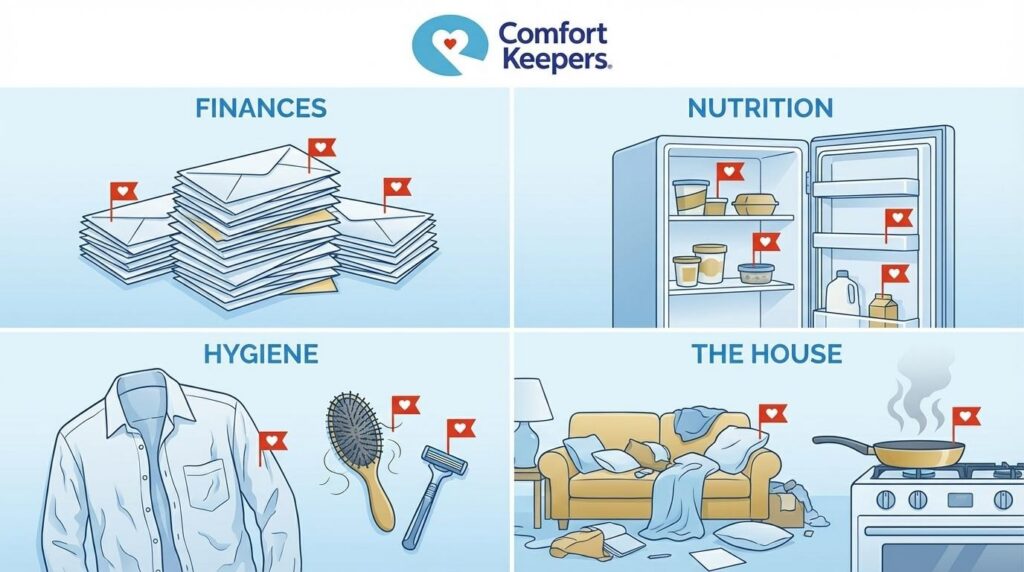
The best time is before a crisis. Look for the “Red Flags”:
- Hygiene: Unkempt appearance or body odor.
- Nutrition: Weight loss or a fridge full of expired food.
- Finances: Unopened mail or unpaid bills.
- The House: Scorch marks on pans or clutter blocking hallways.

How Do I Bring Up Senior Living Without Them Getting Defensive?
Avoid the “intervention” style meeting, which breeds defensiveness.
- Use the “Third Party” Technique: “Mom, I read an article about how falls in the bathroom are the #1 reason seniors end up in the hospital. I don’t want that to happen to you. Can we look at some options just to be safe?”
- Focus on Independence, Not Care: Frame home care as a tool for independence. “A personal assistant could handle the laundry and cleaning so you have more energy to go to the garden/church/bridge club.”
- The Trial Period: Do not ask for a permanent decision. Ask for a trial. “Let’s just try a Comfort Keeper for 3 hours a week to help with groceries. If you hate it after a month, we stop.” Most seniors form a bond with their caregiver and eventually request *more* hours.
Executive Summary
- The “Failure to Cope” Label: Avoid this hospital designation at all costs. It leads to loss of control and forced facility placement.
- Legal Rights: Competent seniors can refuse care (“Right to Risk”). You must secure Power of Attorney early and use persuasion, not force.
- Cost Efficiency: Private home care (approx. $35-$60/hr) is often more cost-effective than private assisted living for low-to-moderate care needs and allows the senior to retain their home asset.
- Start Small: To overcome denial, introduce care as “assistance for independence” (like a housekeeper or driver) rather than “nurse for an invalid.”
Frequently Asked Questions
Q: What is the difference between home care and home health care in Canada?
A: “Home care” typically refers to non-medical support like companionship, meal preparation, housekeeping, and personal care (bathing/dressing). “Home health care” usually involves medical tasks performed by nurses, such as wound care or IV therapy. Comfort Keepers specializes in non-medical home care but often coordinates with medical teams to provide a holistic support system.
Q: Can I force my parent to move into a retirement home if they are unsafe?
A: No, not if they are mentally competent. In Canada, competent adults have the right to make risky decisions about their living arrangements. You can only enforce a move if a medical professional deems them incapable and you hold the appropriate Power of Attorney or guardianship.
Q: How much does 24/7 in-home care cost in Saskatchewan?
A: 24/7 care is a premium service. If using a private agency, costs can range from $15,000 to over $20,000 per month depending on whether it is “live-in” (caregiver sleeps at night) or “awake overnight” (staff is awake 24/7). Many families use a hybrid model – family covers nights, and professional caregivers cover days – to manage costs.
Q: What happens if my parent is hospitalized and cannot return home?
A: If a hospital deems your parent “unsafe for discharge,” they may be designated as an Alternate Level of Care (ALC) patient. A social worker will assess them for long-term care. You will likely be asked to choose a few preferred homes, but if those are full, your parent may be placed in the “first available” bed to free up the hospital capacity.
Q: Does the government pay for home care in Canada?
A: Provincial health plans (like the Saskatchewan Health Authority) cover a limited amount of home care based on a needs assessment. However, this is often capped at a few hours per week for baths or medical tasks. Most families supplement this with private care from agencies like Comfort Keepers Regina to ensure safety and companionship for longer durations.


