



Caregiver Burnout: Early Signs and Practical Next Steps
By the Comfort Keepers Canada Editorial Team. Locally reviewed by Brenda Rosati, Director of Operations and Owner, Comfort Keepers Oakville.
If you are caring for an aging parent or partner in Oakville or Burlington and quietly running low yourself, you are not failing, and you are not alone. Caregiver burnout is a common term for the physical, emotional, and mental exhaustion that can build up after prolonged caregiving stress. Its earlier signs often appear first as caregiver strain, in sleep, mood, health, and everyday routines, and they are easier to recognize than most people expect. Practical support, including respite care, can help well before things reach a crisis. This page walks through the early signs, why families often wait, and the next steps you can take.
A note on scope: this article offers general information to support family caregivers. It does not diagnose burnout or any medical condition. For questions about your own health or a loved one’s, or in an emergency, please speak with a health-care provider, and see the escalation section near the end for who to call.
Key Takeaways
- Caregiver burnout is the physical, emotional, and mental exhaustion that can build from prolonged caregiving stress; recognizing it early and arranging respite care helps before exhaustion takes hold.
- About one in four Canadians is a caregiver, and nearly half of caregivers are caring mainly for an aging parent or parent-in-law (Statistics Canada, “Caregivers in Canada, 2018”).
- The toll is well documented: 56% of unpaid caregivers report feeling tired and 44% feel worried or anxious (Statistics Canada, “More than half of women provide care to children and care-dependent adults in Canada,” The Daily, 2022), and among unpaid caregivers of long-stay home-care clients in CIHI’s data, more than two in five are experiencing distress (Canadian Institute for Health Information, an independent health-data organization, “Caregiver Distress” indicator).
- Respite exists to prevent that: Ontario runs a program built specifically to ease caregiver strain and help families avoid burnout (Ontario Health atHome, “Caregiver Distress Respite Program”).
- Know where to turn: Ontario Health atHome (1-833-515-1234) coordinates publicly funded care, and the Ontario Caregiver Helpline (1-833-416-2273) offers free, 24/7 support for caregivers.
- You do not have to wait for a crisis. Start small, and talk with our Oakville and Burlington team about respite support that fits now.
What Caregiver Strain Can Look Like
Caregiver strain is the physical and emotional wear of caring for someone over time. It tends to show up first in sleep, mood, health, and the small routines of daily life, and noticing it early is the whole point. This is a signal to pay attention to, not a diagnosis to give yourself.
The numbers back up what many caregivers feel. In the most recent national figures, over half of unpaid caregivers (56%) reported feeling tired because of their responsibilities, 44% felt worried or anxious, 37% felt overwhelmed, and about three in ten said their sleep was disturbed (Statistics Canada, “More than half of women provide care to children and care-dependent adults in Canada,” The Daily, 2022). That same survey has a reassuring flip side, though: 30% of caregivers reported no impact on their physical or mental health at all. Among unpaid caregivers of long-stay home-care clients captured in CIHI’s data, more than two in five are experiencing distress (Canadian Institute for Health Information, an independent health-data organization, “Caregiver Distress” indicator). Feeling stretched is common, and lasting harm is not inevitable.
Signs in your body and mood
Ottawa Public Health’s caregiver guide describes signs of caregiver stress that many families will recognize: trouble sleeping or poor sleep, low energy, headaches or stomach upset, trouble concentrating, feeling on edge or unable to relax, existing health problems getting worse, and feeling down (Ottawa Public Health, “Mental Health Caregiver Guide,” 2016). One or two of these on a hard week is normal. Several of them, settling in and staying, is the cue to plan a break and, if they persist, to talk with a health-care provider.
Signs in your day-to-day life
Strain also shows in how life feels. A caregiver handbook from the Regional Geriatric Programs of Ontario lists everyday signals such as no longer having time for yourself, dropping the social contact you used to keep up, arguing more than usual, feeling guilty, worrying you are “not doing a good enough job as a caregiver,” or feeling at the end of your rope. It frames these gently: if one or more sound familiar, “you may be experiencing caregiver stress” (Regional Geriatric Programs of Ontario, “Caregiving Strategies Handbook,” 2019). Read that as an invitation to arrange support.

Why Families Delay Help
Most families do not wait because they are neglectful. They wait because the caregiving role builds up quietly, because reliable information is hard to find, and because a loved one may resist the idea of help. Naming those reasons makes it easier to act sooner.
The information barrier is well documented. A 2025 National Seniors Council review, drawing on earlier caregiver research, reports that half of caregivers find it difficult to locate information and advice about caregiver resources, and that half adjust their daily lives to keep caring, with the impact described as life-altering for about one in ten (National Seniors Council, “Dialogue: Caregivers of older adults,” 2025). On top of that, many people simply do not see themselves as caregivers. In a 2019 survey by the non-profit Ontario Caregiver Organization and The Change Foundation, 35% of caregivers said they had not thought of their role as caregiving at all. The same survey found that among the reasons caregivers do not use respite care, 28% cited the person they care for being unwilling to accept help from others (Ontario Caregiver Organization, “Spotlight on Ontario’s Caregivers,” 2019).
This is where beginning small helps. Early support can start as companionship rather than formal care, so trust has room to build before needs grow.
Practical Support Options
Support ranges from a few hours of help at home to community programs and publicly funded care, and you can combine private and public options. You do not have to carry everything yourself, and you do not have to choose only one path.
Help at home and in the community
Ontario groups in-home help into personal support (bathing, dressing, mobility), homemaking (cleaning, laundry, meals), nursing, and professional therapies, alongside community support services such as adult day programs, friendly visiting, meal services, and transportation (Government of Ontario, “Home and community care”). Our own support in Oakville and Burlington sits on the non-medical side of that list: personal care, companionship, homemaking, and respite for the family. The goal, in the province’s own words, is to help people “live in their homes for as long as possible” (Government of Ontario, “Support services at home and in the community”).
The public pathway: Ontario Health atHome
Publicly funded home and community care in Ontario is coordinated through Ontario Health atHome, formed on June 28, 2024 when the province’s local home-care organizations were brought together into a single service (Government of Ontario, “Connected care update: June 21, 2024”). Families can call 1-833-515-1234, seven days a week, and a care coordinator helps arrange nursing, personal support, and respite (Ontario Health atHome, “Contact”). Many families use the public system and a private provider like us together.
| Option | What it offers | How to reach it |
| Comfort Keepers Oakville | Private, non-medical support you arrange directly: personal care, companionship, homemaking, and respite | Speak with our care team |
| Ontario Health atHome | The provincial access point for publicly funded home and community care, including personal support and respite | Call 1-833-515-1234 |
| Community support services | Adult day programs, friendly visiting, meal services, and transportation | Through Ontario Health atHome or your local agencies |
How Respite Care Can Help

Respite care is planned support that steps in so you can rest, work, or handle the rest of your life while your loved one is well cared for. Ontario puts it simply: “you can take a break, with our help” (Government of Ontario, “Respite care”).
Respite is worth arranging early. The province runs a Caregiver Distress Respite Program whose stated purpose is “to reduce caregiver burden and/or avoid burnout,” providing personal support worker help with personal care, light housekeeping, activities, and meal preparation (Ontario Health atHome, “Caregiver Distress Respite Program”). In other words, taking a break is a recognized, practical way to keep caring well over the long run.
The three forms of respite
In Ontario, respite can be arranged at home through a caregiver visit, at an adult day program with supervised group activities, or as a short stay in a long-term care home for up to 60 days at a time and no more than 90 days in a calendar year (Government of Ontario, “Respite care”). Each suits a different need, from a single afternoon to a longer break.
Respite you can arrange directly
Our respite in Oakville and Burlington is a private option you can arrange directly, on your own timing. It might be a few hours a week, an evening, an overnight, or a regular schedule, and it works alongside any publicly funded care already in place. Because of the way we approach care, which we call Interactive Caregiving, a break for you does not mean your loved one is simply supervised. They stay engaged and in conversation, kept in the familiar routines of their own day. You can learn more on our respite care page.
| Form of respite | What it looks like | Often a good fit when |
| Respite at home | A caregiver comes to the home to provide personal support and homemaking | You want your loved one to stay in familiar surroundings |
| Adult day program | Supervised group activities in a community setting | You need a day or a few regular days each week |
| Short stay in a long-term care home | A stay of up to 60 days, and no more than 90 days in a calendar year | You need a longer break, such as travel or your own recovery |
| Private respite with Comfort Keepers | Flexible hours at home, from occasional to overnight, arranged directly | You want to start small and adjust as needs change |
Planning Before a Crisis
The most practical thing a family can do is arrange a little support before exhaustion forces the decision. A simple plan made early is far easier than scrambling when everyone is already worn down.
A plan does not need to be elaborate. It helps to name who in the family can genuinely share the load, decide what a regular break would look like for you, and keep the key phone numbers somewhere handy before you need them. Federal guidance for caregivers puts it plainly: learn the signs of caregiver stress, and “reach out to friends, family and support services when you need them” (Government of Canada, “Care options”).
When to Seek Professional or Emergency Help
If caregiving is starting to affect your own health or mood, talk with a health-care provider. Our support helps with the day to day, and the contacts below cover the situations that call for professional or urgent help, from a health question to an emergency.
For your own health and mood
When the signs above settle in and stay, it is worth speaking with your family doctor or another health-care provider about how you are doing (Public Health Agency of Canada, “Mental health support: get help”). For free, confidential health advice any time of day, Ontarians can call 811 to reach a registered nurse through Health811 (Government of Ontario, “Find mental health and addiction services”). For support built specifically around the caregiving role, the Ontario Caregiver Helpline offers free information, resource navigation, and caregiver support 24 hours a day by phone at 1-833-416-2273, run by the non-profit Ontario Caregiver Organization (Ontario Caregiver Organization, “Ontario Caregiver Helpline”).
In an emergency or crisis
For a medical or life-threatening emergency, or if someone is in immediate danger, call 911. If you or someone you care for is thinking about suicide or in a mental-health crisis, you can call or text 988, the Suicide Crisis Helpline, which is available 24 hours a day in English and French (Government of Canada, “988: Suicide Crisis Helpline,” 2023). Reaching out is a sign of strength, not a failure.
| If | Contact | What it is |
| Your own health or mood is suffering | Your family doctor, or 811 (Health811) | Medical advice, including a registered nurse any time of day |
| You need caregiver information or support | Ontario Caregiver Helpline, 1-833-416-2273 | Free, 24/7 support for caregivers (non-profit) |
| There is a mental-health crisis or thoughts of suicide | 988, call or text | The Suicide Crisis Helpline, 24/7, English and French |
| There is a medical or life-threatening emergency | 911 | Emergency services and urgent medical help |
This section offers general information and is not medical advice. If things feel overwhelming, please reach out to a health-care provider or one of the lines above.
How Comfort Keepers Oakville Can Help
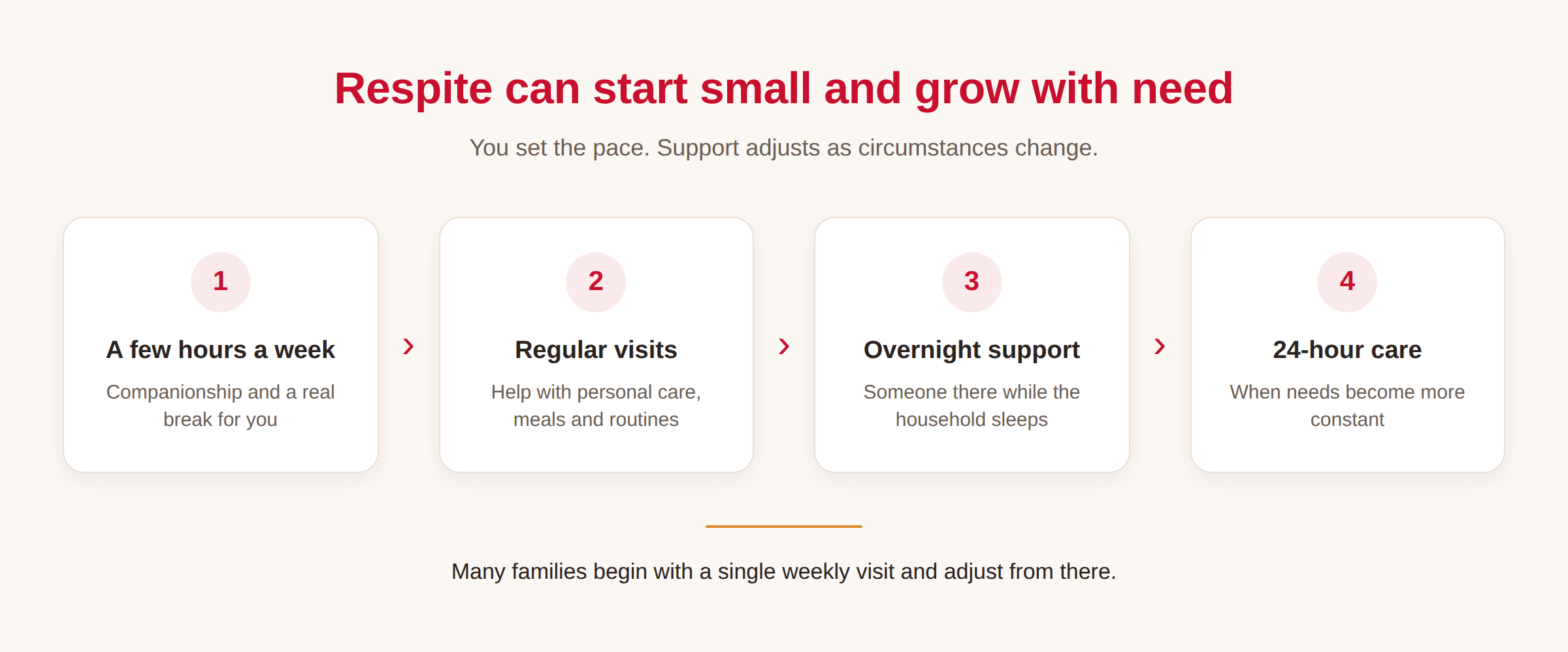
We provide non-medical home care across Oakville and Burlington that gives family caregivers a dependable break while your loved one stays in attentive, familiar company. Support can be as light as a few hours of companionship, or grow into overnight and 24-hour care as needs change.
Day to day, our caregivers help with respite, companionship, personal care such as bathing and dressing, meal preparation, light housekeeping, and specialized dementia care. Because of the way we work, which we call Interactive Caregiving, we do the activities of daily life with your loved one rather than simply for them, so a break for you still means conversation, routine, and connection for them. We match caregivers by skill, personality, and daily routine, and we keep the same familiar faces returning as circumstances change. Our support works alongside whatever medical or publicly funded care is already in place.
Starting Care in Oakville and Burlington
Getting started is a low-pressure conversation, not a big commitment. Care can begin with a few hours a week and grow only as needs change, so nothing has to be decided all at once.
When a family in Oakville or Burlington first reaches out, we start by understanding what is happening at home and what would make the biggest difference right now. Beginning small is completely normal. It lets trust build for your loved one, and it gives you a steady break you can count on. If memory changes are part of the picture, we also provide specialized dementia care.
If you are feeling stretched and are not sure what would help, we are glad to talk it through, privately and with no pressure. Plan Respite Support with our Oakville and Burlington team, and we will help you understand what a break could look like for your family.
About the Reviewer
Brenda Rosati is the Director of Operations and Owner of Comfort Keepers Oakville, where she leads the local team that supports seniors and their families across Oakville and Burlington and reviewed this article for local service accuracy. You can learn more about our local leadership on our About Comfort Keepers Oakville page.
Last reviewed: September 2026
This article provides general information about caregiver support and respite care and is not medical advice. For questions about your own health or a loved one’s, changes in health, or an emergency, contact a health-care provider, Health811 at 811, the Suicide Crisis Helpline at 988, or 911.
References
- Statistics Canada. Caregivers in Canada, 2018. The Daily, 2020.
- Statistics Canada. More than half of women provide care to children and care-dependent adults in Canada. The Daily, November 8, 2022.
- Canadian Institute for Health Information. Caregiver Distress indicator. (An independent, arms-length health-data organization.)
- National Seniors Council. Dialogue: Caregivers of older adults. Government of Canada, 2025.
- Ontario Caregiver Organization. Spotlight on Ontario’s Caregivers, 2019. (A non-profit organization; survey conducted with The Change Foundation.)
- Government of Canada. Care options: choosing the best plan for you and the person you care for. 2024.
- Government of Ontario. Respite care.
- Government of Ontario. Home and community care.
- Government of Ontario. A guide to programs and services for seniors: Support services at home and in the community.
- Government of Ontario. Connected care update: June 21, 2024.
- Ontario Health atHome. Contact.
- Ontario Health atHome. Caregiver Distress Respite Program: Information for patients and families. 2024.
- Ontario Health atHome. Short-Stay.
- Public Health Agency of Canada. Mental health support: get help. 2026.
- Government of Canada. Government of Canada launches three-digit suicide crisis helpline (988). Public Health Agency of Canada, 2023.
- Government of Ontario. Find mental health and addiction services in your community.
- Ontario Caregiver Organization. Ontario Caregiver Helpline. (A non-profit organization funded by the Government of Ontario.)
- Ottawa Public Health. Mental Health Caregiver Guide. 2016.
- Regional Geriatric Programs of Ontario. Caregiving Strategies Handbook: Providing Care and Support for a Senior Living with Frailty. 2019.
- Canadian Institute for Health Information. Unpaid caregiver challenges and supports (Dementia in Canada series). 2018. (An independent, arms-length health-data organization.)
Frequently Asked Questions
What is caregiver burnout?
Caregiver burnout is the physical, emotional, and mental exhaustion that can develop when caregiving demands continue for a long time without enough rest or support. Earlier signs may appear as caregiver strain, showing up in sleep, mood, and energy, and the pressure can build gradually rather than arrive all at once. Respite care offers planned time away before those pressures become harder to manage.
What are the early signs of caregiver burnout?
Early signs can include persistent tiredness, poor sleep, feeling worried or overwhelmed, irritability, trouble concentrating, having little time for yourself, pulling back from friends, and guilt. These signs do not diagnose a medical condition, but when they persist it is worth arranging support and speaking with a health-care provider.
Is caregiver burnout a medical diagnosis?
Not exactly. “Caregiver burnout” is a common, everyday term rather than a clinical diagnosis, and this article is not a way to diagnose yourself. A health-care provider can assess how you are doing if the exhaustion is affecting your health. If how you are feeling worries you, a family doctor is the right person to talk with about what is going on and what would help.
How much does respite care cost, and is any of it publicly funded?
There are two tracks. Publicly funded respite is arranged through Ontario Health atHome, where a care coordinator determines eligibility, and short-stay respite in a long-term care home carries a daily fee (Ontario Health atHome, “Short-Stay”). Private respite, like ours, you arrange directly and pay for privately, which gives you more flexibility over timing and hours. Many families combine the two.
My parent refuses help. What can we do?
This is one of the most common situations we see, and pushing rarely works. It usually helps to start very small and frame the first visits as companionship rather than “care,” a shared coffee, a walk, a hand with errands, so a familiar caregiver can earn trust over time. Reluctance to accept help is a normal barrier, not a dead end, and a gentle, gradual start tends to open the door.
Can respite care work for someone living with dementia?
Yes. Caring for a person living with dementia tends to ask more of the family. Caregivers of seniors with dementia provide about 26 hours of care a week on average, compared with 17 hours for those without, and 45% show signs of caregiver distress, compared with 26% of other caregivers (Canadian Institute for Health Information, “Unpaid caregiver challenges and supports,” 2018). A reliable break matters even more here, and respite can be arranged in a way that keeps routines calm and familiar. Our dementia care support is designed around exactly that.
How quickly can respite support start?
Private respite can usually be arranged fairly quickly, because you set it up directly with us and we build the schedule around your needs. For publicly funded respite, timing depends on assessment and availability through Ontario Health atHome. If you are in a tight spot, tell us, and we will be straight with you about what we can put in place and when.