



Dementia Home Care vs Retirement or Long-Term Care: Questions for Families
There is no single right place for a person living with dementia to receive care. The best setting depends on the person’s needs, their safety, the cost, how much the family can take on, and the person’s own wishes. It often changes, too, as dementia progresses. This guide walks Oakville and Burlington families through what care at home, retirement living, and long-term care each offer, and the questions worth asking before you decide.
Key Takeaways
- No option is automatically “best.” The right choice for dementia care comes down to the person’s needs, safety, finances, and family support, and it can shift as the disease progresses.
- About 61% of Canadian seniors with dementia live at home (Canadian Institute for Health Information, 2015 to 2016 data). Home care supports daily life but does not treat dementia.
- Retirement homes are privately paid and regulated by the Retirement Homes Regulatory Authority under the Retirement Homes Act, 2010. They do not provide 24-hour nursing care.
- Long-term care provides 24-hour nursing. Ontario sets the basic accommodation co-payment ($2,129.17 per month as of July 1, 2026), and access is arranged through Ontario Health atHome.
- Ask each option the same questions about safety, cost, and continuity, and involve the person’s health-care team before you decide.
Why There Is No Single Right Answer
Families often ask us which option is best for a loved one with dementia, and our honest answer is that it depends on the person, not on which type of home it is. Dementia is a chronic condition that gets more severe over time, so the level of care someone needs early on is rarely the level they need later. Close to 487,000 Canadians aged 65 and older were living with diagnosed dementia between April 2022 and March 2023, and their situations vary widely.
Care at home, retirement living, and long-term care are better understood as different tools for different stages than as a ranking from worst to best. Our Oakville team supports families through this exact decision, and we have seen the same option be right for one family and not right for another with a similar diagnosis. Person-centred care, matched to the individual and reviewed as things change, is what Canada’s national dementia strategy encourages across every setting.
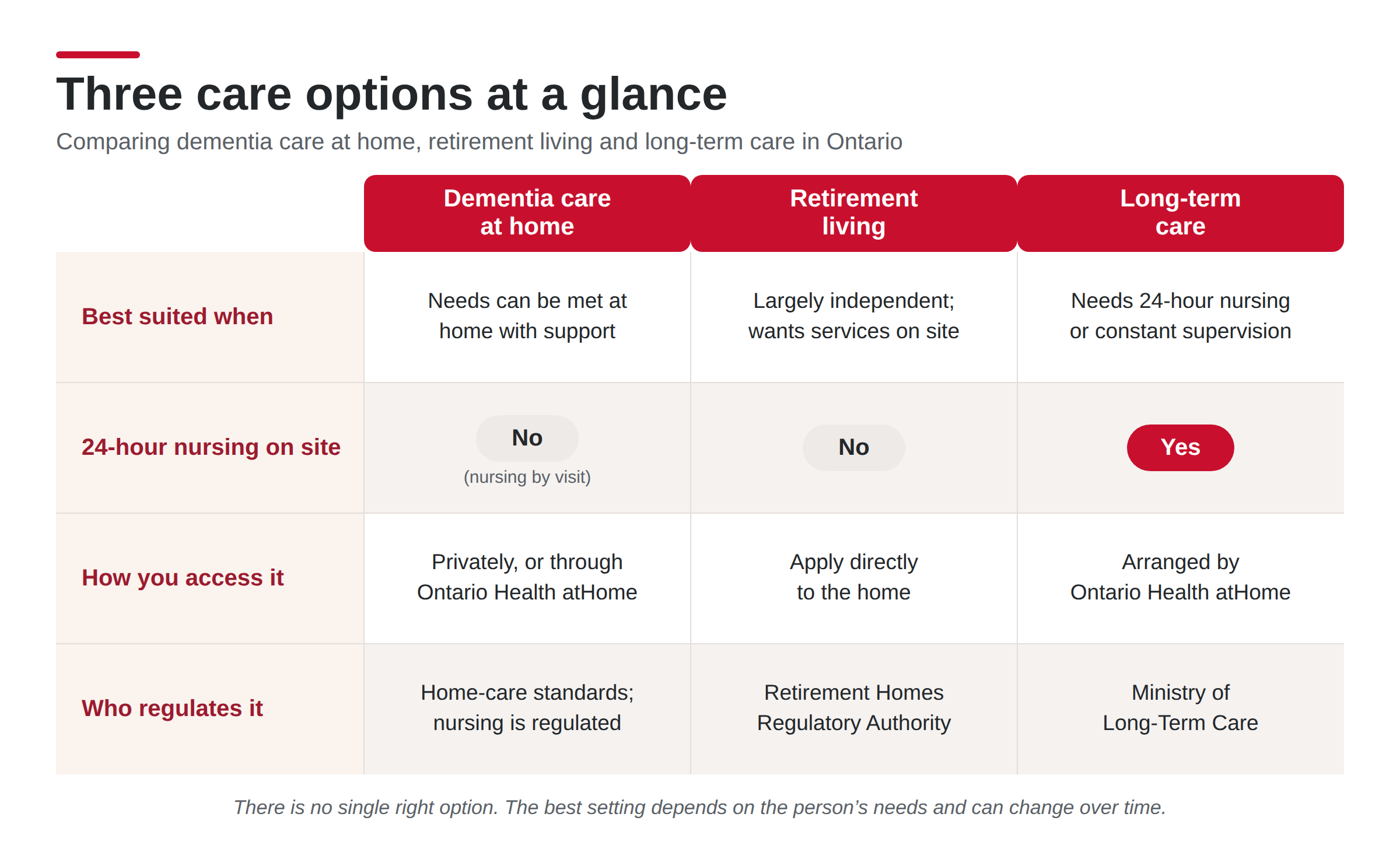
Support Available at Home
Dementia care at home is non-medical support that helps a person keep their routines in a familiar place: personal care, meals, companionship, supervision, and relief for family caregivers. It can be arranged privately or, if the person qualifies, through publicly funded home care coordinated by Ontario Health atHome.
What Dementia Care at Home Can Include
Support at home can cover personal care such as help with bathing, dressing, and mobility; meal preparation and medication reminders; companionship and a steady routine; supervision for safety; and respite so family caregivers can rest. Our approach, Interactive Caregiving, means doing things with the person wherever we can: cooking a favourite meal together, taking a walk, sitting down to talk. It keeps daily dementia care at home active and social rather than a checklist of chores. Care can start small, sometimes only a few hours a week, and grow into daily visits or overnight support as needs change. Staying at home is a realistic path for many people: about 61% of Canadian seniors with dementia live at home, according to CIHI (2015 to 2016 data), with support around them.
Two Ways Home Care Is Paid For
There are two routes. Publicly funded home care is arranged by Ontario Health atHome, which assesses the person and builds a care plan; if they qualify, the province pays for it, though the number of hours is based on that assessment and can be limited. Private home care, which is what our Oakville team provides, covers personal support, companionship, homemaking, respite, and overnight or around-the-clock arrangements, with the flexibility to add hours as needs grow. Non-medical home care, whether public or private, supports comfort and safety, but it does not treat or cure dementia, and it is different from regulated nursing. The dementia support described in this guide is primarily non-medical. When clinical care is required, it comes from nurses and the person’s health-care team, and Comfort Keepers Oakville also offers separate in-home nursing services.
Retirement Living
Retirement homes are privately paid residences for seniors who are largely independent but want services such as meals, housekeeping, and some personal care on site. Some offer optional dementia or memory care, but they do not provide 24-hour nursing care.
Ontario has nearly 780 licensed retirement homes. Residents are usually more independent and need less medical care than long-term care residents, and there are no eligibility criteria to move in: a person applies directly to the home and signs a tenancy agreement. The government does not fund retirement homes, so residents are responsible for the full cost of rent, meals, and any care services they buy through the home. They are regulated by the Retirement Homes Regulatory Authority under the Retirement Homes Act, 2010, which sets care and safety standards, licenses and inspects homes, keeps a public register, and gives residents a Residents’ Bill of Rights.
For dementia specifically, a dementia care program is a service a retirement home may or may not offer, and staff who provide it must be trained in caring for people with dementia. One point families often miss is what happens as dementia advances. A retirement home has to assess whether it can meet a resident’s care needs, and if it cannot, it is required to tell the family about other options, including long-term care. So a retirement home can be a good fit at one stage and still not be the right setting later. Asking a specific home what it can and cannot manage as needs increase is one of the most useful questions you can raise.
Long-Term Care
Long-term care homes provide 24-hour nursing and personal care for people whose needs can no longer be met safely at home or in a retirement home. In Ontario, access is arranged through Ontario Health atHome, the province funds the care itself, and residents pay a set accommodation co-payment.
Ontario has more than 600 long-term care homes, regulated by the Ministry of Long-Term Care under the Fixing Long-Term Care Act, 2021. To qualify, a person must be at least 18, have a valid Ontario health card, and have care needs that meet at least one of the province’s tests: needing 24-hour nursing available on site, needing frequent help through the day with daily activities, or needing frequent supervision for safety, when community-based services are no longer enough. A care coordinator at Ontario Health atHome assesses eligibility and arranges the application. Families choose up to five homes in order of preference, and once a space is offered there are 24 hours to accept it. Wait times vary from home to home, so it helps to apply and plan early rather than in a crisis.
Long-term care is built for higher and more complex needs, including advanced dementia. In 2024 to 2025, 62% of long-term care residents in Ontario had a diagnosis of dementia, compared with 60% nationally, according to CIHI, and many homes have specialized units for residents with dementia and complex behaviours. Ontario sets the accommodation co-payment and keeps it the same across all homes for standard rooms, as the table below shows.
Ontario long-term care accommodation co-payment (effective July 1, 2026)
| Accommodation type | Daily rate | Monthly maximum |
| Basic (long-stay) | $70.00 | $2,129.17 |
| Semi-private (long-stay) | $84.40 | $2,567.17 |
| Private (long-stay) | $100.01 | $3,041.97 |
Residents pay the accommodation co-payment and any optional services they choose (for example telephone, internet, cable, transportation or hairdressing); the province funds nursing and personal care. A Long-Term Care Rate Reduction Program helps people who cannot afford basic accommodation. Source: Government of Ontario, Paying for long-term care.
Safety and Clinical Needs
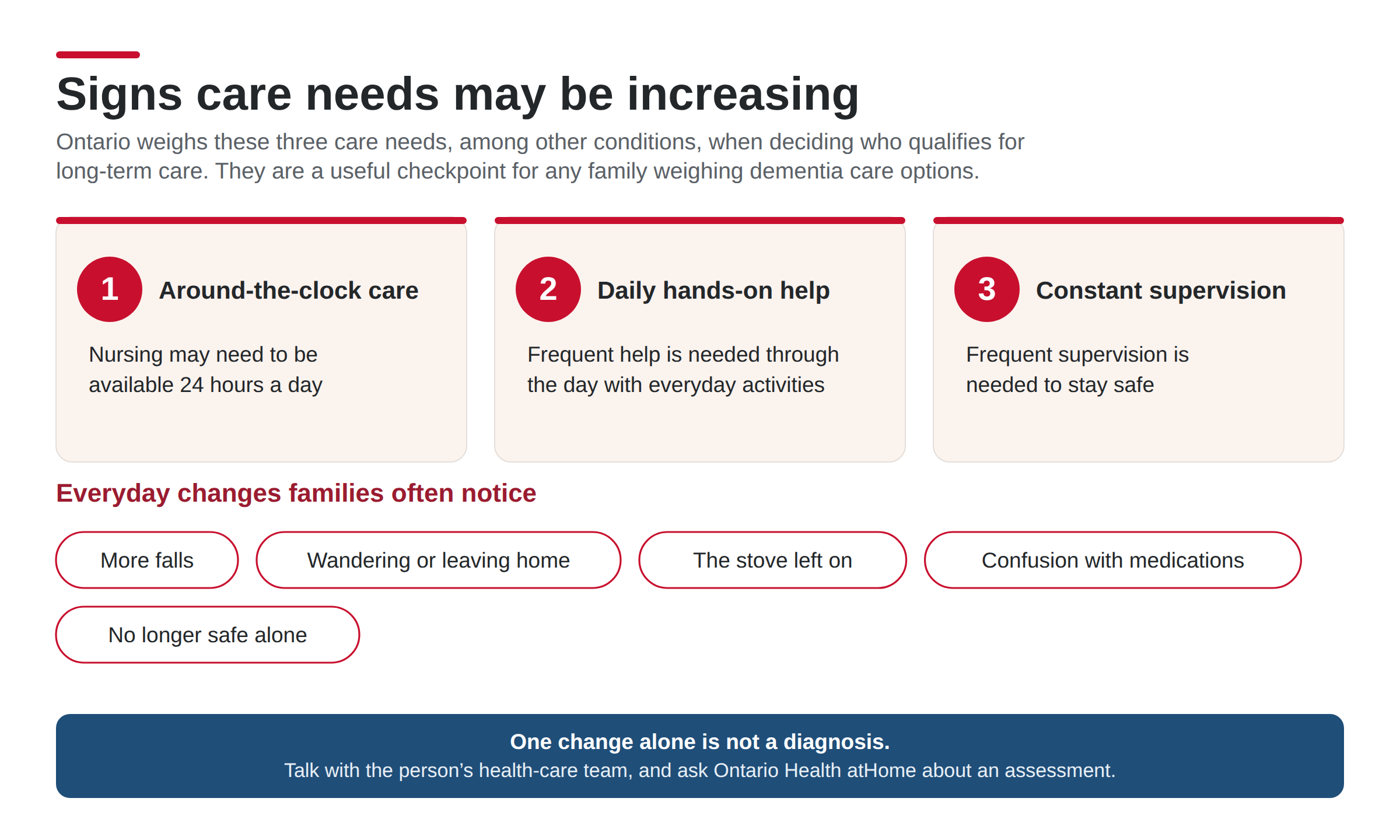
The clearest sign that a person may need more than home support is a need for nursing available 24 hours a day, frequent help through the day with personal care, or frequent supervision to stay safe. These are judgment calls best made with the person’s health-care team, not alone.
Ontario weighs those same three needs, among other factors, when deciding who qualifies for long-term care, which makes them a useful checkpoint for any family. Alongside them, dementia brings its own safety considerations. Falls are the leading cause of injury-related deaths for older adults, and people living with dementia are especially at risk of falling, according to the Alzheimer Society of Canada. Wandering, leaving the stove on, confusion with medications, or no longer being safe alone are the kinds of changes that move a family from managing to needing more help. None of these is a diagnosis on its own, and one hard week is not proof that home is no longer possible. If you are worried about dementia or about safety, the right first step is to talk with the person’s health-care provider, and, for publicly funded services or a long-term care application, to ask Ontario Health atHome for an assessment. Needs are reassessed over time, so a plan can change as the person does.
Family Capacity and Cost Questions

Two practical questions shape most of these decisions: how much care the family can realistically provide, and how each option is paid for. Broadly, home care can be publicly funded or paid privately, retirement living is paid for privately, and long-term care is publicly funded apart from a set accommodation charge.
How much the family can take on shapes everything else. Caregivers of a senior with dementia provide about 26 hours of care a week on average, compared with 17 hours for other seniors, and they are far more likely to feel the strain: 45% show signs of caregiver distress, and 21% feel unable to continue, according to CIHI (2015 to 2016). That strain is a signal to arrange support before a caregiver reaches breaking point. Respite care, from a few hours to an overnight, gives family caregivers a real break so they can keep going. On cost, the three settings work differently, and the table below lays out who pays for what.
Who pays for what
| Setting | What is publicly funded | What the family pays | How it is arranged |
| Dementia care at home | Home care, if the person qualifies (assessed hours) | Private home care hours; some community services carry a fee | Ontario Health atHome, or a private provider directly |
| Retirement living | Nothing; homes are not government funded | Full cost of rent, meals, and care services bought through the home | Apply directly to the home; sign a tenancy agreement |
| Long-term care | Nursing and personal care | A set accommodation co-payment, plus any optional services chosen | Ontario Health atHome |
Source: Government of Ontario, Explore your care options.
Questions to Ask Each Provider
Ask every option the same core questions so you can compare them fairly. The most useful ones cover safety and supervision, dementia experience, what happens as needs change, cost and what is included, and continuity of caregivers.
- Safety and supervision: How is the person supervised, and what happens overnight? How do you handle wandering or a fall?
- Dementia experience and training: What dementia training do your staff have, and how do you support someone whose memory or behaviour is changing?
- What happens as needs increase: At what point can you no longer meet a person’s needs, and what would you do then?
- Cost and what is included: What is in the base price, what costs extra, and how do fees change if care needs grow?
- Continuity and communication: Will the same caregivers come regularly, and how will you keep our family informed?
These questions work whether you are speaking with a home-care provider, a retirement home, or a long-term care home, and the answers tell you as much as any brochure.
Next Steps
Start by naming what has actually changed and what would make the biggest difference now, involve the person’s health-care team, and talk the options through in your own time. You rarely have to decide everything at once.
Many families find it easier to add support gradually and adjust as they learn what helps. Whichever setting fits, aim for the same things: the person stays safe, keeps their dignity, and does as much of their own daily life as they can. You can also read our related guide on whether someone living with dementia can continue living at home.
How Comfort Keepers Oakville Can Help
When home is the right place, families across Oakville and Burlington can count on our team to make it work. We provide in-home dementia care shaped around the person, from a few hours of companionship to daily personal care, overnight help, and around-the-clock support when it is needed. We match caregivers to each person’s routines, personality, and needs, so familiar faces build trust over time, and through Interactive Caregiving we do things with the person rather than for them, helping them stay active, connected, and as independent as possible.
We also give family caregivers real relief through respite care, so the people doing the most do not have to carry it alone. If needs change, we adjust the plan with you, and if a different setting ever becomes the right one, we will tell you honestly. There is no pressure and no obligation, only a clear conversation about what would help right now. When you are ready, talk through home-care options with our Oakville team.
About the Author
This guide was written by the Comfort Keepers Canada Editorial Team and reviewed for local accuracy by Brenda Rosati, Director of Operations and Owner of Comfort Keepers Oakville, who leads our local team supporting seniors and families across Oakville and Burlington. Learn more about Brenda Rosati. Our editorial content is grounded in the day-to-day experience of providing in-home dementia care, respite, and around-the-clock support to local families.
Last reviewed: August 2026.
References
Frequently Asked Questions
Can a person move from home care to a retirement home or long-term care later?
Yes. These are not one-way doors. Many families begin with home care and move to a retirement home or long-term care as needs change, and some use home care to bridge a long-term care waitlist. Because a person’s needs change as dementia progresses, it is normal for the right setting to change more than once.
Does private home care replace publicly funded home care or nursing?
No. The dementia support described in this guide is non-medical. It can add hours or flexibility alongside publicly funded home care, or stand in for it, but it does not replace regulated nursing or medical treatment. Comfort Keepers Oakville offers separate in-home nursing services when clinical care is required, and either can work alongside the person’s health-care team.
How long are long-term care waitlists in Ontario?
There is no single province-wide number, because wait times depend on the specific home, the person’s priority, and their care needs. Ontario Health atHome can give you current figures for the homes you are considering.
Can someone with dementia be turned away from a retirement home?
A retirement home does not have to accept every applicant, and it can reach a point where it is no longer able to meet a resident’s needs as dementia advances. That is why it helps to ask each home directly what it can manage over time, and what it would recommend if a person’s needs outgrow what it offers.
Who decides which option is right?
If the person is capable of making this decision, it is theirs to make, with support from their family and health-care team. If they are not capable of the admission decision, a substitute decision-maker may decide on their behalf, as Ontario’s process provides. For publicly funded home care or a long-term care placement, Ontario Health atHome also assesses needs and eligibility. No single provider should make the choice for you.