


Hiring someone to care for a parent at home is a decision most families make only once, and often at a stressful time. These are the 20 questions we think every Oakville and Burlington family should ask before they commit, covering local ownership, caregiver screening, scheduling, care planning, medical limits, pricing, and references. Ask them of every provider you talk to, including us.
By the Comfort Keepers Oakville team. Reviewed by Brenda Rosati, Director of Operations and Owner.
Key Takeaways
- Ask 20 questions across eight areas before you hire, from local ownership and caregiver screening to pricing, medical limits, and references.
- Non-medical support and regulated nursing are different kinds of care, so check who on a provider’s team is qualified for each.
- Publicly funded hours through Ontario Health atHome can be combined with private care, so ask any provider how the two fit together.
- Confirm the minimum hours per visit, if the same caregiver returns, and what happens when a shift needs backup coverage.
- Ask who owns and runs the local office, and request recent references from families in Oakville or Burlington.
- Bring these questions to a free in-home assessment, and call our Oakville team when you want them answered for your family.
Download the Printable 20 Questions Brochure
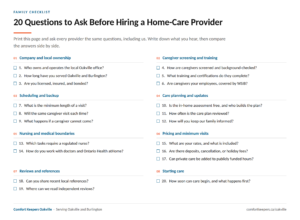
We put these questions into a printable brochure you can download and keep. It includes a comparison chart with a column for each provider, so you can write down their answers and see how they line up on a single page. Save it, print it, or send it to whoever is helping you decide.
Download the Comfort Keepers 20 Questions brochure (PDF)
Why These Questions Matter
When you hire home care, you are inviting someone into a family member’s home to help with personal, private parts of daily life. The quality of that help depends far more on how a company hires, trains, schedules, and supports its caregivers than on how it advertises. That is what these questions are built to reveal.
Families often tell us they did not know what to ask until a problem appeared, like a missed visit or a surprise on the invoice. We would rather you ask everything up front. The eight areas below are the ones that shape day-to-day care.
How to Use This 20-Question Checklist
Ask the same questions of every provider you are considering, including us, so you can compare their answers directly. A provider that stands behind its service will give you specifics, names, timelines, and policies, and will put them in writing. If the answers stay general, or change from one conversation to the next, that tells you something too. Bring the questions to a free in-home assessment, where they turn into a practical conversation about your family’s situation.
Non-Medical Home Care vs. Regulated Nursing: Why It Shapes Every Question
One distinction runs through every question that follows, so it is worth naming now. Some of what an older adult needs at home is practical, day-to-day help, and some of it is clinical care that calls for a regulated professional such as a nurse. When you compare providers, watch how clearly each one draws that line and explains who on its team is qualified for what. A vague answer there is the clearest warning sign on this page. The nursing and medical boundaries section below shows how the two kinds of care divide, and how they fit together.
Company and Local Ownership
Start with who you are actually hiring. A local owner is accountable to the families they serve and can make decisions quickly, which matters when your needs change.
1. Who owns and operates the local Oakville office?
Our Oakville office is locally owned and operated by Brenda Rosati, our Director of Operations and Owner. Ask any provider for a name, not just a brand. Local ownership means the person accountable for your family’s care is close at hand, involved in the community, and someone you can reach directly.
2. How long has the provider delivered home care in Oakville and Burlington?
Comfort Keepers has provided home care in Canada for more than two decades, and our office serves families in Oakville and Burlington today. Ask any provider two separate things: how long the brand has operated, and how long this local office has served your area. The two are not always the same. What matters most is that the care and the caregivers stay consistent, so ask how a provider keeps that continuity as your needs change.
3. Is the company licensed, insured, and bonded?
Insured means the company carries liability coverage if something goes wrong during a visit. Bonding can protect you against employee dishonesty or theft, depending on the coverage in place. Licensed is the loosest of the three words, because Ontario has no single licence that every home-care agency holds, so ask a provider what it actually means when it uses that word. We carry liability insurance and bonding, and we will tell you what each one covers.
Caregiver Screening and Training
The person who walks through the door every week shapes the whole experience of home care. Ask how a provider decides who to hire, and how it keeps those people skilled once they are working.

4. How are caregivers screened and background-checked before they are hired?
No caregiver reaches a client of ours without clearing every step shown above, and the criminal background check is finished before any client contact. When you ask another provider this question, listen for whether they can name their steps in order and say which ones happen before hiring. The details are what matter here, so ask any provider to walk you through its process step by step.
5. What training, certifications, and ongoing education do caregivers complete?
Our caregivers are trained before they start and continue learning while they work with us, including support for mobility, personal care, and dementia. Ask what training a provider requires and how caregivers stay current. If your family member has a specific condition, ask how caregivers are prepared for it.
6. Are caregivers your employees, covered by WSIB and liability insurance, or subcontractors?
Our caregivers are our employees. We screen, train, supervise, and insure them, so you are never placed in the position of being someone’s employer. The distinction carries real financial weight, because the WSIB states that an independent operator is not automatically covered by the business they do work for. If a provider uses contractors, ask who carries the workplace insurance and who would be responsible if that person were hurt on the job.
Scheduling and Backup
A care plan only works if someone actually arrives. These three questions cover the practical side of scheduling, and the answers are where you learn how dependable a provider really is.
7. What is the minimum visit length, and how flexible is scheduling?
Providers set a minimum number of hours per visit, and it varies between companies. Ask what the minimum is before you compare hourly rates, since a low rate with a long minimum can cost more overall. Our care can start with a few hours a week and grow as needs change, and we build the schedule around your family’s routine.
8. Will the same caregiver visit each time, and how are caregivers matched to clients?
We match each client with a caregiver based on care needs, personality, and daily routine, and we work to keep that pairing consistent so your family sees familiar faces. Ask if the same caregiver will visit each time or if a rotating group will. Consistency builds trust, and it matters even more for someone living with memory loss.
9. What is your backup plan if a caregiver is sick, late, or cancels?
If a caregiver cannot make a visit, we arrange trained backup coverage and let your family know. Ask every provider what happens on the day a caregiver is sick or cannot come. A dependable provider plans for coverage so a visit is not simply missed, and it tells you how and how quickly you will be contacted.
Care Planning and Updates
Good care is planned, written down, and adjusted over time. Ask how a provider builds and maintains the plan, and how it keeps you informed.
10. Do you offer a free in-home assessment, and who builds the care plan?
Yes, we offer a free in-home assessment, and we build a personalized care plan from it. Ask who conducts the assessment and if the plan is written down and shared with your family. A care plan should start with a real conversation in the home, not a form filled in over the phone.
11. How often is the care plan reviewed and updated as needs change?
We review the care plan regularly, and again whenever something changes, such as a hospital stay, a fall, or a new diagnosis. Ask a provider what specifically triggers a review, not just how often one happens. Needs in later life rarely hold still for long, and a plan written in January can describe the wrong person by autumn.
12. How will you keep our family informed?
We keep families updated on how care is going and stay reachable when you have questions. Ask who your main contact will be and how quickly you will hear about a concern. Agree on how you prefer to be reached before care begins, by phone, email, or text.
Nursing and Medical Boundaries
This is the area families most often misunderstand, and understanding it helps you plan. Non-medical support covers the everyday tasks of living at home. Clinical care treats a medical condition and calls for a regulated professional such as a nurse. We provide non-medical support through our caregivers, and clinical services through regulated nursing professionals when they are needed, so the two kinds of care can work together under one provider. The table below shows how they usually divide.
| Non-medical support (our caregivers) | Clinical services that may require a regulated health professional |
|---|---|
| Companionship, supervision, and reassurance | Health assessments and monitoring |
| Bathing, dressing, and personal hygiene | Wound care and dressing changes |
| Meal preparation and light housekeeping | Injections and intravenous (IV) therapy |
| Medication reminders | Medication administration and management |
| Mobility support and fall-risk awareness | Catheter insertion and complex catheter or ostomy procedures |
| Accompaniment to appointments and errands | Skilled nursing care after a hospital stay or surgery |
13. Which tasks can caregivers perform, and which require a regulated nurse or other health professional?
Our caregivers provide the non-medical support in the left column. The clinical services on the right may require a regulated health professional such as a nurse. Exactly which tasks call for a nurse depends on the rules that apply to each one, which is why a careful provider will tell you plainly who on its team is qualified for a given task. Regulated nursing in Ontario is defined and overseen by the College of Nurses of Ontario, under the Nursing Act, 1991 and the Regulated Health Professions Act, 1991.
14. How do you coordinate with physicians, hospitals, and Ontario Health atHome?
We work alongside your existing care team and follow the direction set by your doctors, and by the hospital after a discharge. Many of the families we support also receive publicly funded services through Ontario Health atHome, the provincial organization that coordinates in-home and community-based care. Our job in that arrangement is to make sure the help at home reinforces the clinical plan instead of cutting across it. Ask any provider who it talks to, how often, and what it does when instructions from two sources conflict.
Pricing and Minimum Visits
Cost should be clear before care starts. Ask for the full picture rather than a single hourly rate, so nothing on the first invoice takes you by surprise.

15. What are your rates, and exactly what is included?
We explain our pricing during the free assessment, so you can see the full cost for the care you actually need. Ask what the rate includes, what counts as an extra, and how billing works. Two providers can quote the same hourly rate and deliver very different value once you look at what sits inside it.
16. Are there minimum hours, deposits, cancellation fees, or holiday and short-notice charges?
We go through minimum hours, any deposit, cancellation terms, and holiday or short-notice charges before care begins. These are the costs families most often forget to ask about, and they are the ones that turn an affordable-looking rate into a surprising invoice. Ask each provider for the full list in writing, and check how much notice you need to give to cancel a visit without being charged.
17. Can private home care be combined with publicly funded home-care hours?
Yes, and many families do exactly that. Publicly funded home care in Ontario is arranged through Ontario Health atHome, and the allocated hours can be limited, so private care fills the gaps by adding more hours, evening or weekend coverage, or a specific kind of support. Ask a provider how it coordinates with your publicly funded hours. The table below shows how the two usually compare.
| Consideration | Publicly funded (Ontario Health atHome) | Private home care (a provider like us) |
|---|---|---|
| How you access it | Assessed and arranged through Ontario Health atHome | Arranged directly with the provider |
| Cost | Funded by the province, at no direct charge to you | Paid privately, by the family or through insurance |
| Hours available | Allocated based on assessed need and program capacity | Set by the family, from a few hours to around the clock |
| Scheduling | Depends on program capacity | Chosen by the family, including evenings and weekends |
| Choice of caregiver | Usually arranged through the service provider; choice may be limited | Matched with the family and kept consistent |
| Best used for | Assessed clinical and personal support needs | Added hours, flexibility, and continuity |
Reviews and References
Reputation is easy to claim and harder to prove. References and independent reviews are where you check it.
18. Can you share recent references from local families?
We are glad to connect you with families who can speak to their experience with our team. Ask to speak with people a provider currently serves, ideally in Oakville or Burlington. Recent, local references tell you more than a printed testimonial. If a provider cannot offer any, ask why.
19. Where can we read independent, verifiable reviews of your service?
You can find our reviews on our Google Business Profile, and you are welcome to ask us about any of them, including the critical ones. Read past the testimonials chosen for a provider’s own website. The most useful thing in any review section is the replies: a company that answers a complaint with specifics, rather than a form apology, will usually deal with your concerns the same way.
Starting Care
When you are ready, starting care should be simple. Here is how it works with us and what to expect from the first step. You can also see the full range of care we provide in Oakville and Burlington before you call.

20. How soon can care begin, and what are the next steps?
The honest answer is that it depends. How quickly care can start comes down to how much support is needed, at what hours, and which caregivers are free at that moment. Be a little wary of a firm start date offered before anyone has met your family. We will tell you on the first call what is realistic for your situation, and if a straightforward schedule can begin sooner than a complex one, we will say so.
What to Expect From a Free In-Home Assessment
We sit down with you at home, usually with the family there, and talk through the person’s health, their daily routine, and what would make an ordinary day easier. We also look at the practical details of the house, such as stairs, lighting, and where someone tends to lose their footing. There is no obligation, and you can stop at any point. Bring the checklist and your notes, and we will work through them with you.
Talk With the Oakville Team
You do not need to know what kind of care you want before you get in touch. Most families do not. If you would like these 20 questions answered for your own situation, talk with our Oakville team. We will listen first, answer plainly, and arrange a free in-home assessment whenever you are ready for one.
References
About the Author
This guide was written by the Comfort Keepers Oakville team and reviewed by Brenda Rosati, Director of Operations and Owner of Comfort Keepers Oakville. Brenda leads local care delivery for families across Oakville and Burlington.
Frequently Asked Questions
Do you provide care only in private homes, or also in retirement residences and hospitals?
We provide care wherever your family member lives or stays. That includes private homes, apartments, and retirement residences, and we can also sit with someone and provide companionship during a hospital stay. Access rules can differ from one residence or facility to the next, so tell us the setting and we will confirm what is possible.
Can you coordinate care for a parent in Oakville when the family lives in another city?
Yes. Many of the families we work with live in another city or province. We act as your eyes and ears locally and keep you updated on how care is going, so you can stay closely involved from a distance. We will agree with you on how and how often you want to hear from us.
What is the difference between a personal support worker (PSW) and a caregiver?
PSW is a more specific caregiving role, but education, experience, and registration can vary from one worker to the next. In Ontario, some personal support workers complete a formal PSW program, while others qualified through years of hands-on experience, and registration is voluntary. Caregiver is the broader term for anyone who provides non-medical support in the home. What matters most is that the person is properly screened, trained for your family member’s needs, and a good fit, so ask the provider what training and qualifications its workers hold.
What happens if my family member and their caregiver are not a good fit?
Tell us. A good match is part of good care, and personalities do not always click on the first try. If the pairing is not working, we will talk it through with you, adjust, and introduce a different caregiver. You should never feel stuck with a match that is not right.