How Much Does Home Care Cost in Brampton?
Written by the Comfort Keepers Canada Editorial Team | Reviewed by Brenda Rosati, Director of Operations and Owner, Comfort Keepers Brampton | Published September 2026
Cost is one of the first questions families have when they start planning care at home. With 81,830 Brampton residents aged 65 and over in the 2021 Census, it is a question many local households are working through. This guide explains what shapes the cost of home care in Brampton, how publicly funded care fits in, and which questions help you get an estimate that matches the schedule your family needs.
Key Takeaways
- A few hours to 24 hours a day: schedules can be short visits or round-the-clock care, and the total hours each week have a large effect on home care cost in Brampton.
- Public and private care can work together: Ontario Health atHome assesses eligibility for publicly funded care, and private care can add hours or more flexible times.
- Evenings, weekends and Ontario’s 9 public holidays: care plans can include these times, so mention them when we build the schedule together.
- Age 70 and over: eligible low- to moderate-income seniors may claim Ontario’s Seniors Care at Home Tax Credit, and CRA medical expense rules may apply to some attendant care costs at any age.
- Next step: call (905) 671-4004 to book a complimentary in-home care consultation with our Brampton team.
Quick Answer
There is no single flat rate for private home care in Brampton because the cost is based on the individual care plan. At Comfort Keepers Brampton, pricing is determined by the number of care hours, the schedule and the type of support required. Because rates are set locally and the plan is personalized, we provide pricing after learning what support and schedule your family needs. Publicly funded home care through Ontario Health atHome is available to people who qualify (Government of Ontario, Home and community care), and private care can add hours or more flexible times alongside it.
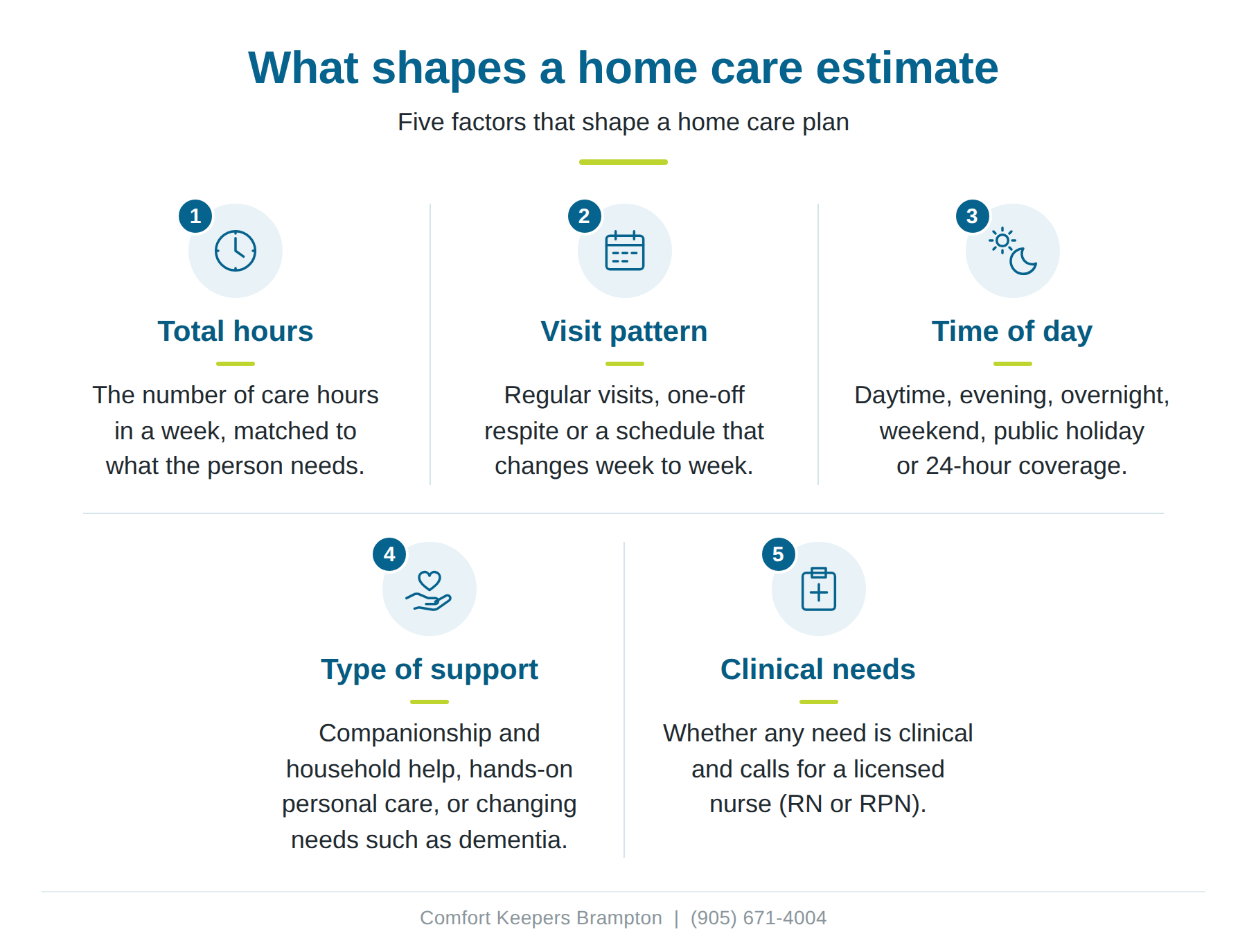
What determines your home care cost? Your weekly care hours, visit schedule, time of day, type of support and whether licensed nursing is required.
What Affects Home Care Cost
Each of these five factors works a little differently, and the sections below explain them one at a time.
From Five Factors to a Care Plan
You don’t need to have the schedule worked out before you contact us. Our process starts with a complimentary in-home care consultation, where we learn about daily routines, preferences and the help needed. That information becomes a Plan of Care, which describes the home care services and sets the schedule, so the estimate reflects the plan your family actually chooses. If you have a target budget in mind, we can also discuss how to structure the schedule around the times when support would make the greatest difference.
How Publicly Funded Home Care Fits In
Publicly funded home care and private home care are arranged and paid for in different ways, and the two can work side by side.
Ontario Health atHome arranges publicly funded home care. A care coordinator assesses needs, and the services a person receives depend on those assessed needs and on what is available in the community (Government of Ontario, Home and community care). Anyone can make a referral to Ontario Health atHome. Call 1-833-515-1234 or visit Ontario Health atHome to get started.
Some community support services can have a client co-payment, and the province notes that people can also pay for their own care through private companies (Government of Ontario, Home and community care). Private care lets a family add hours, choose times that suit the household’s routine, or arrange support while a public assessment is under way.
Table 1: Publicly funded home care and private home care at a glance
| Publicly funded home care (Ontario Health atHome) | Private home care | |
| How it starts | A referral to Ontario Health atHome, followed by an assessment by a care coordinator | A call to a private provider. With us, a complimentary in-home care consultation |
| Who decides what is provided | The care coordinator, based on assessed needs and the services available in the community | The client, family and provider develop the plan together based on the person’s needs, preferences, schedule and chosen services |
| How the schedule is set | Through the care plan, usually as scheduled visits | Through the Plan of Care. With us, plans range from a few hours a visit to 24-hour care |
| Who pays | The Ontario government, for people who qualify | The client or family. Private care can be combined with publicly funded care |
| When needs change | The care coordinator reassesses needs and may adjust the plan | The Plan of Care is reviewed with the client and family and updated |
Sources: Government of Ontario, Home and community care; Ontario Health atHome, Getting Started; Comfort Keepers Brampton, Care Services FAQs and Home Care Services.
Hours and Frequency of Care
Because care is planned in hours, the schedule is the main way to shape the total, and it can be adjusted as the person’s needs become clearer.
How Weekly Hours Add Up
Schedules can be as light or as full as a family needs. With us, care can range from a few hours a visit up to 24 hours a day.

Regular Schedules, One-Off Visits and Changing Plans
Care can be regular or occasional, and it can change over time.
Respite care can be a one-off, a standing weekly block or something that changes week to week, so a family caregiver might book a few hours for appointments or longer cover for time away. With escorted transportation, a caregiver travels with the person, stays with them at the appointment or errand and brings them home, so it helps to know roughly how long regular appointments take.
We review the Plan of Care with the client and family and update it when needs change. Care plans can be adjusted as routines become clearer and needs change, so families do not have to predict every future need before getting started.
Type and Complexity of Support

Two plans with the same hours can look quite different depending on the kind of help involved. Hands-on personal care and changing needs usually take more planning and time than companionship or household help.
Companionship and Household Help
Some people mainly need company and a hand with daily life: conversation, errands, meal preparation, light housekeeping and getting out to appointments. Depending on the person’s routine, this kind of support may fit into shorter or less frequent visits. Our caregivers practise Interactive Caregiving™, which means doing things with a person rather than simply for them. Cooking a meal together or sorting the mail side by side gets the job done and keeps the person involved in their own day.
Personal Care, Mobility and Medication Reminders
Help with bathing, dressing, toileting, moving around the home or getting in and out of bed or a chair is more hands-on. These tasks follow the person’s pace and often happen at set times, such as mornings and bedtime, which shapes both the length and the timing of visits. Our caregivers can help make sure clients take their own medication as prescribed. When you describe a typical day, include medication times so they can be built into the visits.
Dementia and Needs That Change Over Time
Alzheimer’s disease and other dementias often change a care plan over time. The Alzheimer Society of Canada notes that the disease affects each person differently and that in the late stage, care may be required 24 hours a day (Alzheimer Society of Canada, The stages of Alzheimer’s disease). Support can grow with the person, from a few visits a week to longer visits, evening support or continuous coverage. Our dementia home care focuses on preserving independence, dignity and joy.
Daytime, Overnight and Continuous Coverage
Care can be planned for daytime, evenings, overnight, weekends, holidays or around the clock, and each timing is scheduled a little differently.
Evenings, Weekends and Public Holidays
Evening visits often centre on dinner, medication times and getting ready for bed, while weekend visits can give family caregivers time for their own plans. Ontario has nine public holidays: New Year’s Day, Family Day, Good Friday, Victoria Day, Canada Day, Labour Day, Thanksgiving Day, Christmas Day and Boxing Day (Government of Ontario, Your guide to the Employment Standards Act: Public holidays). If care will be needed on any of those days, include them when we plan the schedule together.
Overnight and 24-Hour Care
For clients who need continuous support, our 24-hour care is provided by a team of caregivers working in rotating shifts so assistance is available around the clock.
Publicly funded home care is based on assessed needs and is usually arranged as scheduled visits (Government of Ontario, Home and community care), so families who want longer, overnight or 24-hour coverage sometimes add private care to fill those hours.
Caregiver vs Licensed Nursing
Caregiver support and licensed nursing are separate services provided by different professionals. Knowing which kind of help a need calls for helps you get an accurate estimate.
Personal support workers and other caregivers focus on day-to-day, non-medical support. Licensed nursing care may be provided by Registered Nurses (RNs) or Registered Practical Nurses (RPNs), depending on the care required (College of Nurses of Ontario, An Introduction to the Nursing Act, 1991).
The organization that employs a personal support worker sets their responsibilities and training requirements (College of Nurses of Ontario, Working with Unregulated Care Providers). Every Comfort Keepers caregiver is our employee, screened and trained before caring for a client. When a client’s needs involve licensed clinical care, those needs are assessed separately and appropriate nursing services can be included in the care plan. Many people need only one of these services, and some need both.
If you think nursing may be needed, see our in-home nursing care page, and we can talk through whether it fits.
Table 2: Caregiver support and licensed nursing compared
| Caregiver support | Licensed nursing | |
| Who provides it | Personal support workers and other caregivers | Registered Nurses (RNs) and Registered Practical Nurses (RPNs) |
| Typical help | Companionship, personal care, meal preparation, light housekeeping, errands, transportation and help making sure clients take their own medication as prescribed | Clinical care. Ontario’s publicly funded nursing care includes changing bandages and cleaning wounds |
| How the role is defined | Responsibilities and training set by the employer. At Comfort Keepers, caregivers are screened and trained employees | Regulated health profession overseen by the College of Nurses of Ontario |
| In Ontario’s publicly funded home care (if eligible) | Personal support and homemaking services | Nursing care |
| What to confirm | Which daily tasks are in the plan, and at what times | Whether a need is clinical, and who will assess it |
Sources: College of Nurses of Ontario; Government of Ontario, Home and community care; Comfort Keepers Brampton, Home Care Services and In-Home Nursing Services.
Questions to Ask for an Accurate Estimate
These questions help you compare estimates on the same terms. They are worth asking any home care provider, including us.
About the Care Plan
- Who assesses the person’s needs, and is there a cost for the first consultation?
- Will we receive a written care plan that lists the services and the times?
- How often is the plan reviewed, and what happens when needs change?
- Who do we contact with questions about the schedule?
About the Schedule
- What visit lengths and schedules are possible for our situation?
- How are evenings, weekends and public holidays handled?
- For overnight care, how is the night planned, and what help is available during the night?
- If the regular caregiver is away, how is another caregiver arranged and introduced?
About the Estimate
- Does the estimate include applicable taxes?
- How are escorted outings, appointments and errands included in the plan?
- How are invoices or receipts provided, and do they show the details needed for tax records?
- How easily can hours be added or changed as needs change?
Talk With Our Brampton Team About Your Care Plan

If you are weighing the cost of home care for a parent, a spouse or yourself, start by telling us what a typical day looks like now and where help would make a difference. During a complimentary in-home care consultation, we listen to what you have noticed, build a care plan with you and talk through rates for that plan.
Call (905) 671-4004 or contact Comfort Keepers Brampton to talk through your family’s situation. You can also explore home care in Brampton or see how we build a personalized home care plan.
Comfort Keepers Home Care Brampton | 5 Brisdale Drive, Suite 202, Brampton, ON L7A 0S9 | (905) 671-4004
About the Author
This article was written by the Comfort Keepers Canada Editorial Team, which prepares educational care guides for families using official Canadian and Ontario sources for information about public programs, tax measures and regulated care. It was reviewed by Brenda Rosati, Director of Operations and Owner of Comfort Keepers Brampton, where she leads the local team that supports seniors and their families across Brampton and reviews the office’s care information for local accuracy. Learn more about Comfort Keepers Brampton.
References
Frequently Asked Questions
Can Any Home Care Costs Be Claimed on a Tax Return?
Some can, depending on the person’s situation and CRA rules. The Canada Revenue Agency allows certain attendant care costs to be claimed as medical expenses when its conditions are met, including that the attendant is 18 or older and is not the person’s spouse or common-law partner. Receipts must show the name of the company or individual who was paid, and certification requirements and dollar limits apply in some cases (Canada Revenue Agency, RC4065 Medical Expenses 2025).
Ontario’s Seniors Care at Home Tax Credit is a refundable credit for eligible Ontario seniors age 70 or older, or people whose spouse or common-law partner meets the age requirement. The credit can provide up to 25% of claimable medical expenses up to $6,000, for a maximum credit of $1,500. The amount is reduced as family net income rises above $35,000 and is fully phased out by $65,000. Eligible expenses can include qualifying attendant care (Government of Ontario, Ontario Seniors Care at Home Tax Credit). Family caregivers can also read our guide to the Canada caregiver credit. Tax rules and eligibility can change, so confirm your situation with the CRA or a tax professional.
How Do Sales Taxes Apply to Home Care?
GST/HST treatment can vary depending on the type of home care service and how the care is funded (Canada Revenue Agency, GST/HST Info Sheet GI-166). Ask our Brampton team how any applicable taxes are treated in your estimate or invoice. For advice about your own tax situation, confirm with the CRA or a tax professional.
Can Veterans Get Help Paying for Home Care?
Eligible Veterans may. The Veterans Independence Program provides annual tax-free funding for services such as housekeeping, meal preparation, personal care, and professional health and support services, for Veterans who meet its eligibility rules, such as having qualified for a disability benefit (Veterans Affairs Canada, Veterans Independence Program). Veterans Affairs Canada can confirm eligibility.
What Changes If We Hire a Caregiver Directly?
The family may take on an employer’s responsibilities. The CRA says that a person who hires a caregiver may be considered the worker’s employer, depending on the situation. An employer withholds income tax, CPP contributions and EI premiums and reports the pay on a T4 slip (Canada Revenue Agency, Payments to caregivers, babysitters and domestic workers). Domestic workers hired by a household have rights under Ontario’s Employment Standards Act, including hours of work protections, overtime pay, vacation with pay and public holidays (Government of Ontario, Your guide to the Employment Standards Act: Domestic workers). A private individual who directly employs an attendant for personal care is not required to register with the WSIB, so the household decides whether to apply for coverage (Workplace Safety and Insurance Board, Industry specific coverage). When you work with us, we are the employer, and our caregivers are bonded, insured and covered by Workers’ Compensation.