
PSW Agency vs Home Care Agency in Brampton
By the Comfort Keepers Canada Editorial Team | Published September 2026
When a parent or spouse starts needing help at home, the search usually begins with three letters: PSW. Within minutes you are looking at PSW agencies, home care agencies and independent personal support workers, and they can all seem to offer the same thing. This guide covers how they differ, what to ask each provider and when a nurse needs to be involved.
Brampton had 81,830 residents aged 65 and over at the 2021 Census, and older adults were the fastest-growing age group in Peel Region between 2016 and 2021.
Key Takeaways
- A PSW is a caregiver role. A home care agency is an organization that can employ and coordinate caregivers, and a “PSW agency” in Brampton may work either way.
- Since December 1, 2024, Ontario PSWs can register voluntarily with HSCPOA, so ask each provider how it verifies caregiver training and screening.
- Under CRA rules, hiring a caregiver directly can make your family the employer, responsible for income tax, CPP and EI deductions.
- Some clinical procedures are controlled acts under Ontario law, so the care team decides when a nurse or another authorized professional should be involved.
- Before you choose, ask who employs, screens and replaces the caregiver and who updates the care plan, then book a care conversation.
Quick Answer
A PSW (personal support worker) is a caregiver role; a home care agency is an organization that can employ caregivers and coordinate their care. PSWs give hands-on help with bathing, dressing, meals and moving around safely. A home care agency typically adds screening, scheduling, the care plan and cover when someone is away. Businesses that call themselves PSW agencies vary, so the right choice depends on the person’s needs and on what each provider can confirm it does.
Table 1. At a glance: three ways to arrange private PSW support
| Arrangement | What it is | What to confirm first | Often a good fit when |
| Hiring a PSW directly | Your family finds, hires and schedules an individual personal support worker | Whether your family becomes the employer under CRA rules, and how backup will work | You want to manage hiring and scheduling yourselves |
| A PSW referral or placement service | A business that connects your family with a worker; arrangements vary | Whether the service or your family is the employer, and who plans and adjusts the care | You want help finding a worker and are comfortable coordinating the care |
| A home care agency | An organization that employs caregivers and coordinates care | What the agency handles for you, including screening, care plan reviews and cover | You want one team to handle hiring, scheduling and care planning |
Why the Terms Get Confused

In private-pay home care, “PSW agency” and “home care agency” are used inconsistently. The label alone does not tell you who employs the caregiver, who coordinates the care or who provides backup.
PSW Is a Role, Not a Type of Company
Ontario’s Personal Support Worker Program Standard prepares graduates to work in community care agencies, private homes, retirement homes, long-term care homes and hospitals, and in 2024 the province counted more than 100,000 personal support workers in Ontario. The same trained PSW could be employed by a hospital, a home care agency or a family.
Three Ways PSW Support Reaches a Brampton Home
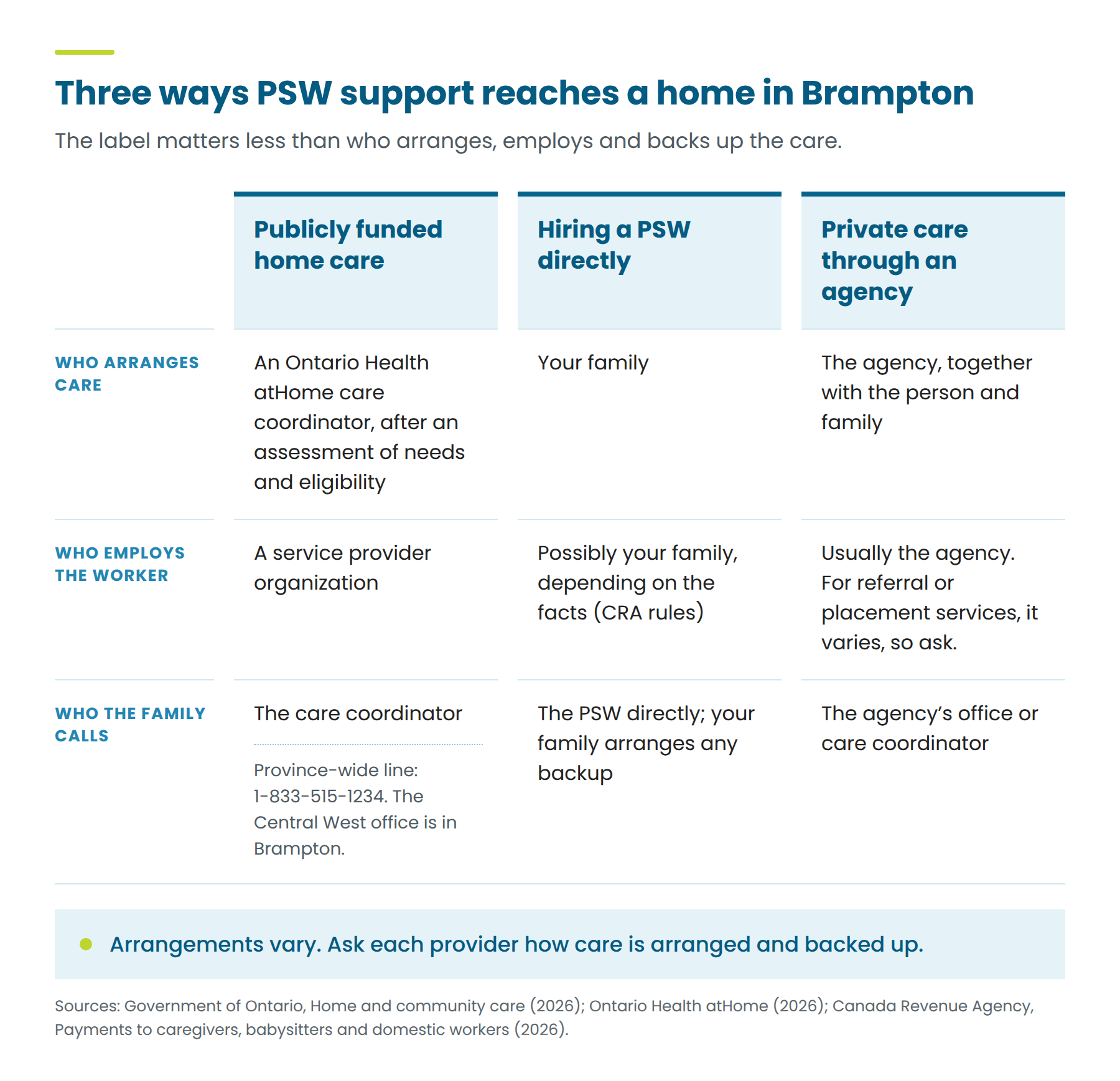
PSW support usually reaches a home through one of three routes.
- Publicly funded home care. Ontario Health atHome assesses eligibility, develops the care plan with the person and family, and arranges publicly funded services. Its Central West office is in Brampton, and the province-wide line is 1-833-515-1234.
- Hiring a PSW directly. Your family finds, hires and schedules the worker, and takes on the responsibilities we cover below.
- Private care through an agency. Ontario’s home and community care guidance notes that families can also pay for care through private companies. Some mainly refer or place workers. A temporary help agency is different again: under Ontario’s Employment Standards Act, the agency is the employer of the workers it assigns. Home care agencies like ours employ caregivers directly and coordinate the care plan, scheduling and backup.
What a PSW May Help With
A PSW’s work centres on personal care and daily routines, with companionship built in. The exact tasks are set by the care plan and the employer.
Everyday Personal Support
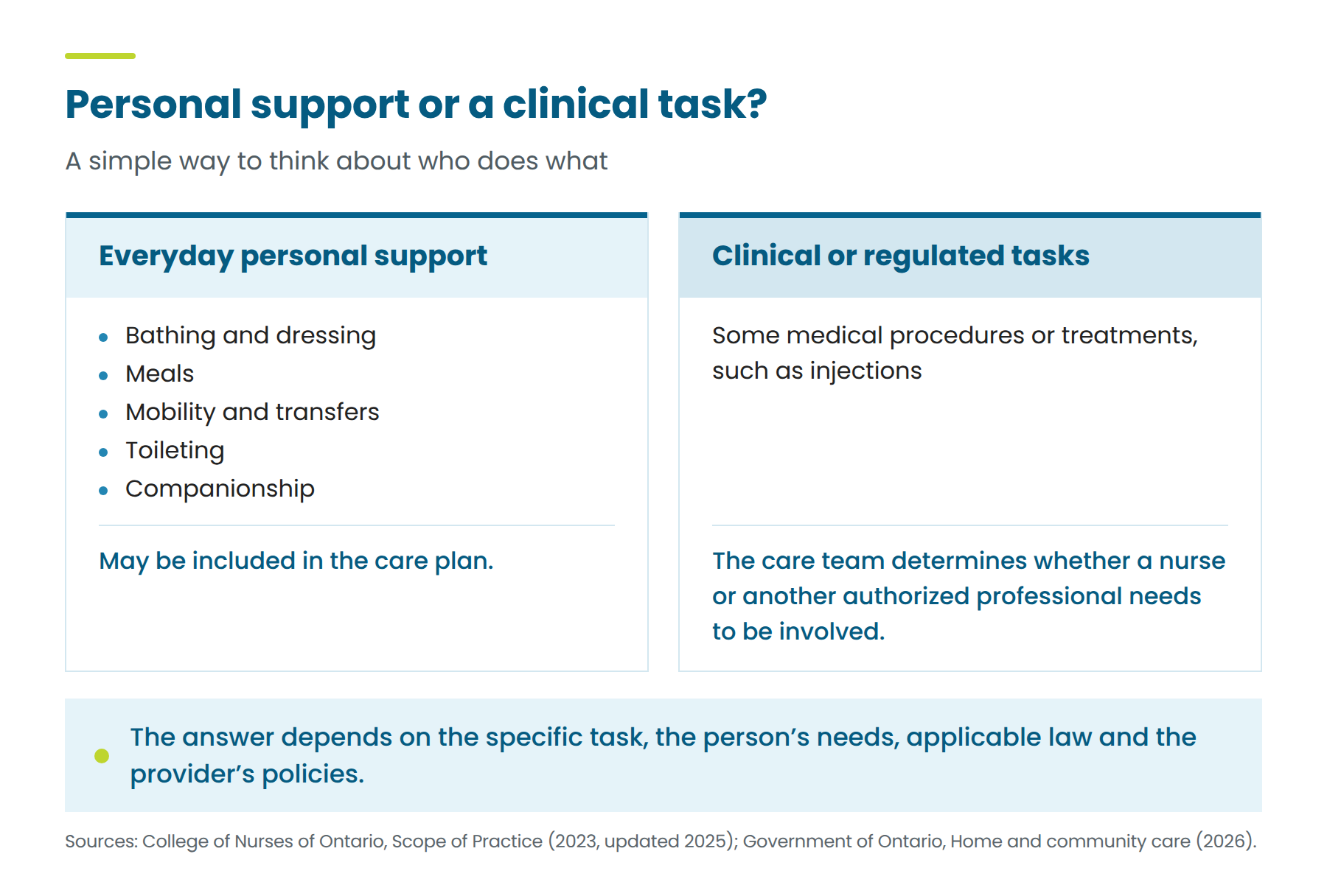
For publicly funded care, Ontario describes personal support as washing and bathing, mouth care, hair care, preventative skin care, routine hand or foot care, getting in and out of chairs, vehicles or beds, dressing and undressing, eating and toileting. Homemaking help, such as housecleaning, laundry, shopping and banking, is treated as a separate service. The province’s own description of the job also includes companionship and building relationships and connections.
Our Interactive Caregiving™ approach means doing things with clients rather than simply for them, so they keep doing the parts of the day they still can.
How PSWs Are Trained in Ontario
Ontario has a provincial program standard for PSW education. Certificate programs are offered through publicly assisted colleges, career colleges, district school boards and Indigenous Institutes, and take about 5 to 8 months. Unlike nurses, PSWs are not a regulated health profession in Ontario, and the College of Nurses of Ontario notes that employers set the role’s scope and training requirements. That makes each employer’s hiring and training standards worth asking about.
What PSW Registration Means Today
Since December 1, 2024, personal support workers have been able to register with the Health and Supportive Care Providers Oversight Authority (HSCPOA), an independent regulatory body accountable to the Ontario government. Registration is currently voluntary, and HSCPOA’s public register shows whether a registered PSW is in good standing, along with any disciplinary actions. Because registration is optional, a PSW who is not listed may simply not have registered, and employers can choose whether to require it. The register works best alongside the employer’s own screening and training checks.
What a Home Care Agency Coordinates
A home care agency takes on much of the work a family would otherwise manage itself when it hires privately. What is included differs from one agency to the next, so ask each one to spell it out.
What a Family Takes On When Hiring Directly
If you hire privately, these responsibilities usually fall to your family. This is general information, not legal or tax advice.
- You may be the employer. The Canada Revenue Agency explains that a family hiring a caregiver may be considered the employer. If the worker is an employee, the employer withholds income tax, CPP contributions and EI premiums and reports them on a T4 slip. Employment status depends on all of the facts, rather than on what both sides intend alone.
- Employment standards may apply. If the caregiver is your employee and works in your home directly for your household, Ontario generally treats them as a domestic worker with Employment Standards Act rights, including minimum wage, vacation pay and public holidays.
- Workplace insurance needs a decision. The WSIB says a private individual who directly employs an attendant for personal care is not required to register but may choose to apply for coverage. It helps to decide before care starts how a workplace injury would be handled.
- Screening rests with the family. Under Ontario’s police record check rules, a check needs the person’s knowledge and consent, and the vulnerable sector check is meant for people in a position of trust or authority over vulnerable persons. Families can ask a caregiver to share a recent check, along with references and proof of training.
- Cover and scheduling rest with you. If the PSW is sick or on vacation, the family arranges a replacement.
Table 2. Who handles what when hiring directly, and how we handle it
| Responsibility | Hiring a PSW directly | At Comfort Keepers Brampton |
| Employer and payroll | Possibly your family, depending on the facts | Every caregiver is a Comfort Keepers employee |
| Insurance and workplace coverage | Your family decides whether to apply for optional WSIB coverage and whether other insurance is appropriate | All caregivers are bonded, insured and covered by Workers’ Compensation insurance |
| Screening | Your family | National and local criminal background checks, plus personal and professional reference checks, before caring for a client |
| Care plan | Agreed between your family and the PSW | A confidential Plan of Care, reviewed with the client and family at least every six months, and more often when needs call for it |
| Cover when the caregiver is away | Your family | With a team of caregivers, our coordinator can arrange an interim caregiver, let you know about the change and review the Plan of Care with them |
| Hours | Agreed with the worker | Schedules can range from a few hours a visit to 24-hour care, discussed at your consultation |
How Care Coordination Works at Comfort Keepers Brampton
With our Brampton team, it starts with a complimentary in-home care consultation. We listen to what has changed, what the person wants to keep doing and what your family is managing now. Our Client Care Coordinator then documents the support needed and the person’s preferences for a caregiver match, and arranges an introduction between the client, the caregiver and the coordinator, where everyone reviews the Plan of Care together. Our Care Services FAQs explain how we handle screening, caregiver matching and backup caregivers.
Questions to Ask Before Choosing
The most useful questions cover who employs and screens the caregiver, who owns the care plan, and what happens when the usual caregiver cannot come.
About the Caregiver
- What training does the caregiver have, including any PSW certificate, and what ongoing training does the employer provide?
- How does the employer verify training and screening? (HSCPOA registration is optional, so ask what else is checked.)
- What background and reference checks are completed before a caregiver starts?
- Has the caregiver supported someone with similar needs, such as dementia or mobility changes?
About Employment, Insurance and Payroll
- Who is the caregiver’s legal employer?
- If it is our family, who handles payroll deductions and T4 slips?
- Is there WSIB or other workplace insurance coverage, and who holds it?
- Is the caregiver bonded and insured?
- What will our invoices or receipts show?
About the Care Plan and Continuity
- Who writes the care plan, and how often is it reviewed?
- Who do we call when something changes, including evenings and weekends?
- What happens if the regular caregiver is sick or on vacation?
- How are caregivers, including replacement caregivers, introduced?
- How are changes in health or behaviour reported to the family?
- Who decides whether a task needs a nurse?
When Nursing Is Different
Some care needs go beyond personal support. Nurses are regulated health professionals, and certain clinical procedures are controlled acts under Ontario law, so the care team decides when a nurse or another authorized professional should be involved.
H3: Protected Titles and How to Check a Nurse
Nursing titles are protected in Ontario. For nurses registered with the College of Nurses of Ontario, families can verify registration through the College’s public register, Find a Nurse. Nurses already registered and in good standing elsewhere in Canada can use the College’s automatic recognition process to register in Ontario. Separately, eligible nurses registered in good standing in a U.S. jurisdiction may practise temporarily in Ontario under As of Right rules for up to six months while the College reviews their registration.
How the Care Team Decides Who Does a Task
Some procedures, such as injections, are controlled acts that may be performed only by authorized regulated health professionals, with exceptions set out in the law. A PSW can perform one only through an exception, such as a routine and predictable activity of living, or when an authorized professional delegates it. A nurse can also teach a caregiver a procedure for a particular client.
There is no single province-wide list of PSW tasks. The answer depends on the specific task, the person’s needs, applicable law and the provider’s policies, and those decisions belong with the person’s health care team. This section is general information, not medical advice.
If nursing may be part of the plan, you can learn about in-home nursing care in Brampton and talk with our team about whether nursing fits your family’s plan.
Choosing Next Steps

A good first step is to look at what the person needs each day and which tasks might need a nurse, then compare providers using the questions above.
Note the parts of the day that feel hardest right now (mornings and bathing, meals, evenings, appointments) and any tasks the doctor or hospital has described as clinical. Bring that list to every provider you speak with, including us.
When you are ready, our team is here to talk through what has changed and what level of home care in Brampton may fit, at your family’s pace.
- Talk with Comfort Keepers Brampton about your care needs: call (905) 671-4004 or contact our Brampton office.
- Explore in-home nursing services if clinical care may be part of the picture.
Comfort Keepers Home Care Brampton, 5 Brisdale Drive, Suite 202, Brampton, ON L7A 0S9
About the Author
This article was written by the Comfort Keepers Canada Editorial Team, which prepares family guidance on home care using current official Canadian and Ontario sources. Brenda Rosati is the Director of Operations and Owner of Comfort Keepers Brampton, where she leads the local team that supports seniors and their families across Brampton and reviews the office’s care information for local accuracy. Learn more about Comfort Keepers Brampton.
References
Frequently Asked Questions
Do We Need a Doctor’s Referral to Get PSW Support?
Not for private care, since families can contact a home care provider directly. For publicly funded care, anyone can refer a person to Ontario Health atHome, including family members and friends. A valid OHIP card makes a person eligible for an assessment by a care coordinator, who then determines eligibility for services.
Can Publicly Funded Home Care and Private Care Be Used Together?
Ontario notes that you can also pay for your own care through private companies. If you use private care as well as publicly funded services, tell your care coordinator and share schedules and care plan details with each provider so visits cover different parts of the day or week rather than overlapping.
Can Private Home Care Costs Count as a Medical Expense?
Sometimes. The CRA’s medical expenses guide (RC4065) allows certain attendant care costs, with conditions. The attendant cannot be the person’s spouse or common-law partner and must be 18 or older, receipts must show who was paid (including the social insurance number when the payee is an individual), and some attendant care claims need an approved Form T2201 or a medical practitioner’s written certification. Eligibility depends on individual circumstances, so keep detailed receipts and confirm with the CRA or a tax professional. This is general information, not tax advice.