



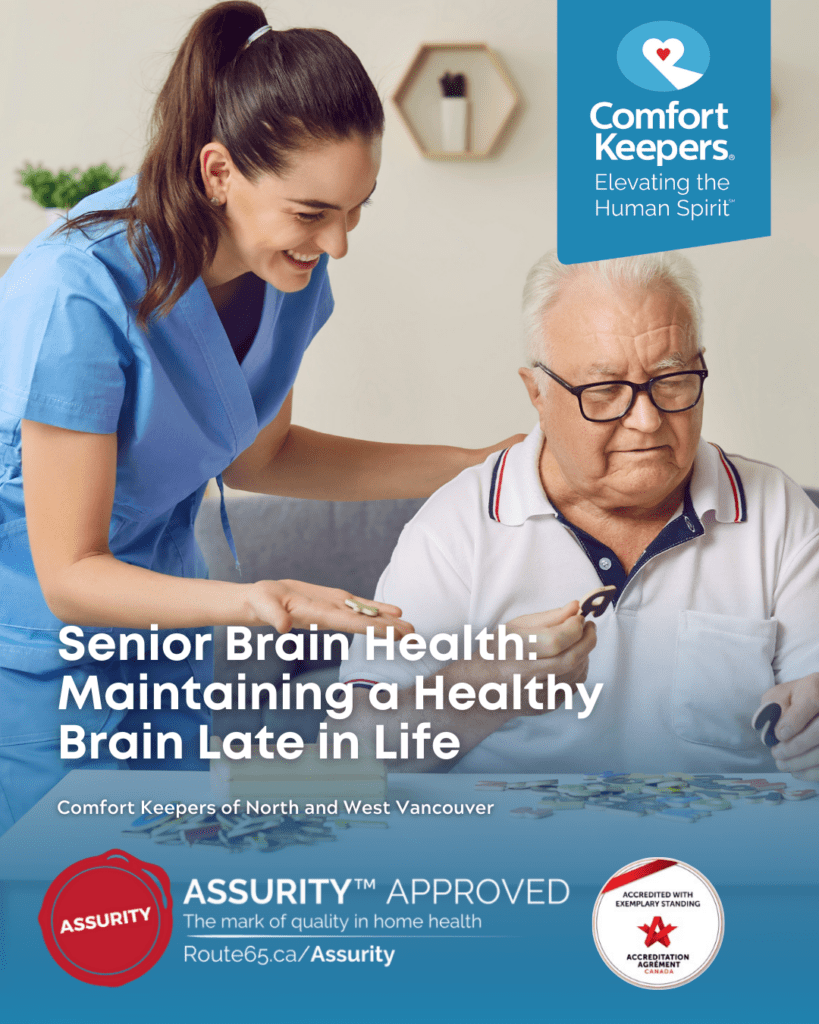
What Every Senior in North Vancouver and West Vancouver Needs to Know About Maintaining Optimal Brain Health
Senior Brain Health | When exploring the brain, with each breakthrough the scientific community makes, new unprecedented questions arise. This allows research to become more focused, it also illuminates that the brain is vastly and endlessly complex.
Senior Brain Health FAST FACT: Although the human brain represents only two percent of the body’s weight, it receives nearly a quarter of its total blood supply.
Despite all the brain’s mysteries, like all our organs, it inevitably ages. The brain’s overall volume slowly shrinks—about 5% per decade after age 40—leading to a loss of some neural connections. This can impact the reduced blood flow and certain cardiovascular conditions.
For seniors, these factors may lead to occasional forgetfulness or memory lapses. Significant memory loss, however, is not normal aging and may indicate Alzheimer’s disease or Dementia.
If your aging loved ones are experiencing memory loss or problems with language skills, perception, or other mental functions, you must address these concerns with a physician.
Senior Brain Health: Four Ways to Keep the Senior Brain Healthy with Optimal Function
Research indicates there are several ways seniors can help reduce the risk of cognitive decline – many of which are beneficial for other aspects of the body. Encourage your aging loved ones to incorporate the following best practices. Be sure that, before beginning any new exercise regimen or diet, your loved ones consult with a physician and dietician.
#1. Stimulation:
In the last few years, there have been numerous research studies in the area of neurological plasticity, which refers to the brain’s ability to modify in response to new experiences. This “re-wiring” of nerve cells is what is at the center of most cognitive and physical rehabilitation practices.
However, it essentially serves the same function for those looking to keep their brains healthy, and it can be done simply by learning new skills or keeping the brain regularly “exercised” through puzzles or games.
Many suggest that seniors enroll in a class or other form of organized learning. This can help develop new skills but also cultivate socialization.
#2. Exercise Regularly:
While it’s not exactly news that exercise is good for the body, it may come as a surprise to some that regular exercise also has quite an impact on mental health. Physical activity improves cardiovascular health, which in turn helps supply the brain with blood.
It also helps in developing new/increasing existing neural connections (see neurological plasticity above), allowing the brain to be more adaptive. Research suggests that regular exercise can also significantly reduce mental stress.
Some seniors may join a class with close friends for exercise, but it can be done at home. The key is to ensure that the heart rate is elevated through moderate activity, for at least 20-30 minutes each day.
#3. Watch Your Diet:
The food we consume has a direct effect on our mental wellbeing and health. To operate at its optimum level, the brain requires fuel in the form of vitamins, minerals, and other essential nutrients.
Consider switching your diet if it consists primarily of salt, sugar, fat, and refined/processed foods. Studies show that diets consisting of fruits, vegetables, whole grains, sources of B vitamins, and lean meats can significantly reduce anxiety levels and even the risk of depression.
#4. Stay Social:
Although it’s not entirely understood how socialization bolsters brain health, studies show that a correlation between having strong social connections and longer life expectancy does exist. Interaction with friends, family members, or next-door neighbours reduces cognitive decline and improves overall mental well-being.
This is especially evident in those who volunteer their time to help others. Try reaching out through organizations, community centers, or schools to see how you can help make a positive impact on others – and the health of your brain.

Senior Brain Health: Best Practices for Optimal Brain Function
What unifies all of these best practices for maintaining brain health? The key, as countless scientific studies would suggest, is engagement. In this case, it means getting out and meeting new people versus staying inside and watching TV, choosing to find healthy alternatives to cheap fast food, and finding ways to help not only yourself but those in your community as well.
Comfort Keepers® North and West Vancouver Can Help
If your loved ones are working to improve their mental well-being and want to incorporate the aforementioned best practices into their lifestyle, we can help.
The Best Senior Home Care in North and West Vancouver is Comfort Keepers®
Our senior home care agency offers in-home care focusing on aging in place. Our services include; dementia care, end-of-life care, post-surgery care, and palliative care. Comfort Keepers can assist seniors with living transition services, personal care, companionship care, and more!
Quality and Accredited Elderly Care: Happier, Healthier, and at Home with 24/7 Senior Care Opportunities!
Do you need a home care solution for yourself or a loved one? Have you been thinking about retirement homes and their alternatives as a solution? Comfort Keepers® enables seniors to maintain happy, healthy lives in the comfort of their own homes. In-home care services are available in North Vancouver, West Vancouver, and the surrounding areas.
Comfort Keepers® is a Senior Care Agency That Can Make a Difference with Interactive Caregiving™
Our in-home caregivers ensure our senior clients have the best quality of life. The Interactive Caregiving™ program ensures that a senior’s safety, nutrition, mental well-being, and everyday needs are met. This program brings joy and good health to each client’s home.
Comfort Keepers® North Vancouver and West Vancouver Can Help with In-Home Elderly Care Services!
If you are concerned about the health and well-being of a loved one we can help! Comfort Keepers offers 24-hour care and delivers top-quality and compassionate care for seniors. We are dedicated to safety technology solutions that foster independence and enhance well-being.
Locally Owned and Operated Home Health Care Agency
Our care centers around companionship for seniors. Empathetic care originates from the soul and allows us to meet our client’s requirements. The seasoned in-home caregivers employed by Comfort Keepers are carefully chosen based on their empathetic qualities.
Contact the Comfort Keepers® North Vancouver and West Vancouver office at (604) 998-8806 to learn more about our unique in-home care solutions for seniors.
Comfort Keepers is an Accredited Senior Care Agency in North and West Vancouver, BC
Comfort Keepers® North and West Vancouver accredited with Exemplary Standing with Accreditation Canada. Accreditation is an intensive process in which industry experts examine an organization’s processes, policies, and procedures against quality standards. To achieve accredited status, Comfort Keepers® met or exceeded the rigorous standards for Home Care companies, outlined by Accreditation Canada.
References:
- Harvard Health Publications. “12 Ways to Keep Your Brain Young.” Web. 2006.
- Everyday Health. “How to Stay Sharp As You Age” by Krisha McCoy. Web. 2017.
- Brain Facts. “What We Know – and Don’t Know – About Aging.” Web. 2012.
- National Institute on Aging. “The Aging Brain.” Web. 2017.
Tips for Seniors: How to Stay Sharp as You Age


What Every Senior in North Vancouver and West Vancouver Needs to Know About Staying Sharp with Age
Tips to Stay Sharp as You Age | One of the greatest fears many people have of growing older is losing their mental acuity. While there are some diseases and conditions of the brain over which we have no control, there are some that are preventable with certain lifestyle changes.
The good news is that these changes can be implemented no matter what the person’s age is. Researchers have identified several characteristics that seem to help keep people mentally sharp well into their senior years.
Senior Care Agency Tips to Stay Sharp as You Age
1. Stay sharp while learning & mentally exercising:
While there is some debate as to whether doing puzzles and other mind games has any significant impact on staving off cognitive decline, there is strong evidence that learning for the long term keeps the brain elastic. Research has shown that the process of learning helps keep the brain sharp when that which is learned is retained, or remembered. In other words, by this definition, learning is the process of memorization.
Thus, learning something for the short term, such as following a recipe, then forgetting it later, does not have any lasting impact. However, learning how to play an instrument or fix a car, and perhaps even teaching others, requires memorization and strengthens the brain’s circuits.
2. Stay sharp with more years of formal education:
People who have more years of formal education face a reduced risk of cognitive decline than those with fewer years of formal schooling. Formal education works the brain through the learning process and creates stronger connections in the brain circuit. This can help compensate as the brain changes with age.
Additionally, those with greater formal education tend to have lifestyles that are healthier for the brain in general. For seniors who never had the chance to continue their formal education, retirement may just be the opportune time to do so. Many colleges and universities offer courses at low cost or for free to seniors.
3. Stay sharp by interacting socially:
Seniors who interact regularly with friends, family, and community are less likely to experience cognitive decline and can experience a better sense of overall well-being. This may be due to the fact that social engagement allows people to deal with stress more productively and seniors who are more socially engaged tend to be more physically active.
Seniors who are unable to drive can enlist the help of family and friends to get to social engagements or seek the assistance of professional caregivers. Professional caregivers can help seniors get to events and engagements when family and friends are unavailable.
4. Stay sharp with physical activity:
You have heard the experts tout exercise as a remedy for most of what ails the general populace today, and it turns out that exercise is also a great way to help keep the mind sharp. Seniors who have not been physically active should consult with a physician before beginning an exercise program.
5. Stay sharp with good nutrition:
Certain forms of dementia, such as some types of Alzheimer’s disease, can be averted, or at least the risk can be significantly decreased, with a diet that is made up primarily of vegetables, legumes, fish, and whole grains. Before making changes to diet, though, it is important that seniors first discuss any changes with their doctors.
Seniors who need help with some daily activities, such as cooking, can seek the help of professional caregivers. Professional caregivers can help seniors with meal preparations and help them adhere to doctor-prescribed diets.
6. Stay sharp with self-efficacy or believing in one’s abilities:
Scientists are not sure why self-efficacy seems to ward off mental decline, but it may have to do with the person’s ability to manage stress. People who believe in their ability to tackle problems have a more positive outlook and can more quickly bounce back from setbacks. This helps them to become more deeply involved in activities and maintain interest in what they are doing, which in turn challenges the brain.
While some changes in the brain are normal as people age, those changes do not always have to have a strong impact on seniors’ lives. Many seniors are as sharp, or sharper than many young adults in their 20s. Taking an active role in engaging the mind can help seniors reduce their risk of brain diseases, such as dementia, and live fulfilling lives as strong contributors to their communities. To learn how professional caregiving can help seniors stay active, social, and engaged, contact your local Comfort Keepers® office today.

The Best Senior Home Care in North and West Vancouver is Comfort Keepers®
Our senior home care agency offers in-home care focusing on aging in place. Our services include dementia care, end-of-life care, post-surgery care, and palliative care. Comfort Keepers can assist seniors with living transition services, personal care, companionship care, and more!
Quality and Accredited Elderly Care: Happier, Healthier, and at Home with 24/7 Senior Care Opportunities!
Do you need a home care solution for yourself or a loved one? Have you been thinking about retirement homes and their alternatives as a solution? Comfort Keepers® enables seniors to maintain happy, healthy lives in the comfort of their own homes. In-home care services are available in North Vancouver, West Vancouver, and the surrounding areas.
Comfort Keepers® is a Senior Care Agency That Can Make a Difference with Interactive Caregiving™
Our in-home caregivers ensure our senior clients have the best quality of life. The Interactive Caregiving™ program ensures that a senior’s safety, nutrition, mental well-being, and everyday needs are met. This program brings joy and good health to each client’s home.
Comfort Keepers® North Vancouver and West Vancouver Can Help with In-Home Elderly Care Services!
If you are concerned about the health and well-being of a loved one we can help! Comfort Keepers offers 24-hour care and delivers top-quality and compassionate care for seniors. We are dedicated to safety technology solutions that foster independence and enhance well-being.
Locally Owned and Operated Home Health Care Agency
Our care centers around companionship for seniors. Empathetic care originates from the soul and allows us to meet our client’s requirements. The seasoned in-home caregivers employed by Comfort Keepers are carefully chosen based on their empathetic qualities.
Contact the Comfort Keepers® North Vancouver and West Vancouver office at (604) 998-8806 to learn more about our unique in-home care solutions for seniors.
Comfort Keepers is an Accredited Senior Care Agency in North and West Vancouver, BC
Accreditation is a rigorous process that involves industry experts evaluating an organization’s processes, policies, and procedures. Comfort Keepers® North and West Vancouver has been awarded Exemplary Standing by Accreditation Canada. This achievement recognizes that Comfort Keepers® meets or exceeds the stringent quality standards for Home Care companies established by Accreditation Canada.
References
Bergland, C. (April 9, 2014). Physical activity improves cognitive function. Psychology Today. Retrieved from https://www.psychologytoday.com/blog/the-athletes-way/201404/physical-activity-improves-cognitive-function.
Cherry, K. (n.d.). What is self-efficacy? About Education. Retrieved from http://psychology.about.com/od/theoriesofpersonality/a/self_efficacy.htm.
LaPonsie, M. (May 15, 2015). 5 Secrets to staying sharp as you age. U.S. News & World Report. Retrieved from http://money.usnews.com/money/retirement/articles/2015/05/15/5-secrets-to-staying-sharp-as-you-age.
NRTA and the Dana Alliance for Brain Initiatives. (2011). Staying sharp: Learning as we age. Retrieved from http://www.dana.org/uploadedFiles/The_Dana_Alliances/Staying_Sharp/Staying%20Sharp%20Learning%20as%20We%20Age.pdf.