


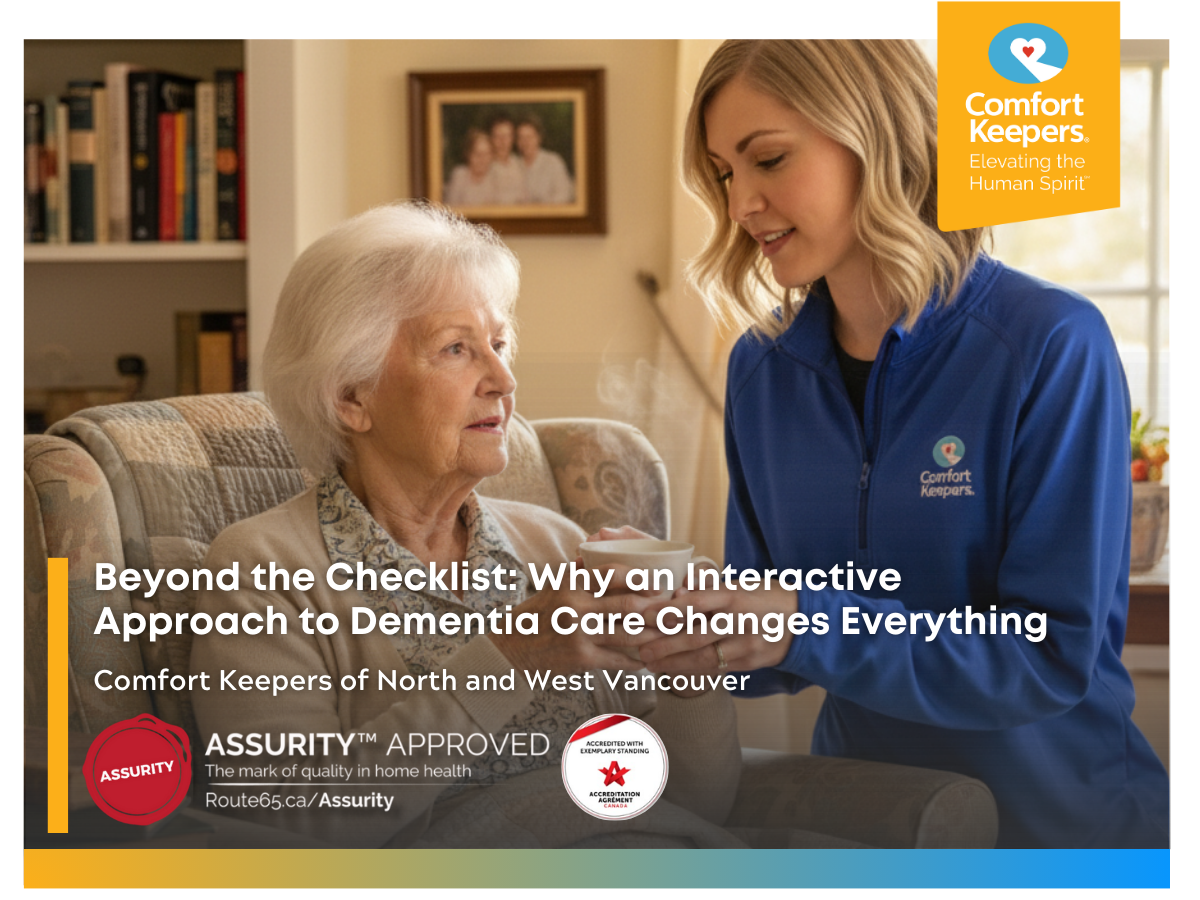
You’ve likely read a dozen articles listing activities for seniors with dementia. You’ve bookmarked ideas for puzzles, music, and memory games. Yet, a nagging feeling remains: is simply keeping a loved one busy the same as helping them live well?
This is the critical question that many families face when evaluating care options. The search for quality dementia care often gets bogged down in checklists of services, but the most significant factor in your loved one’s well-being isn’t the list of things a caregiver does – it’s the philosophy that guides how they do them.
The truth is, not all care models are created equal. While one approach can lead to passivity and withdrawal, another can unlock moments of joy, connection, and purpose. The difference lies in engagement, and the science is clear: meaningful interaction doesn’t just improve mood; it can fundamentally alter the course of cognitive decline. Research shows that frequent social engagement can delay the onset of dementia by an average of five years and is linked to a 38% reduction in dementia risk.
Understanding this distinction is the first step to making a truly confident decision for your family.
The Two Paths of Dementia Care: A Framework for Evaluation
When you look closely, most dementia care falls into one of two distinct models. Recognizing them is key to choosing a path that promotes dignity and quality of life.
The Passive Model: Activity-Based Care
This is the traditional, task-oriented approach. It’s driven by a schedule and focuses on completing a list of duties: mealtime, bath time, and activity time. The caregiver “does for” the client, often with the best intentions of efficiency and safety.
- Focus: Task completion and supervision.
- Dynamic: The senior is a passive recipient of care.
- Typical Scene: A caregiver prepares lunch and serves it while the senior watches television. The task is done, but an opportunity for connection is lost.
- Outcome: While physical needs are met, this model can inadvertently lead to feelings of loneliness, helplessness, and a faster decline in cognitive and physical abilities.
The Engaged Model: Person-Centered Care
This modern approach puts the individual first. It’s built on understanding the person’s history, preferences, and remaining abilities. The goal isn’t just to complete tasks, but to use them as opportunities for collaboration and connection. The caregiver “does with” the client.
- Focus: Emotional well-being and relationship building.
- Dynamic: The senior is an active participant in their own life.
- Typical Scene: The caregiver and senior prepare lunch together, perhaps washing vegetables or setting the table, sharing stories along the way.
- Outcome: This model is proven to reduce agitation and depression while improving overall quality of life. It fosters a sense of purpose and preserves independence for as long as possible.
The Gold Standard: Introducing Interactive Caregiving™
At Comfort Keepers North & West Vancouver, we’ve built our entire dementia care program on the engaged model, refining it into a proprietary philosophy we call Interactive Caregiving™. It’s a holistic approach that transforms everyday routines into opportunities to stimulate the mind, body, and spirit.
The core principle is simple but powerful: shared activity is a tool for connection. Whether it’s preparing a meal, folding laundry, or looking through a photo album, our caregivers are trained to turn these moments into meaningful interactions that enrich our clients’ lives. We focus on what they can do, not what they can no longer do.
The Four Pillars of Interactive Caregiving™ in Action
Our philosophy is grounded in four pillars that work together to support a person’s whole health.
1. Mental Stimulation and Cognitive Engagement
An active mind maintains sharper cognitive function. High engagement in cognitive activities is shown to have a strong protective effect, reducing dementia risk with a hazard ratio of 0.58. We go beyond generic puzzles and integrate mental stimulation directly into daily life.
- Instead of just listening to music: We encourage clients to share memories associated with favorite songs or sing along, sparking emotional and cognitive recall.
- Instead of just looking at photos: We use them as conversation starters to discuss family history, past careers, and cherished life events, reinforcing their sense of identity.
- Instead of just reading a book: We might read aloud together from a newspaper and discuss current events or stories, promoting engagement with the world.
2. Physical Activity and Mobility
Physical activity helps maintain strength, balance, and mood. Our approach integrates movement safely and naturally throughout the day.
- Doing with: We invite clients to join in light housekeeping tasks like folding towels or sweeping, which provides a sense of contribution and gentle exercise.
- Getting outdoors: A short walk in the garden or to the mailbox isn’t just exercise; it’s a chance to discuss the changing seasons, see neighbours, and enjoy fresh air.
- Following their lead: If a client enjoys gardening, we’ll help them tend to indoor plants. If they loved to dance, we’ll put on their favourite music.
3. Emotional Support and Dignity
Dementia can be a confusing and frustrating experience. Our caregivers are trained to provide consistent emotional support, build trust, and preserve our clients’ dignity at every turn.
- Effective Communication: We use proven techniques for someone living with dementia, such as maintaining eye contact, speaking clearly, and using non-verbal cues to offer reassurance.
- Validating Feelings: We acknowledge and validate emotions, rather than dismissing or correcting them, which helps reduce anxiety and agitation.
- Promoting Independence: We empower clients by offering choices whenever possible, from what to wear to what to eat, reinforcing their sense of control.
4. Shared Routines and Home Safety
Consistent routines create a predictable and secure environment, which is especially comforting for someone with dementia. We make clients active partners in these daily rhythms.
- Meal Preparation: Helping to plan a menu or wash vegetables provides purpose and stimulates the senses.
- Home Safety: We collaborate on tasks like tidying up pathways, turning it into a shared goal rather than a caregiver’s chore. This fosters a sense of ownership over their environment.
Your Evaluation Checklist: 7 Questions to Ask Any Care Provider
Choosing a care partner is a major decision. Use these questions to look beyond the sales pitch and understand the core philosophy of any provider you consider.
- Can you describe your specific care philosophy for clients with dementia? Is it documented?
- How do you train your caregivers to engage with clients, not just supervise them?
- How do you learn about my loved one’s personal history, hobbies, and preferences to build a care plan?
- Can you provide examples of how you turn daily tasks into interactive moments?
- How do you measure success and quality of life for your clients?
- How do you support a client’s emotional well-being and help manage challenging behaviors like agitation or confusion?
- Is the goal of your care to “do for” my loved one or “do with” them?
Frequently Asked Questions
My loved one is in the later stages of dementia. Can they still benefit from Interactive Caregiving™?
Absolutely. While the activities may be adapted, the philosophy remains the same. Engagement in later stages might focus more on sensory stimulation – the feel of a soft blanket, the sound of a familiar song, the scent of a favorite food, or the comfort of a hand to hold. The goal is always to connect and provide comfort and dignity, regardless of cognitive ability.
How are Comfort Keepers caregivers trained in this specific philosophy?
Every caregiver completes extensive training in our Interactive Caregiving™ methodology, which includes specialized modules on Alzheimer’s and dementia care. This training is ongoing and covers communication techniques, activity planning, and strategies for managing dementia-related behaviors with empathy and respect. It’s a core competency, not an add-on.
What does Interactive Caregiving™ look like on a typical day?
It looks like life, just with gentle support. It might start with the caregiver and client choosing an outfit for the day together. They might then collaborate on preparing breakfast, chatting while they work. Later, they could spend time looking through a photo album, going for a short walk, or listening to classic radio shows. The day is a fluid blend of meeting essential needs – like personal care and nutrition – and creating moments of connection and joy.
Choosing the right care is about finding a partner who sees the person, not just the diagnosis. It’s about ensuring your loved one feels safe, respected, and connected to the life they’ve lived. The philosophy of care is the foundation for everything else.
To learn more about how our accredited, award-winning approach can make a difference for your family, explore our website and see how we bring Interactive Caregiving™ to life for seniors in North & West Vancouver.
The Best Senior Home Care in North and West Vancouver is Comfort Keepers®
Our senior home care agency offers in-home care focusing on aging in place. Our services include dementia care, end-of-life care, post-surgery care, and palliative care. Comfort Keepers can assist seniors with living transition services, personal care, companionship care, and more!
Quality and Accredited Elderly Care: Happier, Healthier, and at Home with 24/7 Senior Care Opportunities!
Do you need a home care solution for yourself or a loved one? Have you been thinking about retirement homes and their alternatives as a solution? Comfort Keepers® enables seniors to maintain happy, healthy lives in the comfort of their own homes. In-home care services are available in North Vancouver, West Vancouver, and the surrounding areas.
Comfort Keepers® is a Senior Care Agency That Can Make a Difference with Interactive Caregiving™
Our in-home caregivers ensure our senior clients have the best quality of life. The Interactive Caregiving™ program ensures that a senior’s safety, nutrition, mental well-being, and everyday needs are met. This program brings joy and good health to each client’s home.
Comfort Keepers® North Vancouver and West Vancouver Can Help with In-Home Elderly Care Services!
If you are concerned about the health and well-being of a loved one we can help! Comfort Keepers offers 24-hour care and delivers top-quality and compassionate care for seniors. We are dedicated to safety technology solutions that foster independence and enhance well-being.
Locally Owned and Operated Home Health Care Agency
Our care centers around companionship for seniors. Empathetic care originates from the soul and allows us to meet our client’s requirements. The seasoned in-home caregivers employed by Comfort Keepers are carefully chosen based on their empathetic qualities.
Contact the Comfort Keepers® North Vancouver and West Vancouver office at (604) 998-8806 to learn more about our unique in-home care solutions for seniors.
Comfort Keepers is an Accredited Senior Care Agency in North and West Vancouver, BC
Accreditation is a rigorous process that involves industry experts evaluating an organization’s processes, policies, and procedures. Comfort Keepers® North and West Vancouver has been awarded Exemplary Standing by Accreditation Canada. This achievement recognizes that Comfort Keepers® meets or exceeds the stringent quality standards for Home Care companies established by Accreditation Canada.
Senior Brain Health: Maintaining a Healthy Brain Late in Life

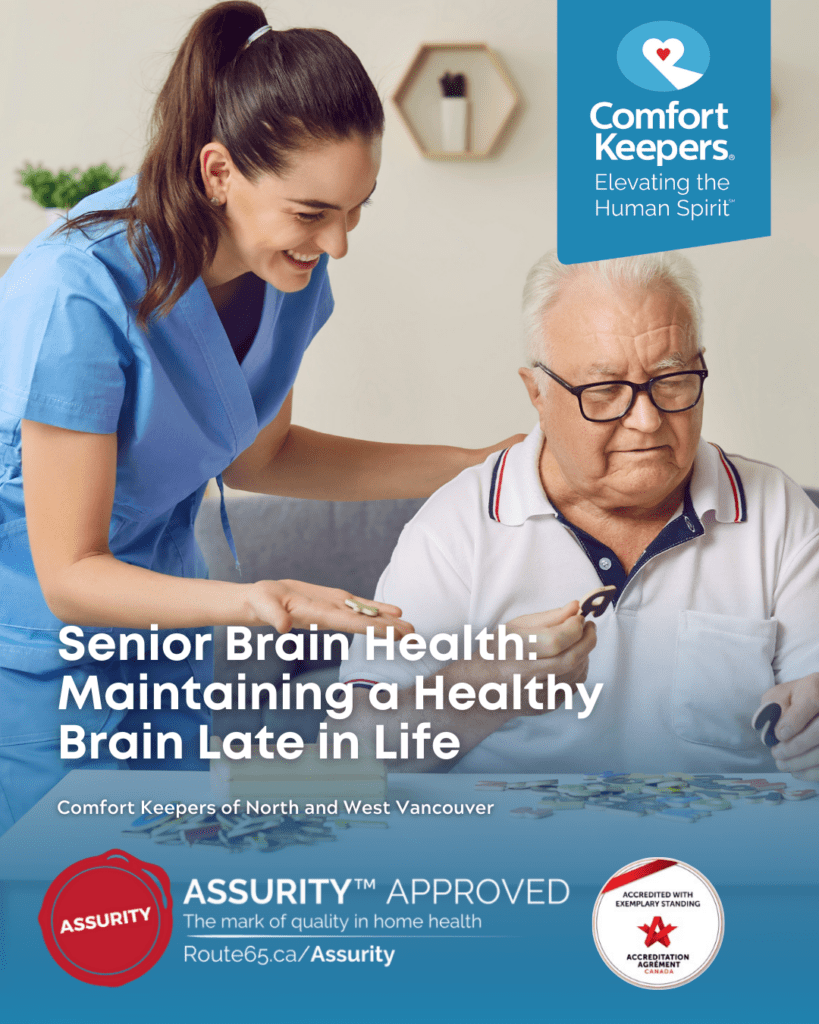
What Every Senior in North Vancouver and West Vancouver Needs to Know About Maintaining Optimal Brain Health
Senior Brain Health | When exploring the brain, with each breakthrough the scientific community makes, new unprecedented questions arise. This allows research to become more focused, it also illuminates that the brain is vastly and endlessly complex.
Senior Brain Health FAST FACT: Although the human brain represents only two percent of the body’s weight, it receives nearly a quarter of its total blood supply.
Despite all the brain’s mysteries, like all our organs, it inevitably ages. The brain’s overall volume slowly shrinks—about 5% per decade after age 40—leading to a loss of some neural connections. This can impact the reduced blood flow and certain cardiovascular conditions.
For seniors, these factors may lead to occasional forgetfulness or memory lapses. Significant memory loss, however, is not normal aging and may indicate Alzheimer’s disease or Dementia.
If your aging loved ones are experiencing memory loss or problems with language skills, perception, or other mental functions, you must address these concerns with a physician.
Senior Brain Health: Four Ways to Keep the Senior Brain Healthy with Optimal Function
Research indicates there are several ways seniors can help reduce the risk of cognitive decline – many of which are beneficial for other aspects of the body. Encourage your aging loved ones to incorporate the following best practices. Be sure that, before beginning any new exercise regimen or diet, your loved ones consult with a physician and dietician.
#1. Stimulation:
In the last few years, there have been numerous research studies in the area of neurological plasticity, which refers to the brain’s ability to modify in response to new experiences. This “re-wiring” of nerve cells is what is at the center of most cognitive and physical rehabilitation practices.
However, it essentially serves the same function for those looking to keep their brains healthy, and it can be done simply by learning new skills or keeping the brain regularly “exercised” through puzzles or games.
Many suggest that seniors enroll in a class or other form of organized learning. This can help develop new skills but also cultivate socialization.
#2. Exercise Regularly:
While it’s not exactly news that exercise is good for the body, it may come as a surprise to some that regular exercise also has quite an impact on mental health. Physical activity improves cardiovascular health, which in turn helps supply the brain with blood.
It also helps in developing new/increasing existing neural connections (see neurological plasticity above), allowing the brain to be more adaptive. Research suggests that regular exercise can also significantly reduce mental stress.
Some seniors may join a class with close friends for exercise, but it can be done at home. The key is to ensure that the heart rate is elevated through moderate activity, for at least 20-30 minutes each day.
#3. Watch Your Diet:
The food we consume has a direct effect on our mental wellbeing and health. To operate at its optimum level, the brain requires fuel in the form of vitamins, minerals, and other essential nutrients.
Consider switching your diet if it consists primarily of salt, sugar, fat, and refined/processed foods. Studies show that diets consisting of fruits, vegetables, whole grains, sources of B vitamins, and lean meats can significantly reduce anxiety levels and even the risk of depression.
#4. Stay Social:
Although it’s not entirely understood how socialization bolsters brain health, studies show that a correlation between having strong social connections and longer life expectancy does exist. Interaction with friends, family members, or next-door neighbours reduces cognitive decline and improves overall mental well-being.
This is especially evident in those who volunteer their time to help others. Try reaching out through organizations, community centers, or schools to see how you can help make a positive impact on others – and the health of your brain.

Senior Brain Health: Best Practices for Optimal Brain Function
What unifies all of these best practices for maintaining brain health? The key, as countless scientific studies would suggest, is engagement. In this case, it means getting out and meeting new people versus staying inside and watching TV, choosing to find healthy alternatives to cheap fast food, and finding ways to help not only yourself but those in your community as well.
Comfort Keepers® North and West Vancouver Can Help
If your loved ones are working to improve their mental well-being and want to incorporate the aforementioned best practices into their lifestyle, we can help.
The Best Senior Home Care in North and West Vancouver is Comfort Keepers®
Our senior home care agency offers in-home care focusing on aging in place. Our services include; dementia care, end-of-life care, post-surgery care, and palliative care. Comfort Keepers can assist seniors with living transition services, personal care, companionship care, and more!
Quality and Accredited Elderly Care: Happier, Healthier, and at Home with 24/7 Senior Care Opportunities!
Do you need a home care solution for yourself or a loved one? Have you been thinking about retirement homes and their alternatives as a solution? Comfort Keepers® enables seniors to maintain happy, healthy lives in the comfort of their own homes. In-home care services are available in North Vancouver, West Vancouver, and the surrounding areas.
Comfort Keepers® is a Senior Care Agency That Can Make a Difference with Interactive Caregiving™
Our in-home caregivers ensure our senior clients have the best quality of life. The Interactive Caregiving™ program ensures that a senior’s safety, nutrition, mental well-being, and everyday needs are met. This program brings joy and good health to each client’s home.
Comfort Keepers® North Vancouver and West Vancouver Can Help with In-Home Elderly Care Services!
If you are concerned about the health and well-being of a loved one we can help! Comfort Keepers offers 24-hour care and delivers top-quality and compassionate care for seniors. We are dedicated to safety technology solutions that foster independence and enhance well-being.
Locally Owned and Operated Home Health Care Agency
Our care centers around companionship for seniors. Empathetic care originates from the soul and allows us to meet our client’s requirements. The seasoned in-home caregivers employed by Comfort Keepers are carefully chosen based on their empathetic qualities.
Contact the Comfort Keepers® North Vancouver and West Vancouver office at (604) 998-8806 to learn more about our unique in-home care solutions for seniors.
Comfort Keepers is an Accredited Senior Care Agency in North and West Vancouver, BC
Comfort Keepers® North and West Vancouver accredited with Exemplary Standing with Accreditation Canada. Accreditation is an intensive process in which industry experts examine an organization’s processes, policies, and procedures against quality standards. To achieve accredited status, Comfort Keepers® met or exceeded the rigorous standards for Home Care companies, outlined by Accreditation Canada.
References:
- Harvard Health Publications. “12 Ways to Keep Your Brain Young.” Web. 2006.
- Everyday Health. “How to Stay Sharp As You Age” by Krisha McCoy. Web. 2017.
- Brain Facts. “What We Know – and Don’t Know – About Aging.” Web. 2012.
- National Institute on Aging. “The Aging Brain.” Web. 2017.