




Vitamin D Deficiency and its Effects
Vitamin D Deficiency and its Effects – Aging brings about symptoms one may never have experienced in his or her younger years: fatigue, general muscle pain and weakness, joint pain, poor concentration, restless sleep – the list goes on. These symptoms may be the result of normal wear and tear on the body over the years. They are also symptoms of vitamin D deficiency, a potentially serious condition that has gotten more attention over the years, especially in the senior population. It is estimated that more than 40% of seniors do not have enough vitamin D in their systems.
DID YOU KNOW?
It is estimated that more than 40% of seniors do not have enough vitamin D in their systems.
Vitamin D is more than sunlight
Vitamin D was once believed to only help strengthen bones and teeth. However, recent advances in science show that vitamin D plays an important role in the proper functioning of the body and can help prevent many diseases and conditions. Vitamin D is found in small amounts of food, such as fatty fish and fortified dairy products, juices and cereals. However, 80-90 percent of vitamin D is obtained by exposure to sunlight.
Researchers have found several factors that put seniors at greater risk for vitamin D deficiency than other age groups. Seniors who are either unable or do not otherwise leave their homes do not receive the benefits of the sun’s rays. Active seniors must bear in mind the changes in the skin due to aging decrease the skin’s ability to synthesize sunlight into vitamin D. Also, kidney function decreases with age, which inhibits the body’s ability to properly process the vitamin.
Vitamin D deficiencies can be dangerous
Studies have found that vitamin D deficiency may contribute to osteoporosis, muscle weakness, hip fractures, diabetes, cancer, heart disease, arthritis and poor general health. The New England Journal of Medicine recently studied vitamin D and how it prevents fractures in seniors. While the recommended dosage of vitamin D varies from person to person, the study showed that it takes a daily dose of at least 800 international units (IU) of vitamin D to consistently prevent broken bones. This dosage reduced the risk of hip fractures by 30 percent and other breaks by 14 percent. The study also demonstrated that too much calcium, more than 1,000 mg per day, may dilute vitamin D’s benefits to bones.
The symptoms of vitamin D deficiency are often subtle and a doctor should always be consulted before treatment is considered.
Related Article: How Seniors Can Enhance Mental Health
A list of Vitamin D deficiency and symptoms that seniors may experience:
- Fatigue
- General muscle pain and weakness
- Muscle cramps
- Joint pain
- Chronic pain
- Weight gain
- High blood pressure
- Restless sleep
- Poor concentration
- Headaches
- Bladder problems
- Constipation or diarrhea
Those caring for seniors who notice these symptoms should advise a trip to the doctor.
The following tips can help seniors increase their Vitamin D intake:
- Researchers suggest 10 minutes of uncovered sun exposure three times a week, without the use of sunscreen.
- Supplements, such as a multivitamin, may help if approved by a physician.
- Help the senior in your life choose foods that are high in vitamin D such as cod liver oil, salmon, mackerel, tuna, beef liver, cheese, and egg yolks.
- Help the senior find foods fortified with vitamin D. These foods include milk, breakfast cereals, and juice drinks. While the daily diet may not provide the daily amount of vitamin D required, studies show that these foods can increase vitamin D levels in the body.
Always ensure the senior you care for consults a health care provider before considering any of these suggestions
The Best Senior Home Care in North and West Vancouver is Comfort Keepers®
Our senior home care agency offers in-home care focusing on aging in place. Our services include dementia care, end-of-life care, post-surgery care, and palliative care. Comfort Keepers can assist seniors with living transition services, personal care, companionship care, and more!
Quality and Accredited Elderly Care: Happier, Healthier, and at Home with 24/7 Senior Care Opportunities!
Do you need a home care solution for yourself or a loved one? Have you been thinking about retirement homes and their alternatives as a solution? Comfort Keepers® enables seniors to maintain happy, healthy lives in the comfort of their own homes. In-home care services are available in North Vancouver, West Vancouver, and the surrounding areas.
Comfort Keepers® is a Senior Care Agency That Can Make a Difference with Interactive Caregiving™
Our in-home caregivers ensure our senior clients have the best quality of life. The Interactive Caregiving™ program ensures that a senior’s safety, nutrition, mental well-being, and everyday needs are met. This program brings joy and good health to each client’s home.
Comfort Keepers® North Vancouver and West Vancouver Can Help with In-Home Elderly Care Services!
If you are concerned about the health and well-being of a loved one we can help! Comfort Keepers offers 24-hour care and delivers top-quality and compassionate care for seniors. We are dedicated to safety technology solutions that foster independence and enhance well-being.
Locally Owned and Operated Home Health Care Agency
Our care centers around companionship for seniors. Empathetic care originates from the soul and allows us to meet our client’s requirements. The seasoned in-home caregivers employed by Comfort Keepers are carefully chosen based on their empathetic qualities.
Contact the Comfort Keepers® North Vancouver and West Vancouver office at (604) 998-8806 to learn more about our unique in-home care solutions for seniors.
Comfort Keepers is an Accredited Senior Care Agency in North and West Vancouver, BC
Accreditation is a rigorous process that involves industry experts evaluating an organization’s processes, policies, and procedures. Comfort Keepers® North and West Vancouver has been awarded Exemplary Standing by Accreditation Canada. This achievement recognizes that Comfort Keepers® meets or exceeds the stringent quality standards for Home Care companies established by Accreditation Canada.
References:
Age and Aging (2008). Vitamin d deficiency: can old age learn from childhood? Retrieved on December 28, 2012 from http://ageing.oxfordjournals.org/content/37/1/6.full.pdf+html
Emery, Gene (2012). High-dose vitamin d prevents fractures in elderly. Retrieved on December 28, 2012 fromhttp://www.reuters.com/article/2012/07/05/
us-vitamind-idUSBRE86414220120705.
Mosekilde, Leif. Medscape (2005). Vitamin d and the elderly. Retrieved on December 28, 2012 from http://www.medscape.com/viewarticle/500874.
Holick, M.D., PhD, Michael F. The New England Journal of Medicine (2007). Vitamin d deficiency. Retrieved December 28, 2012 from http://www.nejm.org/na102/home/
ACS/publisher/mms/journals/content/nejm/2007/nejm_2007.357.issue-3/nejmra070553/production/nejmra070553.fp.png_v03
WebMD.com. Vitamin d. Retrieved on December 28, 2012 from http://www.webmd.com/vitamins-supplements/ingredientmono-929-vitamin+d.aspx?activeIngredientId=929&activeIngredientName=vitamin+d&source=1.
VitaminDCouncil.org (2012). Vitamin d deficiency: a global epidemic. Retrieved on December 28, 2012 from http://www.vitamindcouncil.org/about-vitamin-d/vitamin-d-deficiency/.
MayoClinic.com. Vitamin d. Retrieved on December 28, 2012 from http://www.mayoclinic.com/health/vitamin-d/NS_patient-vitamind
Jegtvig, Shereen. About.com (2012). Nutrient deficiency: vitamin d. Retrieved on December 28, 2012 from http://nutrition.about.com/od/therapeuticnutrition1/a/Vitamin-D-Deficiency.htm
Vitamin D Council. Vitamin d toxicity. Retrieved on December 29, 2012 from http://www.vitamindcouncil.org/about-vitamin-d/what-is-vitamin-d/vitamin-d-toxicity/
American Journal of Physical Medicine and Rehabilitation. Vitamin d deficiency, implications in the rehabilitation setting. Retrieved on December 29, 2012
Keeping Seniors with Alzheimer’s Safe Room-by-Room

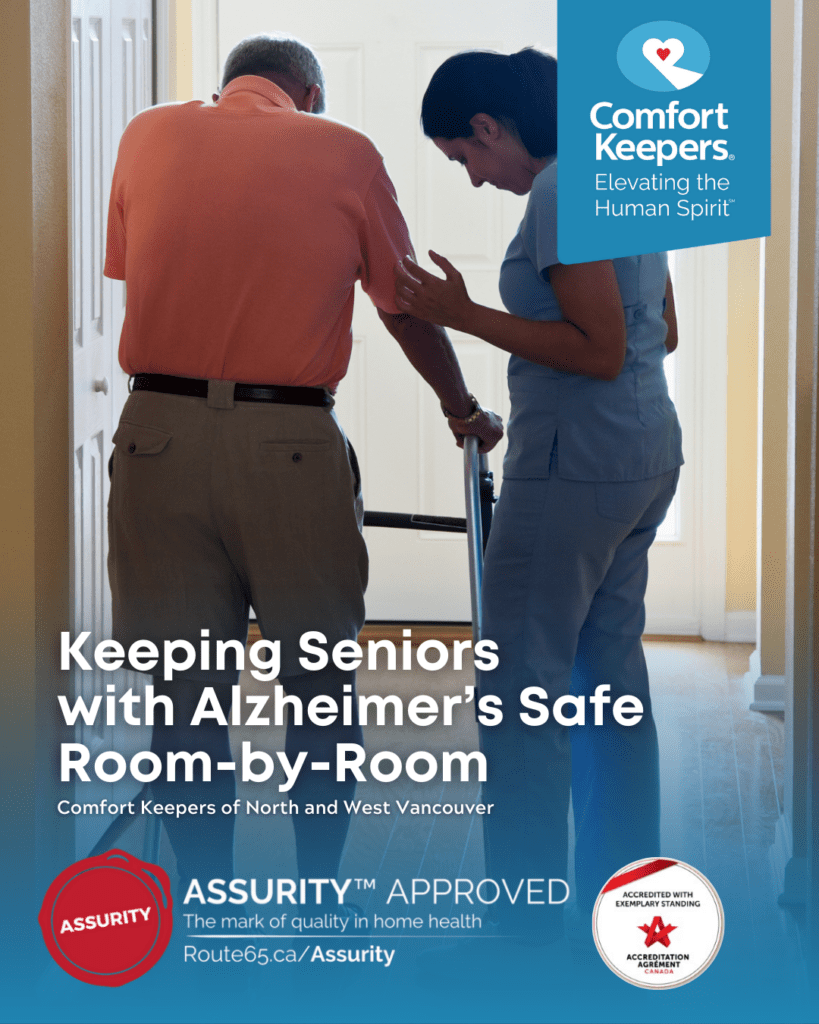
What Every Senior in North Vancouver and West Vancouver Needs to Know About Room Safety and Alzheimer’s Disease
Keeping Seniors with Alzheimer’s Safe Room-by-Room | Ensuring that your senior loved one remains as self-sufficient as possible, and yet safe around the house, requires a delicate balance. For those caring for a person with Alzheimer’s or other forms of dementia, that challenge increases tenfold.
Caregivers providing care for someone with Alzheimer’s must be diligent about identifying potential dangers in the home. Dangers such as throw rugs, inadequate lighting, loose baseboards, and many seemingly innocent household challenges can prove to be catastrophic when caring for someone with Alzheimer’s.
Keeping Alzheimer’s Clients Safe Room-by-Room
It may seem like a daunting task to identify all of the risks in a home and then take corrective action, but it’s easier if you address hazards room by room:
The Bedroom:
One of the most common hazards in the bedroom is inadequate lighting. Bedroom lighting is typically low and soft for comfort. But if something as simple as reaching for the television remote control is no longer an easy thing to do, and your loved one gets up to retrieve the item, you may be risking a preventable fall. While lighting during the night keeps some people awake, a nightlight might be a lifesaver for someone with Alzheimer’s. Also, make sure bed clothing fits appropriately to prevent accidents.
Many caregivers have found creating some kind of communication system such as an intercom or bell can alleviate the risk of accidents.
The Bathroom:
In the early stages of Alzheimer’s, many people can perform basic hygiene, although someone should always remain close. To help preserve your loved one’s independence as long as possible, consider installing these devices:
- Raised toilet seats
- Grab or sidebars on and around the tub and toilet areas
- Non-skid mats in the tub and a safe, non-skid floor surface
Getting in and out of the tub is often quite frightening for those with Alzheimer’s, as well as their caregivers, so consider using a stool or shower chair to reduce the apprehension and fear of falling.
Additional bathroom safety tips include:
-
- Remove items from the shelving.
- Ensure the water temperature on the house meter is no higher than 120 degrees.
The Kitchen:
The kitchen is likely the most dangerous room in the home for anybody, but especially for those with cognitive issues.
Preventing risks in the kitchen starts with a careful evaluation of your loved one’s cognitive abilities. If it is not safe for your loved one to cook without someone supervising, then prepare meals ahead when someone can oversee the process. Keeping someone with cognitive challenges involved in those things he/she has loved doing – like cooking- is a great way to keep someone inspired and feel as though he/she is contributing. But don’t take any unnecessary risks. Cook ahead of time and store meals in microwaveable containers.
Additional Safety Tips for Seniors with Alzheimer’s
If your loved one’s condition worsens, you may have to take greater control by removing metal cans that might accidentally get microwaved, and disabling appliances—not just in the kitchen but throughout the home—when you are not there. Keep surfaces clear of items and appliances such as crockpots and toasters (and hair dryers in the bath).
If your loved one is still relatively self-sufficient in the kitchen, use labels to describe individual items or the contents of drawers and cupboards. To help ease embarrassment during a meal, use brightly colored plates, cups, flatware, and napkins, which are easier to identify. If your loved one is confused about the proper utensils he/she may refuse to eat, and that may be mistaken as a symptom of something else. So make it as easy as possible and be there to lend a helping hand.
Keeping Alzheimer’s Clients Safe Room-by-Room: Identity Zones
This zone concept is presented in an article titled “A Guide to Safe Guarding Your Home For Alzheimer’s Patients,” written by Carole B. Larkin for AlzheimersReadingRoom.com. She recommends first identifying Danger Zones are areas that are completely off-limits to your loved one.
Danger zones include:
- garages
- basements
- attics
- hobby room
- computer rooms
- kitchens (as the disease progresses)
- doorways leading to the outside.
PLEASE NOTE: Take special care addressing safety in these rooms using locks and/or removing all dangerous equipment, chemicals, and other sharp objects.
Keeping Alzheimer’s Clients Safe Room-by-Room: The Zones
Respite Zones represent caregiver sanctuaries. Taking care of someone with Alzheimer’s is mentally and physically exhausting. If you, as a caregiver, don’t take breaks you are putting yourself and your loved one in danger. You need to remain as alert and rested as possible.
Safe Zones represent sanctuaries for your loved one. While it’s advantageous to safe-proof a room whenever possible versus making it off-limits, managing symptoms is easier when those with Alzheimer’s have areas to roam safely. These zones should be kept clear of anything that could agitate your loved one.
Keeping Alzheimer’s Clients Safe Room-by-Room – Tech Devices May Help
Additional items that you might incorporate into your Alzheimer’s safety plan can be found online or in retail stores. These include medic alert systems, sensory alarms, stand-alone and other types of motion sensors, medication alert instruments, and gel-top trays that are restraint-free. Before purchasing these items, ask friends and physicians for advice.
Keeping Alzheimer’s Clients Safe Room-by-Room: One Last Look
Before you consider your safety plan finished, take one last look throughout the house for dangerous items you overlooked.
- Doorways that are located near stairs should be locked.
- Throw rugs should be eliminated or tacked down.
- All medications should be kept in a safe, locked box.
- Any financial information and cheque books should be kept out of reach.

The Best Senior Home Care in North and West Vancouver is Comfort Keepers®
Our senior home care agency offers in-home care focusing on aging in place. Our services include dementia care, end-of-life care, post-surgery care, and palliative care. Comfort Keepers can assist seniors with living transition services, personal care, companionship care, and more!
Quality and Accredited Elderly Care: Happier, Healthier, and at Home with 24/7 Senior Care Opportunities!
Do you need a home care solution for yourself or a loved one? Have you been thinking about retirement homes and their alternatives as a solution? Comfort Keepers® enables seniors to maintain happy, healthy lives in the comfort of their own homes. In-home care services are available in North Vancouver, West Vancouver, and the surrounding areas.
Comfort Keepers® is a Senior Care Agency That Can Make a Difference with Interactive Caregiving™
Our in-home caregivers ensure our senior clients have the best quality of life. The Interactive Caregiving™ program ensures that a senior’s safety, nutrition, mental well-being, and everyday needs are met. This program brings joy and good health to each client’s home.
Comfort Keepers® North Vancouver and West Vancouver Can Help with In-Home Elderly Care Services!
If you are concerned about the health and well-being of a loved one we can help! Comfort Keepers offers 24-hour care and delivers top-quality and compassionate care for seniors. We are dedicated to safety technology solutions that foster independence and enhance well-being.
Locally Owned and Operated Home Health Care Agency
Our care centers around companionship for seniors. Empathetic care originates from the soul and allows us to meet our client’s requirements. The seasoned in-home caregivers employed by Comfort Keepers are carefully chosen based on their empathetic qualities.
Contact the Comfort Keepers® North Vancouver and West Vancouver office at (604) 998-8806 to learn more about our unique in-home care solutions for seniors.
Comfort Keepers is an Accredited Senior Care Agency in North and West Vancouver, BC
Accreditation is a rigorous process that involves industry experts evaluating an organization’s processes, policies, and procedures. Comfort Keepers® North and West Vancouver has been awarded Exemplary Standing by Accreditation Canada. This achievement recognizes that Comfort Keepers® meets or exceeds the stringent quality standards for Home Care companies established by Accreditation Canada.
REFERENCES
www.store.best-alzheimers-products.com
The Alzheimer’s Family Center Inc.
The editors of www.agingcare.com
The editors of www.helpforalzheimersfamilies.com e-Learning Course, Class 5: safety
The MedicAlert Foundation
“A Guide to Safe Guarding Your Home For Alzheimer’s Patients,” by Carole B. Larkin for www.AlzheimersReadingRoom.com