


What Every Family in North Vancouver and West Vancouver Needs to Know About Inclement Weather Safety for Seniors
No matter where your client or loved one lives, bad or unexpected weather is bound to happen. It’s time to talk about Senior Winter Safety!
Here is a quick guide for protecting seniors around their homes ─ and when they are out and about.
Senior Winter Safety Fast Facts: The Red Cross online guide, “Disaster Preparedness For Seniors By Seniors” includes tips and supply checklists.
Senior Winter Safety and Power Outages
Whether it’s a winter storm, during a flood, or hurricane season ─ snow, ice, rain, and wind can cause power outages.
How to prepare a senior for power outages:
#1. Emergency Numbers:
Supply the phone numbers of all utility companies including power, gas, and water. Also include emergency numbers such as the fire department, police, doctor, and home care provider. Quick access to these phone numbers is crucial.
#2. Working Flashlights
Make sure seniors are equipped with working flashlights and a battery-powered radio. Have extra batteries on hand.
#3. Be Prepared:
Seniors should stockpile warm blankets and non-perishable foods, and if it’s cold or damp, wear several layers of clothing, including a hat. Moving around also raises body temperature.
#4. Alert Authorities of Home Medical Devices
Does your senior rely on a home medical device powered by energy? As soon as an essential medical device is put in service in the home, the local electric utility (and sometimes other authorities) should be notified of its existence and need. This can put your loved one on a list for immediate attention during a power outage.
Senior Winter Safety and Carbon Monoxide Poisoning
Burning wood, natural gas, kerosene and other fuels produce carbon monoxide, a deadly gas that no one can see or smell. Unless fireplaces, wood and gas stoves, and gas appliances are properly vented, cleaned, and used, they can leak dangerous amounts of carbon monoxide.
These and other appliances, such as kerosene and electric heaters, can also be fire hazards.
Here are some sound safety measures to prevent carbon monoxide poisoning:
#1. Call an inspector:
Chimneys and flues need to be inspected yearly and cleaned when necessary. (Ask the local fire department to recommend an inspector, or look up “chimney cleaning” for your area.)
#2. Air the room out:
Open a window. Just a crack will do when using a kerosene stove.
#3. Install detectors:
Use carbon monoxide detectors. Put battery-operated carbon monoxide and smoke detectors near fireplaces, wood stoves, or kerosene heaters.
#4. Ensure proper heating appliances:
Never allow someone to heat a home using a gas stove. Charcoal grills or other stoves are not made for home heating.
Senior Winter Safety and Driving Tips
Adults 65 and older are involved in more car accidents per mile driven than those in any other age group.
Because driving can be more hazardous during bad weather, seniors should:
#1. Winter vehicle maintenance:
Have the car weatherized ahead of time. This means having antifreeze, tires, and windshield wipers checked and changed, as needed.
#2. Travel with phone:
Take a cell phone when driving in bad weather. Seniors should always let someone know where they are going and when they expect to arrive, in case a call for help is necessary.
#3. Plan your route:
Avoid wet or icy roadways, overpasses, or bridges, if possible. Check the news (or go online) for road conditions. It may be wise to consider a different route.
#4. Prepare a winter kit for the car:
Stock the car with basic emergency supplies, such as:
- a first aid kit
- blankets
- extra warm clothes
- booster cables
- a good quality windshield scraper
- rock salt, a bag of sand, or cat litter for wheel traction
- containers of water, canned or dried foods, and a can opener
- a flashlight and a shovel
Senior Winter Safety and Slippery Surfaces
Falls are common for senior citizens and can cause major injuries such as hip and wrist fractures, head trauma, and major lacerations. It is easy to slip and fall, especially in wet, icy, and snowy conditions.
Here are some precautions that can be taken:
#1. Shovelling:
Shovel snowy steps and walkways for seniors or hire someone. At home, seniors should stay inside until pathways are shovelled. When away, they should look for sidewalks that are dry and cleared.
#2. Proper footwear:
Seniors should wear boots with non-skid soles to prevent slippage. Have them remove footwear as soon as they return indoors because rain, snow, and ice can be tracked in and lead to slippery conditions inside.
#3. Secure walking aides:
If a senior uses a cane, replace the rubber tip before it is worn smooth. You might also buy (at a medical supply store) an ice pick-like attachment that fits onto the end of the cane.
With a sound plan in place, seniors can be properly prepared for inclement weather.

The Best Senior Home Care in North and West Vancouver is Comfort Keepers®
Our senior home care agency offers in-home care focusing on aging in place. Our services include; dementia care, end-of-life care, post-surgery care, and palliative care. Comfort Keepers can assist seniors with living transition services, personal care, companionship care, and more!
Quality and Accredited Elderly Care: Happier, Healthier, and at Home with 24/7 Senior Care Opportunities!
Do you need a home care solution for yourself or a loved one? Have you been thinking about retirement homes and their alternatives as a solution? Comfort Keepers® enables seniors to maintain happy, healthy lives in the comfort of their own homes. In-home care services are available in North Vancouver, West Vancouver, and the surrounding areas.
Comfort Keepers® is a Senior Care Agency That Can Make a Difference with Interactive Caregiving™
Our in-home caregivers ensure our senior clients have the best quality of life. The Interactive Caregiving™ program ensures that a senior’s safety, nutrition, mental well-being, and everyday needs are met. This program brings joy and good health to each client’s home.
Comfort Keepers® North Vancouver and West Vancouver Can Help with In-Home Elderly Care Services!
If you are concerned about the health and well-being of a loved one we can help! Comfort Keepers offers 24-hour care and delivers top-quality and compassionate care for seniors. We are dedicated to safety technology solutions that foster independence and enhance well-being.
Locally Owned and Operated Home Health Care Agency
Our care centers around companionship for seniors. Empathetic care originates from the soul and allows us to meet our client’s requirements. The seasoned in-home caregivers employed by Comfort Keepers are carefully chosen based on their empathetic qualities.
Contact the Comfort Keepers® North Vancouver and West Vancouver office at (604) 998-8806 to learn more about our unique in-home care solutions for seniors.
Comfort Keepers is an Accredited Senior Care Agency in North and West Vancouver, BC
Comfort Keepers® North and West Vancouver accredited with Exemplary Standing with Accreditation Canada. Accreditation is an intensive process in which industry experts examine an organization’s processes, policies, and procedures against quality standards. To achieve accredited status, Comfort Keepers® met or exceeded the rigorous standards for Home Care companies, outlined by Accreditation Canada.
References:
- American Red Cross. “Disaster Preparedness for Seniors by Seniors”. Web. 2015.
- AgingCare.com. “Little-Known Winter Dangers for Elders”. Web. 2015.
- HealthInAging.org. “Winter Safety Tips for Older Adults”. Web. 2011.
- National Institutes of Health (NIH). “When the Weather Gets Cold”. News in Health. January 2009.
- MedicineNet. “Winter Can Pose Hazards for Seniors, Expert Warns”. Web. 2013.
Keeping Seniors with Alzheimer’s Safe Room-by-Room

What Every Senior in North Vancouver and West Vancouver Needs to Know About Room Safety and Alzheimer’s Disease
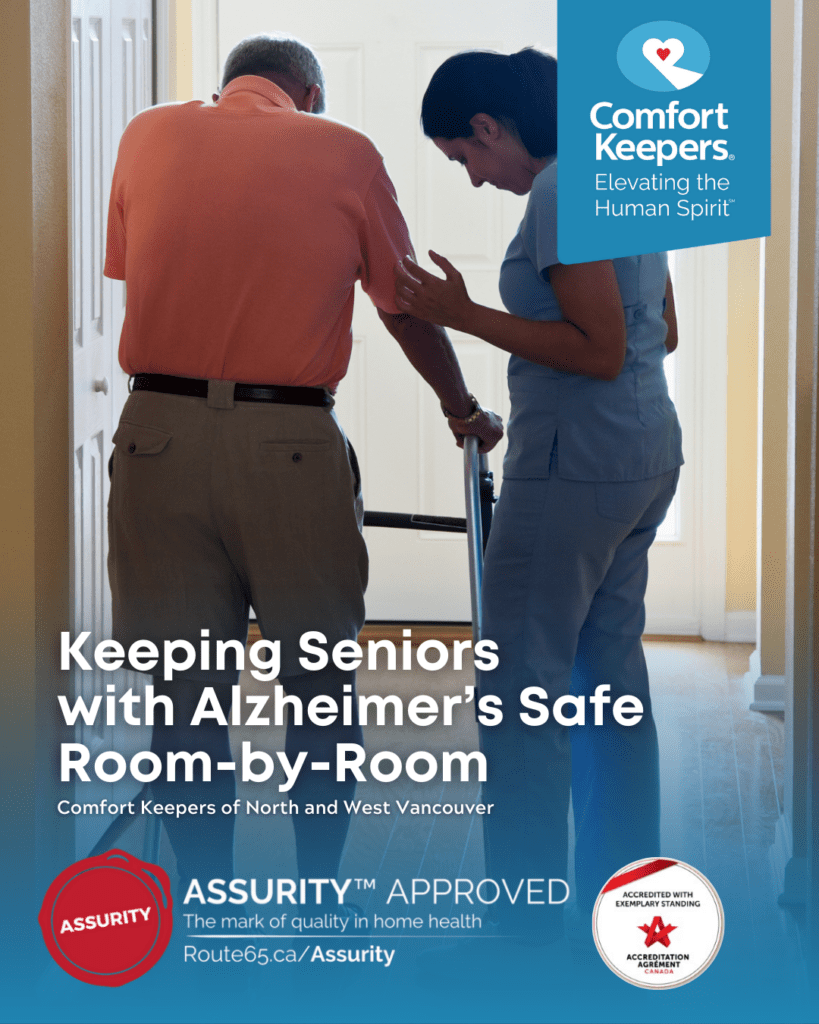
Keeping Seniors with Alzheimer’s Safe Room-by-Room | Ensuring that your senior loved one remains as self-sufficient as possible, and yet safe around the house, requires a delicate balance. For those caring for a person with Alzheimer’s or other forms of dementia, that challenge increases tenfold.
Caregivers providing care for someone with Alzheimer’s must be diligent about identifying potential dangers in the home. Dangers such as throw rugs, inadequate lighting, loose baseboards, and many seemingly innocent household challenges can prove to be catastrophic when caring for someone with Alzheimer’s.
Keeping Alzheimer’s Clients Safe Room-by-Room
It may seem like a daunting task to identify all of the risks in a home and then take corrective action, but it’s easier if you address hazards room by room:
The Bedroom:
One of the most common hazards in the bedroom is inadequate lighting. Bedroom lighting is typically low and soft for comfort. But if something as simple as reaching for the television remote control is no longer an easy thing to do, and your loved one gets up to retrieve the item, you may be risking a preventable fall. While lighting during the night keeps some people awake, a nightlight might be a lifesaver for someone with Alzheimer’s. Also, make sure bed clothing fits appropriately to prevent accidents.
Many caregivers have found creating some kind of communication system such as an intercom or bell can alleviate the risk of accidents.
The Bathroom:
In the early stages of Alzheimer’s, many people can perform basic hygiene, although someone should always remain close. To help preserve your loved one’s independence as long as possible, consider installing these devices:
- Raised toilet seats
- Grab or sidebars on and around the tub and toilet areas
- Non-skid mats in the tub and a safe, non-skid floor surface
Getting in and out of the tub is often quite frightening for those with Alzheimer’s, as well as their caregivers, so consider using a stool or shower chair to reduce the apprehension and fear of falling.
Additional bathroom safety tips include:
-
- Remove items from the shelving.
- Ensure the water temperature on the house meter is no higher than 120 degrees.
The Kitchen:
The kitchen is likely the most dangerous room in the home for anybody, but especially for those with cognitive issues.
Preventing risks in the kitchen starts with a careful evaluation of your loved one’s cognitive abilities. If it is not safe for your loved one to cook without someone supervising, then prepare meals ahead when someone can oversee the process. Keeping someone with cognitive challenges involved in those things he/she has loved doing – like cooking- is a great way to keep someone inspired and feel as though he/she is contributing. But don’t take any unnecessary risks. Cook ahead of time and store meals in microwaveable containers.
Additional Safety Tips for Seniors with Alzheimer’s
If your loved one’s condition worsens, you may have to take greater control by removing metal cans that might accidentally get microwaved, and disabling appliances—not just in the kitchen but throughout the home—when you are not there. Keep surfaces clear of items and appliances such as crockpots and toasters (and hair dryers in the bath).
If your loved one is still relatively self-sufficient in the kitchen, use labels to describe individual items or the contents of drawers and cupboards. To help ease embarrassment during a meal, use brightly colored plates, cups, flatware, and napkins, which are easier to identify. If your loved one is confused about the proper utensils he/she may refuse to eat, and that may be mistaken as a symptom of something else. So make it as easy as possible and be there to lend a helping hand.
Keeping Alzheimer’s Clients Safe Room-by-Room: Identity Zones
This zone concept is presented in an article titled “A Guide to Safe Guarding Your Home For Alzheimer’s Patients,” written by Carole B. Larkin for AlzheimersReadingRoom.com. She recommends first identifying Danger Zones are areas that are completely off-limits to your loved one.
Danger zones include:
- garages
- basements
- attics
- hobby room
- computer rooms
- kitchens (as the disease progresses)
- doorways leading to the outside.
PLEASE NOTE: Take special care addressing safety in these rooms using locks and/or removing all dangerous equipment, chemicals, and other sharp objects.
Keeping Alzheimer’s Clients Safe Room-by-Room: The Zones
Respite Zones represent caregiver sanctuaries. Taking care of someone with Alzheimer’s is mentally and physically exhausting. If you, as a caregiver, don’t take breaks you are putting yourself and your loved one in danger. You need to remain as alert and rested as possible.
Safe Zones represent sanctuaries for your loved one. While it’s advantageous to safe-proof a room whenever possible versus making it off-limits, managing symptoms is easier when those with Alzheimer’s have areas to roam safely. These zones should be kept clear of anything that could agitate your loved one.
Keeping Alzheimer’s Clients Safe Room-by-Room – Tech Devices May Help
Additional items that you might incorporate into your Alzheimer’s safety plan can be found online or in retail stores. These include medic alert systems, sensory alarms, stand-alone and other types of motion sensors, medication alert instruments, and gel-top trays that are restraint-free. Before purchasing these items, ask friends and physicians for advice.
Keeping Alzheimer’s Clients Safe Room-by-Room: One Last Look
Before you consider your safety plan finished, take one last look throughout the house for dangerous items you overlooked.
- Doorways that are located near stairs should be locked.
- Throw rugs should be eliminated or tacked down.
- All medications should be kept in a safe, locked box.
- Any financial information and cheque books should be kept out of reach.

The Best Senior Home Care in North and West Vancouver is Comfort Keepers®
Our senior home care agency offers in-home care focusing on aging in place. Our services include dementia care, end-of-life care, post-surgery care, and palliative care. Comfort Keepers can assist seniors with living transition services, personal care, companionship care, and more!
Quality and Accredited Elderly Care: Happier, Healthier, and at Home with 24/7 Senior Care Opportunities!
Do you need a home care solution for yourself or a loved one? Have you been thinking about retirement homes and their alternatives as a solution? Comfort Keepers® enables seniors to maintain happy, healthy lives in the comfort of their own homes. In-home care services are available in North Vancouver, West Vancouver, and the surrounding areas.
Comfort Keepers® is a Senior Care Agency That Can Make a Difference with Interactive Caregiving™
Our in-home caregivers ensure our senior clients have the best quality of life. The Interactive Caregiving™ program ensures that a senior’s safety, nutrition, mental well-being, and everyday needs are met. This program brings joy and good health to each client’s home.
Comfort Keepers® North Vancouver and West Vancouver Can Help with In-Home Elderly Care Services!
If you are concerned about the health and well-being of a loved one we can help! Comfort Keepers offers 24-hour care and delivers top-quality and compassionate care for seniors. We are dedicated to safety technology solutions that foster independence and enhance well-being.
Locally Owned and Operated Home Health Care Agency
Our care centers around companionship for seniors. Empathetic care originates from the soul and allows us to meet our client’s requirements. The seasoned in-home caregivers employed by Comfort Keepers are carefully chosen based on their empathetic qualities.
Contact the Comfort Keepers® North Vancouver and West Vancouver office at (604) 998-8806 to learn more about our unique in-home care solutions for seniors.
Comfort Keepers is an Accredited Senior Care Agency in North and West Vancouver, BC
Accreditation is a rigorous process that involves industry experts evaluating an organization’s processes, policies, and procedures. Comfort Keepers® North and West Vancouver has been awarded Exemplary Standing by Accreditation Canada. This achievement recognizes that Comfort Keepers® meets or exceeds the stringent quality standards for Home Care companies established by Accreditation Canada.
REFERENCES
www.store.best-alzheimers-products.com
The Alzheimer’s Family Center Inc.
The editors of www.agingcare.com
The editors of www.helpforalzheimersfamilies.com e-Learning Course, Class 5: safety
The MedicAlert Foundation
“A Guide to Safe Guarding Your Home For Alzheimer’s Patients,” by Carole B. Larkin for www.AlzheimersReadingRoom.com