



Beyond the Paycheck: Navigating the Loss of Identity After Retirement
Senior Retirement | February 23, 2026
For decades, work was the North Star of your life. The alarm clock ringing at 6 a.m., the familiar commute, the title on your business card, the rhythm of deadlines and projects. Then, one day, it all stops. The congratulations cards are put away, the farewell cake is a memory, and you wake up to a quiet house with a calendar that is suddenly, shockingly, empty.
You’ve planned your finances for years, but no one handed you a roadmap for this feeling – a sense of being adrift, of not knowing who you are without the job that defined you.
If this sounds familiar, you are not alone. This experience, often called “retirement identity loss,” is a normal and profound part of the transition for millions of people. It’s the unspoken challenge of retirement, and understanding it is the first step toward building a new, vibrant chapter of life.
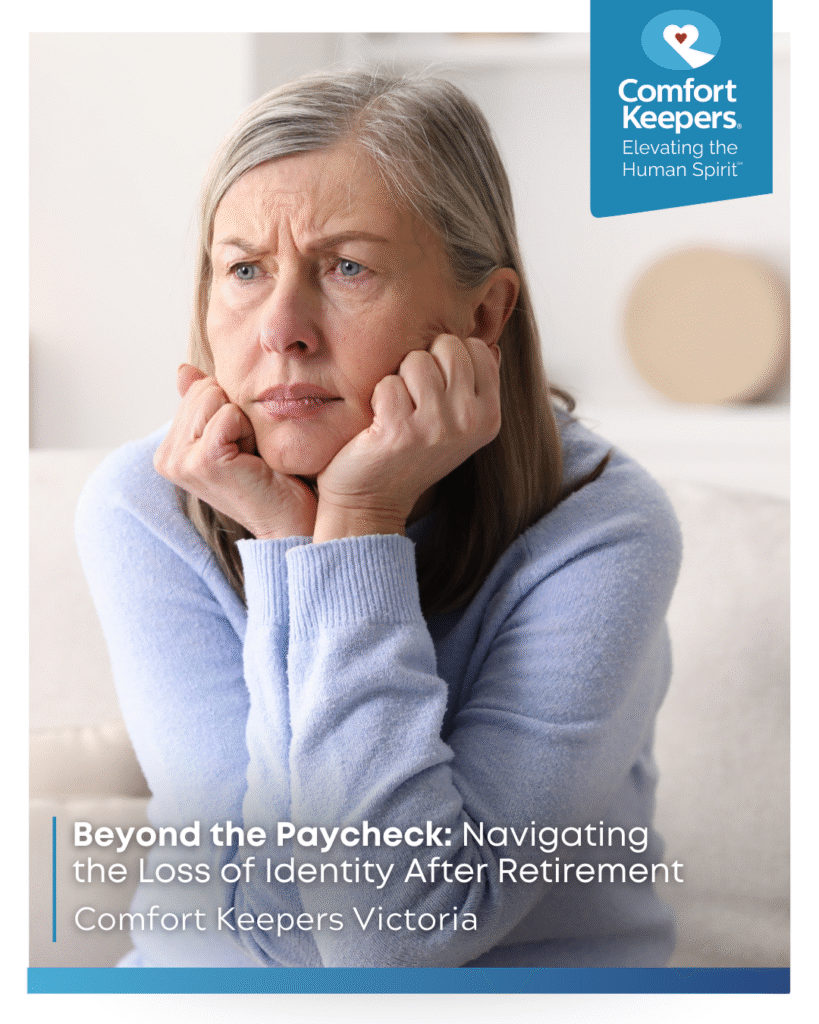
Understanding the “Retirement Identity Crisis”
For many of us, our career is more than just a job; it’s a core part of our identity. When it ends, the emotional impact can be as significant as any other major life change.
What Exactly Is a Loss of Identity in Retirement?
Loss of identity in retirement is the feeling of disorientation and purposelessness that can occur when a person’s professional role, which often shapes their self-concept, social life, and daily routine, comes to an end.
Think of your career as a scaffold. It provided:
- Structure: A reason to get up in the morning and a schedule for your days and weeks.
- Purpose: A clear sense of contribution, of solving problems and achieving goals.
- Social Connection: A built-in community of colleagues, clients, and collaborators.
- Validation: A sense of expertise and respect that came with your role and responsibilities.
When that scaffold is suddenly removed, it’s natural to feel unstable. The challenge isn’t just filling the time; it’s rebuilding your sense of self from the ground up.
Why Your Job Becomes Your Identity (And Why It’s So Hard to Let Go)
In our society, the first question people often ask is, “What do you do?” Our work becomes shorthand for who we are. This connection is deeply rooted in psychology. Social role theory explains that we derive a large part of our self-concept from the roles we play – parent, spouse, and, for many, professional.
Losing that professional role can feel like a part of you has disappeared. This isn’t a sign of weakness; it’s a testament to the dedication and meaning you poured into your career. Acknowledging this loss is the first, most crucial step toward moving through it.
The Emotional Landscape of Your New Chapter
Navigating post-retirement life is an emotional journey with its own unique terrain. Recognizing the path ahead can make the transition feel less daunting and more manageable.
“Retirement Grief”: The 5 Emotional Stages of Leaving Your Career
Have you ever felt that letting go of your career feels a lot like grief? That’s because it is. Applying the classic stages of grief to this transition can be a powerful “aha moment,” validating your feelings and showing you a way forward.
- Denial: “This is great! I have all the freedom in the world.” You might over-schedule yourself or refuse to acknowledge any negative feelings, insisting that everything is perfect.
- Anger: “I’m bored and useless. I worked my whole life for this?” Frustration and resentment can set in as the novelty wears off and the lack of structure becomes apparent.
- Bargaining: “If I just find the perfect hobby, or maybe do some consulting, I’ll feel like myself again.” You might desperately search for a single replacement for the fulfillment your job provided.
- Depression: A sense of deep sadness, lethargy, and hopelessness can emerge. You might withdraw from social activities and question your worth. (It’s vital to distinguish this from clinical depression, which we’ll discuss next.)
- Acceptance: “My career was an important part of my life, but it isn’t the only part.” You begin to explore new interests and build an identity that is separate from your past profession, integrating your experiences into a new way of living.
Understanding these stages helps normalize your experience. You aren’t just “being negative” – you are processing a significant life event.
A Crucial Distinction: Is It Boredom or Depression?
Many retirees struggle with feelings of emptiness, but it’s essential to know the difference between temporary boredom and clinical depression. Boredom is a feeling of dissatisfaction due to a lack of stimulation, while depression is a persistent mood disorder that affects your overall well-being.
| Boredom | Depression |
| You feel restless and uninspired. | You feel a persistent sadness, emptiness, or hopelessness. |
| Your mood lifts when you engage in an interesting activity. | You lose interest in activities you once enjoyed (anhedonia). |
| Your energy levels are generally normal. | You experience significant fatigue and changes in sleep patterns. |
| Your appetite is largely unchanged. | You experience major changes in appetite or weight. |
| You are looking for something to do. | You feel a sense of worthlessness and may have difficulty concentrating. |
If you’re experiencing symptoms from the “Depression” column for more than two weeks, it’s important to speak with a doctor or mental health professional. Getting the right support is a sign of strength.
Rebuilding and Redefining: A Practical Guide to Finding Your New “You”
Moving forward isn’t about replacing your old life, but about building a new one that honours your past while embracing the future. This is an active process of discovery.
Step 1: Conduct a “Purpose Audit” – Who Are You Without a Job Title?
Before you can build a new identity, you need to rediscover your foundation. Your skills, passions, and values didn’t retire when you did. Grab a notebook and spend some time with these questions:
- What did you love about your job that had nothing to do with the work itself? (e.g., mentoring others, solving complex problems, organizing projects).
- What did you dream of doing when you were a child, before you had to think about a “sensible” career?
- What subjects do you love reading about? What causes make you passionate?
- When do you feel most energized and alive?
This isn’t about finding a new job; it’s about identifying the core ingredients that bring you a sense of purpose.
Step 2: From Colleagues to Community – Building Your New Social Structure
Your work provided a ready-made social circle. Now, it’s time to be more intentional about building connections. Meaningful social interaction is one of the strongest predictors of health and happiness in retirement.
- Reconnect: Reach out to old friends and family you may have lost touch with during your busy career.
- Find Your Tribe: Join a club or group centered around an interest – a book club, a walking group, a choir, or a gardening group like the Victoria Horticultural Society.
- Share Your Wisdom: Look for opportunities to mentor young professionals or students.
- Focus on Quality: Meaningful relationships are key. Having regular, positive social interactions can combat loneliness and provide a profound sense of belonging. The support of others, including professional companionship services, can be instrumental in creating a vibrant social life.
Step 3: Experiment with Purpose – Crafting a Fulfilling Routine
Purpose doesn’t have to be a single grand passion. It can be a collection of activities that bring meaning to your days. Think of yourself as an explorer and try on different roles:
- The Learner: Take a class at a local college, learn a new language online, or master a musical instrument.
- The Creator: Try painting, writing, woodworking, or photography. The goal is the process, not the product.
- The Volunteer: Give your time to a cause you care about, whether it’s an animal shelter, a local library, or a community food bank.
- The Steward: Focus on your health and wellness. Take up a new physical activity like yoga or tai chi.
Having reliable help with daily tasks through in-home care services can free up the mental and physical energy needed to explore these new and exciting avenues for personal growth.
Your Questions About Retirement and Identity, Answered
Q1. Is it normal to feel lost or bored after retiring?
A1. Absolutely. It is one of the most common, yet least talked about, challenges of retirement. You’ve undergone a massive shift in your daily life and identity. Feeling lost is a sign that you’re in a period of transition, which is the first step toward rediscovery.
Q2. How long does it take to adjust to retirement emotionally?
A2. There’s no magic number. For some, it takes a few months; for others, it can take a year or more. Be patient and compassionate with yourself. Just like you didn’t build your career in a day, you won’t build your new retirement identity overnight.
Q3. What are some simple first steps if I feel overwhelmed?
A3. Start small. Don’t try to plan the rest of your life in one week. Instead, focus on creating a simple daily routine. For example: take a walk every morning, call one friend each day, and spend 30 minutes on a hobby. Small, consistent actions build momentum.
Q4. How can I explain these feelings to my family?
A4. Be honest. Use language like, “I’m finding the transition to retirement harder than I expected. I miss the structure and purpose of my job.” Sharing articles like this one can also help them understand the concept of “retirement grief” and offer better support.
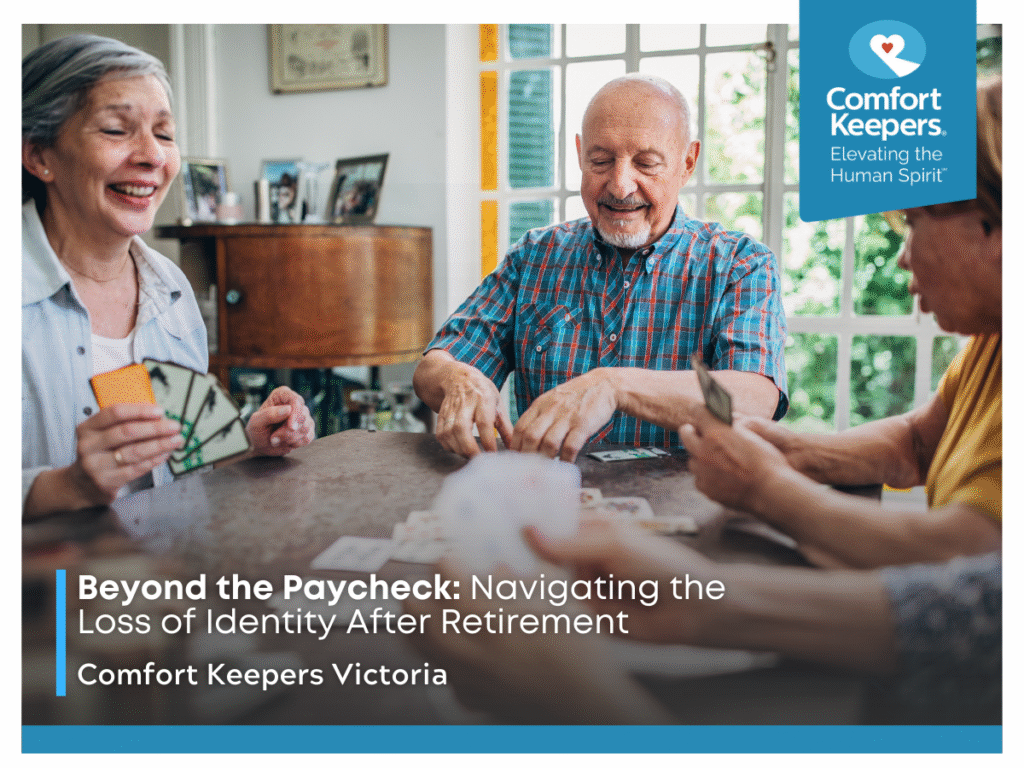
Your Journey Starts Now
Retirement is not an ending; it is a transformation. It’s an opportunity to shed a title that defined what you did, so you can fully embrace who you are. The journey of rediscovery requires patience, curiosity, and the courage to try new things.
Take a moment today to reflect on one small passion you’ve put on the back burner for years. Maybe it’s dusting off that old guitar, visiting the local art museum, or simply taking a new route on your daily walk.
This next chapter is unwritten, and you hold the pen. For those navigating retirement alongside specific health challenges, remember that support is available. Personalized strategies, including specialized care for conditions like dementia and Alzheimer’s, can help ensure you have the foundation needed to live this new chapter with dignity, purpose, and joy.
The Best Senior Home Care Provider in Victoria, BC, is Comfort Keepers®
Firstly, if you are concerned about the health and well-being of your aging loved ones, we can help with 24-hour care. We offer senior care, post-surgery care, palliative care, personal care, senior living transition services, and much more!
Comfort Keepers® Victoria Provides In-Home Elderly Care Services
Aging in place means keeping seniors happy and healthy at home. Comfort Keepers® trained caregivers provide seniors with the highest quality of life possible. In particular, our Interactive Caregiving™ system provides care that addresses safety, nutrition, mind, body, and activities of daily living.
Comfort Keepers® Victoria In-Home Caregivers Can Help with Interactive Caregiving™
Personal and empathetic care starts in the heart and allows us to meet our clients’ needs. Our philosophy is to elevate the human spirit. Our caregivers will be there every step of the way to ensure your loved one has a better quality of life.
Senior Homecare in Victoria, BC
Our unique services offer families respite care, overnight care, personal care, companionship care, palliative care, and end-of-life care. To learn more, contact the Comfort Keepers Victoria office.
Comfort Keepers® Victoria is Proud to Provide Senior Care and Home Care Services to Keep Seniors Safe in Their Homes
If you are searching for home care near you, we can help! Comfort Keepers® Victoria can provide home care for Victoria and surrounding areas. Service territory includes Colwood, Saanich, Sidney, James Bay, and Oak Bay. Please call (778) 265-5999 and learn how your loved ones can receive compassionate, professional in-home care.
Quality and Accredited Respite Care for British Columbia Families
Comfort Keepers® Victoria has achieved Exemplary Standing accreditation from Accreditation Canada. This accreditation, a rigorous evaluation of organizational processes, policies, and procedures against established quality standards by industry experts, signifies that Comfort Keepers’ offices have successfully met or surpassed the stringent benchmarks for Home Care companies as defined by Accreditation Canada.
Individualized Home Care Options
Long-Term Home Care, 24 Hour Home Care & Short Term Care Options Customized for You