

Symptoms of Dehydration in Seniors: A Summer Safety Guide for Winnipeg Families
Summer in Winnipeg brings the small pleasures we look forward to all year. Tea on the porch, time in the garden, a slow walk around the neighbourhood, a warm afternoon with family. With a little planning, the older adults we care for can keep enjoying all of it while staying safer and more comfortable when the weather turns hot.
One of the simplest ways to protect an older adult in summer is to pay attention to hydration. As the body ages, it stops signalling thirst as clearly, and hot, humid days make it easy to lose fluids before anyone notices. In this guide we walk through how to recognize the symptoms of dehydration in seniors, why older adults are more vulnerable in the heat, what to do when warning signs appear, and how a little support at home can make the whole season feel lighter for your family.
Key Takeaways
- The most common early symptoms of dehydration in seniors are dry mouth, dark or reduced urine, fatigue, headache, and dizziness.
- Thirst becomes unreliable with age, so an older adult can be seriously low on fluids without ever feeling thirsty or asking for water.
- In Winnipeg and southern Manitoba, a Heat Warning is generally triggered when daytime highs of at least 32°C and overnight lows of at least 16°C are forecast for two or more consecutive days, or when the humidex is forecast to reach at least 38 for two or more days.
- Call 911 immediately if you suspect heat stroke, especially if the person has a high body temperature with confusion, unusual behaviour, poor coordination, fainting, or loss of consciousness. Do not wait for sweating to stop, as someone with heat stroke may have dry or damp skin.
- One Canadian study found emergency visits about 2.6 times more common on hot days, with regular social contact acting as a protective factor.
- Start a routine before the heat arrives: offer fluids on a schedule, plan a cool space, and arrange daily check-ins.
Quick Answer: What Are the Symptoms of Dehydration in Seniors?

Common early symptoms of dehydration in seniors include dry mouth, dark or reduced urine, tiredness, headache, dizziness, and light-headedness. New confusion, unusual drowsiness, fainting, or a sudden change in alertness is more serious and requires prompt medical assessment. Dry mouth and dark or reduced urine are among the dehydration symptoms identified by the NHS.
Here is the part that surprises many families. Thirst is not a reliable warning sign in older adults, so watch for a change from the person’s usual self rather than waiting for them to ask for a drink. Sudden confusion, fainting, a fall, a racing heartbeat, or unusual drowsiness on a hot day should always be taken seriously and may need urgent medical care.
Why Seniors Get Dehydrated More Easily Than Younger Adults
Seniors get dehydrated more easily because aging changes several things at once: how the body stores water, how clearly it senses thirst, and how well it cools itself in the heat. Three shifts do most of the work.
Body Water and Kidney Changes
Older bodies carry less water, and the kidneys hold onto it less well. Peer-reviewed research indexed in PubMed Central indicates that total body water declines with age, leaving older adults with a smaller fluid reserve. The same research shows the kidneys concentrate urine far less efficiently over time, so an older adult can keep losing fluid through urination even when the body needs to hold on to it.
H3: Why Thirst Stops Being a Reliable Signal
The thirst signal itself weakens with age. Health Canada notes that even in active, healthy older adults the sensation of thirst is decreased, which can lead to further dehydration in hot weather. That matches what researchers have found in the lab: a 1997 study in the American Journal of Physiology and later work in Medicine & Science in Sports & Exercise both show that older adults tend to drink less than younger adults after losing fluid, exercising, or spending time in the heat. In plain terms, an older adult can need water without feeling any urge to drink it, which is exactly why waiting for thirst is not safe.
Medications That Raise the Risk
Some everyday medications add to the risk. Health Canada’s guidance for pharmacists names diuretics, often called water pills, along with several blood pressure medications, antidepressants, and antipsychotics as drugs that can affect fluid loss, sweating, thirst, or how the body copes with heat. This does not mean a senior should stop taking anything during a hot spell. It means it is worth asking a pharmacist or the prescribing doctor whether any of these medications call for extra care when the temperature climbs.
Why Winnipeg’s Summer Heat Raises the Risk for Seniors

Winnipeg summers can be especially hard on older adults, because high temperatures, humidity, and warm nights all work against the body’s ability to cool down and recover. Two important environmental factors help show how risky a hot stretch may become: whether conditions meet the official heat-warning criteria, and how humid the days and warm the nights become.
When a Heat Warning Is Issued in Manitoba
Manitoba Health publishes the regional heat-warning criteria, and Environment and Climate Change Canada issues a Heat Warning when forecasters expect either the combined daytime and overnight temperature thresholds, or the humidex threshold, to be met for two or more consecutive days. In Winnipeg and southern Manitoba, that means daytime highs of at least 32°C together with overnight lows of at least 16°C, or a humidex of at least 38. The thresholds are lower in northern Manitoba:
| Region | Daytime high | Overnight low | Or humidex | Duration |
| Southern Manitoba (incl. Winnipeg) | 32°C or higher | 16°C or higher | 38 or higher | 2 or more days |
| Northern Manitoba | 29°C or higher | 16°C or higher | 34 or higher | 2 or more days |
Either the two-day humidex threshold or the combined daytime and overnight temperature threshold can trigger a warning. Both daytime heat and the lack of overnight cooling are important, but an elevated overnight temperature does not trigger a warning on its own.
Why Humid Days and Warm Nights Are Harder on the Body
High humidity and warm nights can make extreme heat even more dangerous by limiting cooling and preventing the body from recovering overnight. The body sheds heat mainly by sweating, and, as Health Canada explains, it is the evaporation of that sweat that cools you. When the air is heavy with moisture, sweat evaporates slowly, so cooling stalls and body temperature creeps up. That is why a humid 30°C afternoon puts more strain on an older adult than a dry one.
The humidex is simply a way to describe how hot the air feels once humidity is added in. Environment and Climate Change Canada rates 40 to 45 as great discomfort where exertion should be avoided, and anything above 45 as dangerous. Overnight temperatures matter just as much. When the air stays warm after dark, the body never gets its usual chance to recover from the day’s heat, and the strain carries into the next morning.
Warning Signs of Dehydration in Seniors and What to Do
Dehydration in an older adult can look like an ordinary off day, so the safest approach is to watch for changes from the person’s usual energy, alertness, balance, and bathroom habits, then match your response to how serious the signs are. The graphic below groups the signs by level and pairs each one with a sensible next step.
Dehydration Signs in Seniors with Dementia
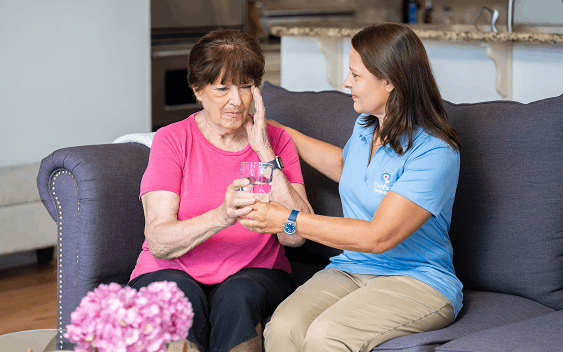
For someone living with dementia or another memory condition, dehydration often shows up as a change in behaviour rather than a spoken complaint. In our experience, the first thing our caregivers tend to notice is not a request for water but a shift in mood: more agitation, more withdrawal, new confusion, heavier sundowning in the late afternoon, or a quiet refusal of drinks that were fine yesterday. When a person cannot easily say how they feel, those small changes become the warning system, and they are worth acting on early.
What Should You Do if a Senior May Be Dehydrated?

If you think an older adult may be dehydrated, move them somewhere cooler and, if they are fully awake and able to swallow safely, offer small amounts of fluid. Lower their heat exposure and watch closely for urgent warning signs. Health Canada advises moving to a cool place and drinking liquids right away, with water the best choice. A practical order of steps looks like this:
- Move the person somewhere cooler, such as an air-conditioned room, a shaded spot, or a public cool space like a library, community centre, or mall.
- Offer fluids slowly, and only if the person is alert and able to swallow safely. Small, frequent sips are generally easier than a large glass. Do not give drinks to someone who is unconscious, severely confused, vomiting repeatedly, or unable to swallow safely, because of the aspiration risk.
- Skip alcohol, which worsens dehydration and clouds judgment on a hot day.
- Check for medical limits. Anyone with heart failure, kidney disease, or a doctor-set fluid limit should follow that guidance rather than simply drinking more.
- Watch for escalation. Confusion, fainting, rapid breathing or heartbeat, a fall, or very little urine over several hours means it is time to act fast.
If the signs are severe, come on suddenly, or point to heat stroke, call 911.
For non-emergency health guidance in Manitoba, contact Health Links-Info Santé at 204-788-8200 in Winnipeg or 1-888-315-9257 toll-free.
How to Tell the Difference Between Heat Exhaustion and Heat Stroke
Heat exhaustion is a serious warning sign, while heat stroke is a medical emergency. Symptoms can overlap, but severe or worsening changes in mental status are especially concerning. Marked confusion, unusual behaviour, severe loss of coordination, seizures, fainting, or unconsciousness can indicate heat stroke, particularly when accompanied by a very high body temperature. Sweating alone is not a reliable way to rule heat stroke in or out. Health Canada advises calling 911 immediately when someone has a high body temperature and is unconscious or confused.
| Condition | Common signs | What to do |
| Heat exhaustion | Heavy sweating, cool or clammy skin, headache, nausea, dizziness or fainting, rapid breathing and heartbeat, extreme thirst, weakness, and sometimes mild confusion or unsteadiness. | Move to a cool place and rest. If the person is fully alert and able to swallow safely, offer small sips of water. Get medical help if the symptoms do not improve quickly or begin to worsen. |
| Heat stroke | High body temperature, marked confusion or unusual behaviour, severe loss of coordination, seizures, fainting or unconsciousness, and very hot or red skin. The skin may be dry or damp. | Call 911 immediately. Move the person to the coolest place available, loosen clothing, and apply cool, damp cloths while you wait for help. |
A Simple Summer Hydration Plan That Actually Works
A real routine works far better than telling an older adult to drink more water. Scheduled fluids, a glass kept within reach, and easy access to the washroom are what make hydration happen day to day. Here is the approach we use with the families we support.
- Offer fluids on a schedule instead of waiting for thirst. Good anchors are waking up, each meal, mid-morning, mid-afternoon, and after any activity.
- Keep a glass or bottle within easy reach in the rooms that get used most, including the bedroom overnight.
- Vary the sources. Water, herbal tea, milk, broth, and watered-down juice all help, and so do water-rich foods like cucumber, watermelon, oranges, berries, and yogurt.
- Treat bathroom worries as a hydration issue. If someone drinks less for fear of not reaching the toilet in time, a clearer path, better lighting, gentle reminders, or a bedside commode can remove the reason.
- Go easy on alcohol and large amounts of caffeine on hot days, especially when the person is already drinking less than usual.
- Ask a pharmacist or doctor how the person’s medications interact with heat, and follow any personalized fluid limits set for heart or kidney conditions.
How Much Fluid Does a Senior Need on a Hot Day?
There is no single amount that fits everyone. As a general baseline, European Society for Clinical Nutrition and Metabolism guidance recommends offering older women at least 1.6 litres of drinks a day and older men at least 2 litres, unless a health condition requires a different plan. Needs may increase during hot weather, physical activity, fever, vomiting, or diarrhea. Anyone with heart failure, kidney disease, severe liver disease, or a physician-set fluid limit should follow personalized medical guidance rather than a general target.
Which Seniors Are at Higher Risk During Summer Heat?

Summer risk is often about the situation as much as age. An older adult who manages beautifully in mild weather can struggle on the third humid day of a heat warning, especially when fatigue is building and the house never cools down overnight. Manitoba Health identifies older adults, people living alone, people with chronic health conditions, and people taking certain medications as being at increased risk during extreme heat. These and other health and practical factors are reasons to pay closer attention when an older adult:
- Lives alone or has little daily contact with others.
- Has dementia, mild cognitive change, depression, or trouble communicating how they feel.
- Takes diuretics or several medications at once.
- Lives with heart, kidney, lung, or mobility concerns.
- Has recently been ill, spent time in hospital, or been less active than usual.
- Drinks less because of bladder or bathroom-access worries.
- Has no reliable air conditioning or way to reach a cool public space.
The evidence backs this up. A Canadian study, the NuAge study of older adults, found emergency department visits about 2.6 times more frequent on hot days than on normal summer days, and it identified strong social participation as a protective factor. Public Health Agency of Canada research on seniors and heat adds a telling detail: among seniors who lived alone, 56.3 percent felt unprepared or only somewhat prepared for extreme heat, well above those who lived with others. Isolation, in other words, is a risk factor in its own right.
When Extra Support at Home Makes Summer Safer

Extra support at home helps most when an older adult needs a hand noticing, preventing, or responding to heat-related changes before they turn into emergencies. Not every senior needs daily care. But for someone who lives alone, takes several medications, has memory changes, or is recovering from an illness, a regular presence can make a real difference.
Through our Companion Care and personalized in-home care services, our caregivers provide the small, steady forms of support that can help make hot days safer and more manageable. We make sure fluids are within reach and being used, encourage small drinks through the day, prepare light meals with water-rich foods, close blinds during the hottest hours, and check that fans or air conditioning are working. We also watch for the changes that matter most, in mood, alertness, balance, and bathroom habits, and let the family or a medical professional know when something shifts.
That steady company matters on its own. The person who is there regularly is the one most likely to notice when a normal hot day is quietly turning into a health problem, and to act before it does. For families, that presence also brings peace of mind. An adult child in another city, or a spouse who works during the day, does not have to carry the worry alone.
A Gentle Next Step
Summer in Winnipeg is meant to be enjoyed, on the porch, in the garden, on a bench by the lake, with a cold drink close by. With a little planning and the right level of support, that stays possible at any age.
If you have noticed symptoms of dehydration in a parent, a spouse, a neighbour, or yourself, or if the coming heat season feels hard to manage alone, our local Winnipeg care team is glad to talk it through and help you understand what kind of support would make daily life safer and more comfortable. We offer personalized in-home care in Winnipeg, including scheduled visits that can support hydration, meals, daily routines, and early observation of changes during hot weather.
References
- Health Canada. Extreme heat events: How to protect yourself from the health effects of extreme heat.
Frequently Asked Questions
Can a senior drink too much water during a heat wave?
For most healthy older adults, steady sipping through the day is safe and sensible. Some people with heart failure, kidney disease, severe liver disease, or another medical condition may have a physician-set fluid limit. Anyone with a fluid restriction should stay within the amount recommended by their healthcare provider and ask how that amount should be managed during hot weather. It is generally better to drink small amounts regularly than to try to catch up by drinking a large amount at once.
My parent has dementia and keeps refusing drinks. How can I help them stay hydrated?
Refusal is common, and pushing rarely works. What tends to help is offering rather than asking, since a question like “are you thirsty” often gets a reflexive no. Put a filled cup in their hand at natural moments, try different temperatures and a favourite mug, and lean on water-rich foods like watermelon, yogurt, and soup that feel like a treat rather than a task. Making it social, a drink shared together, often does more than any reminder.
Is a fan enough to keep a senior safe in extreme heat?
A fan may help with comfort, but it should not be the only cooling plan during extreme heat. Health Canada notes that fans are ineffective at cooling the body when temperatures are above 35°C. On the hottest days, spend time in an air-conditioned or otherwise cool space, take a cool shower or bath, and use cool, damp cloths. A public cooling space can help when air conditioning is not available at home.
How often should someone check on an older adult who lives alone during a heat warning?
During a heat warning, an isolated older adult benefits from more than one contact a day. The CDC suggests that caregivers visit at-risk adults at least twice a day in hot weather. During each check, confirm that the person seems alert and steady, is drinking fluids, has access to a cool space, and is not showing signs of heat illness.