


Dementia Care at Home in Winnipeg: What Families Should Know
Dementia care at home in Winnipeg is personalized, non-medical support with daily routines, personal care, meals, companionship, safety supervision, medication reminders, and family respite. It can work alongside Manitoba Home Care and medical care, but it does not diagnose or treat dementia.
Most people living with dementia are not in a care home. They are at home, in familiar rooms, following routines they have kept for years. If you are a son, daughter, spouse, or close friend trying to work out what help your loved one needs, the good news is that a lot can be done at home to support their days, and yours. We are Comfort Keepers Winnipeg, a local in-home care team. This guide explains what non-medical dementia care at home can and cannot do, how it supports familiar routines, safety, and engagement, and where to turn for help in Winnipeg. To be clear from the start: in-home care supports quality of life and safety. It does not diagnose, treat, cure, or slow dementia, and it never replaces medical care.
Key Takeaways
- Dementia care at home in Winnipeg is non-medical, personalized support that helps a loved one keep familiar routines, stay engaged, and stay safer, while giving the family relief.
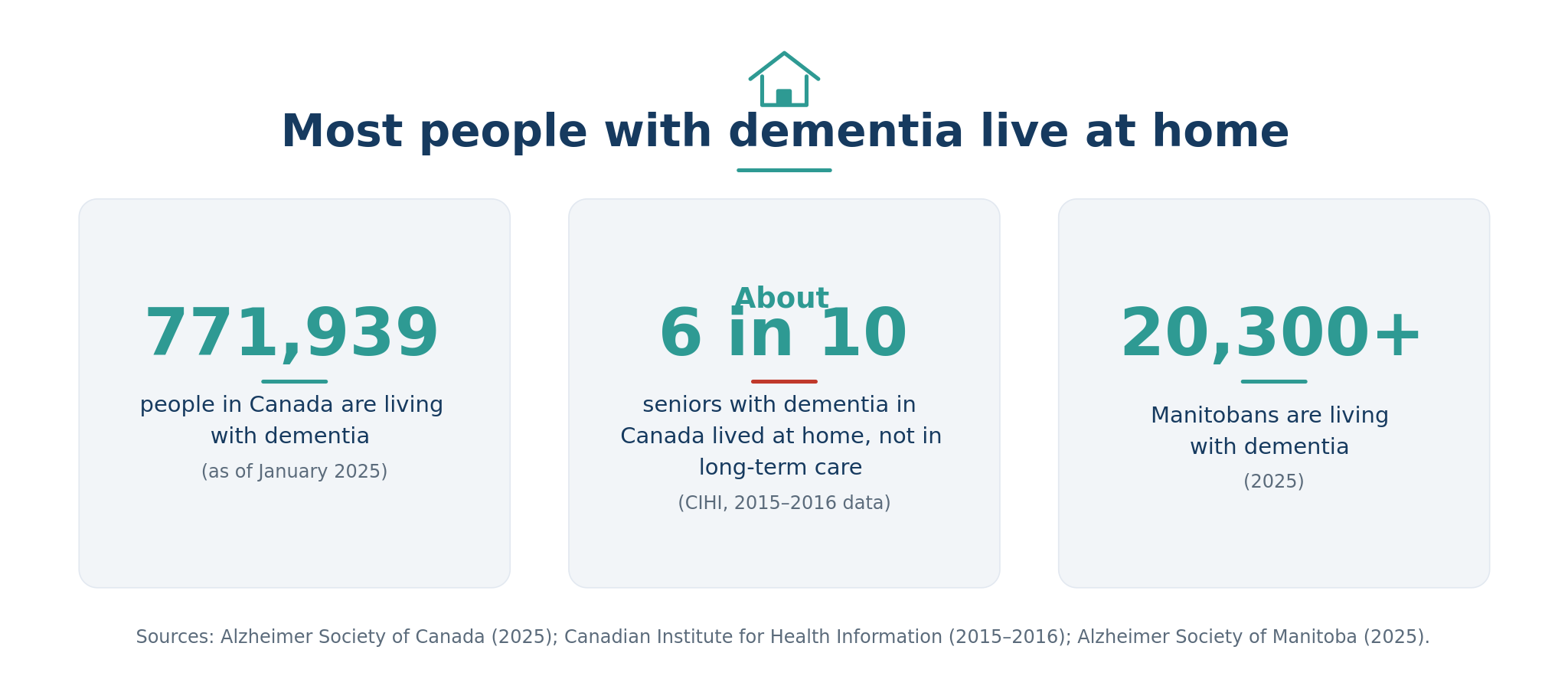
- In CIHI’s 2015–2016 data, about 6 in 10 seniors with dementia lived at home in the community rather than in long-term care, so staying home is a common path, not the exception.
- In-home care can include personal care, meals, medication reminders, companionship, and safety supervision. It does not include diagnosis, prescribing, or medical treatment.
- Caregivers of people with dementia carry a heavy load, about 26 hours of care a week, and are far more likely to experience distress, which is why planned respite matters early.
- You can combine supports in Winnipeg: publicly funded Manitoba Home Care through the WRHA, the Alzheimer Society of Manitoba, and private care like ours. Call us at (204) 488-4600 to talk it through.
Why Many Families Prefer to Support a Loved One at Home
Keeping a loved one with dementia at home is normal and, for many families, the right first choice. In the Canadian Institute for Health Information’s 2015–2016 analysis, about 61% of Canadian seniors with dementia, more than 261,000 people, lived outside publicly funded long-term care or nursing homes. Nationally, an estimated 771,939 people are living with dementia as of January 2025, and here in the province, more than 20,300 Manitobans are living with Alzheimer’s disease or another dementia, as reported by the Alzheimer Society of Canada, Dementia numbers in Canada and the Alzheimer Society of Manitoba, Dementia by the numbers.
There is a practical reason home works for so many families. A place that is safe, familiar, and comfortable can help a person live well with dementia, because at home they are free to follow life-long routines and stay in a neighbourhood they know, while a move to an unfamiliar setting can mean a loss of self-reliance and control, as the Alzheimer Society of Canada explains in Living safely and independently. That is also the goal Manitoba’s own home care program is built around, helping people “stay in their homes for as long as is safely possible,” in the words of the Government of Manitoba’s guide to home care services.
Home is not the right answer in every situation, and needs change over time. But for a family weighing what to do next, it helps to know that support at home is a well-worn path, not a last resort.
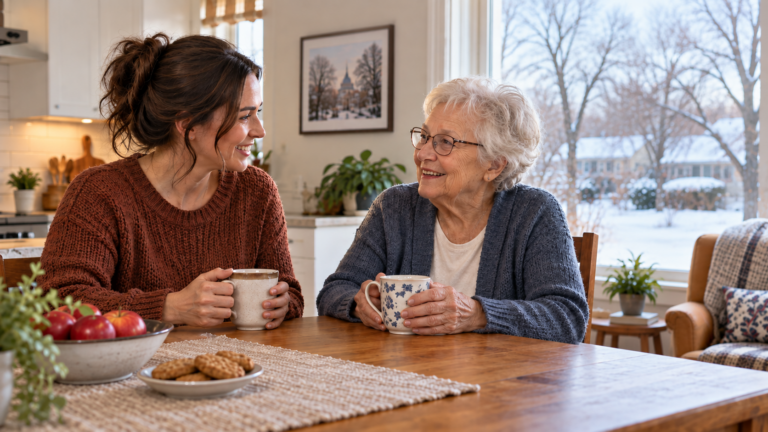
From our Winnipeg team: In the years we have supported Winnipeg families, the moments that matter most are rarely the big ones. They are a familiar mug in the right cupboard, a walk along the same block, a favourite song after supper. Our approach, which Comfort Keepers calls Interactive Caregiving, is to keep a person doing the everyday things they still can, with us alongside them, rather than doing everything for them. Familiar surroundings give people something to hold onto, and our job is to protect that.
What In-Home Dementia Care Can Include
In-home dementia care is non-medical, personalized help with everyday life. It covers the practical parts of the day a person may find harder over time, from personal care and meals to companionship and gentle supervision for safety, and it gives family caregivers a break. The Alzheimer Society of Canada’s guidance on day-to-day care describes how people living with dementia “gradually need more and more help” with personal care, meals, routines, and getting around, and that is the ground in-home care covers.
These are the same supports Manitoba’s public program lists in its own words: help “with mobility, such as walking, transferring and personal care, such as bathing, dressing and toileting,” help “with activities such as meals, light housekeeping and laundry,” and “short periods of in-home relief for your caregiver,” per the Government of Manitoba home care guide. A good caregiver does this with the person, not simply for them. World Health Organization guidance for caregivers puts it plainly, to “engage the person in personal care by helping them do as much as they can themselves,” and to remind the person to eat and drink rather than take the task away, in its information for caregivers. Our own care is personalized rather than a fixed package, so it can begin with a few hours a week and grow as needs do.
There is a clear line between this kind of support and medical care, and it matters. Non-pharmacological support of this kind “can improve quality of life and daily functioning,” according to the World Health Organization’s dementia fact sheet, but the same source is direct that there is no cure for dementia. In-home care helps a person live better day to day. It does not treat the condition. The table below shows where that line sits.
Table 1. What non-medical in-home dementia care can and cannot do
| What our caregivers can support | What stays with medical professionals |
| Personal care: bathing, dressing, grooming, toileting, mobility | Diagnosing dementia or its stage |
| Meals, nutrition, and reminders to drink fluids | Prescribing or adjusting medications |
| Medication reminders (prompting, not administering treatment) | Medical or nursing treatment of the disease |
| Companionship, conversation, and meaningful activity | Therapies aimed at the disease itself |
| Gentle supervision and everyday safety awareness | Emergency and acute medical care |
| Transportation, errands, and appointments | Fitness-to-drive and clinical assessments |
| Respite so family caregivers can rest | Long-term prognosis and treatment planning |
If a family is unsure which needs are medical and which are day-to-day, that is exactly the kind of thing our dementia care team in Winnipeg can help you sort out, and we will always point you back to your physician or Manitoba Home Care for the medical side.
The Role of Familiar Routines and Meaningful Engagement

Consistent routines and meaningful activity help a person with dementia know what to expect, stay engaged, and keep a sense of independence and dignity. Routines “help the person with dementia know what to expect, and help them continue to do things on their own,” which supports “greater dignity and confidence,” as the Alzheimer Society of Canada notes in Setting routines and reminders. The World Health Organization adds that “it is important to maintain routines similar to the ones that the person had before developing dementia,” in its caregiver guidance. Familiarity is the thread, and a routine a person already knows carries less confusion than a new one.
Engagement matters just as much as routine. Staying socially active “may help manage the symptoms of dementia, allowing people with dementia to live independently for a longer period of time,” according to the Alzheimer Society of Canada. Activity works best when it is matched to what the person can still do and enjoy, so they “feel successful and have fun,” as the U.S. National Institute on Aging advises on adapting activities. This is the heart of person-centred care, which the Alzheimer Society of Canada describes as recognizing a person’s “unique values, personal history and personality” and their “equal right to dignity, respect.” Canada’s national dementia strategy is built on the same idea, “a person-centred approach that focuses on respecting and preserving an individual’s rights, autonomy and dignity,” in the words of the Public Health Agency of Canada.
Everyday Ways We Support a Familiar Routine
Supporting a routine is mostly small, steady things. We keep the day’s rhythm close to what a person is used to, waking, meals, a walk, rest, and evening wind-down at familiar times. We build activity around what someone already loves, whether that is folding laundry together, a hand of cards, a favourite radio programme, or preparing a family recipe. Shared meals give the day structure, and we serve them in a calm, quiet place, encourage the person to feed themselves where they can, offer regular drinks to avoid dehydration, and never rush, following the Alzheimer Society of Canada’s mealtime guidance. None of this is complicated. It just has to be consistent and led by the person.
Communicating in a Way That Reduces Stress
How we speak with someone can make an ordinary moment calmer or harder. Widely recommended approaches are gentle and simple: make eye contact and use the person’s name, be aware of your tone and body language, allow more time for a reply, and never talk about the person as though they are not there, as the National Institute on Aging sets out. The World Health Organization adds to “speak clearly, slowly” and “face-to-face and at eye level,” and to ask “one thing at a time,” in its caregiver information. Our caregivers use these approaches every day, because a familiar face and an unhurried manner do as much for a person’s comfort as any task on the schedule.
Everyday Safety and Awareness at Home
Safety at home means reducing everyday risks, falls, kitchen and medication hazards, and the chance of a person becoming lost, through simple adjustments and a consistent, watchful presence. It is worth being honest that no measure removes risk entirely. The aim is to lower it while protecting a person’s independence.
Falls are the biggest everyday hazard. They are “the leading cause of injury-related hospitalizations and injury deaths among people aged 65 or older” in Canada, and it is estimated that between 20% and 30% of seniors fall each year, according to the Public Health Agency of Canada’s surveillance report on falls and its Seniors’ Falls in Canada report. Many risks are reducible with practical changes, good lighting and night lights, grab bars by the toilet and bath, non-slip bath mats, and removing or securing loose scatter mats, as Health Canada advises. For dementia specifically, the Alzheimer Society of Canada suggests locking away medications and cleaning products, checking whether appliances can be used safely, and improving lighting to reduce shadows that may cause confusion, while cautioning against restricting a person so much that it harms their confidence.
Some people with dementia become disoriented and lose their way. Six in ten people who live with dementia are at risk of getting lost, notes the Alzheimer Society of Canada, which prefers the term “walking about” to “wandering.” Families can register a loved one with MedicAlert® Safely Home®, described as “a nationwide service designed to help identify a person living with dementia who has gone missing,” and in Manitoba you can sign up through the Alzheimer Society of Manitoba. It is important to keep expectations realistic, because “no device or system can guarantee that a person living with dementia will not get lost or that they will be found,” as the Alzheimer Society of Canada states plainly. What a consistent caregiver adds is steady attention. Regular check-ins and presence “can help reduce risks,” in the Society’s words.
Driving is often the hardest safety conversation. Most people in the early stages of dementia “can continue to drive safely and competently,” but the condition will eventually raise the risk, and a person “should stop driving as soon as possible” once a collision becomes more likely, according to the Alzheimer Society of Canada’s guidance on driving. This is a medical and legal matter, not something a home-care team decides. We support families around it, and we point you to your physician and Manitoba’s licensing process for the actual determination.
Table 2. Common home-safety concerns and practical steps
| Concern | A practical step | How a caregiver can help |
| Falls while walking | Improve lighting, add grab bars and non-slip mats, remove loose rugs (Health Canada) | Supervise movement, keep paths clear, encourage safe activity |
| Kitchen and appliances | Check whether stove, kettle, and appliances can be used safely (Alzheimer Society) | Prepare meals together and stay present during cooking |
| Medications and hazards | Lock away medications, cleaning products, and chemicals (Alzheimer Society) | Provide medication reminders and safe storage awareness |
| Becoming lost (“walking about”) | Register with MedicAlert Safely Home; keep routines that reduce restlessness | Offer familiar routines, activity, and steady companionship |
| Night-time safety | Plan for higher-risk evening hours and consider added supervision | Provide overnight or continuous support where needed |
Safety measures work best layered together, and none of them replaces knowing the person well enough to notice when something is off.
How Care Can Support Family Caregivers
In-home care gives family caregivers real, scheduled relief, and that relief is a healthy, normal part of dementia caregiving, not a sign of failing. The load is heavy and well documented. About 26 hours a week of informal care is required for a Canadian aged 65 or older living with dementia, compared with 17 hours for a senior without dementia, according to the Canadian Institute for Health Information. The distress that comes with it is real, and recent federal data shows the gap remains substantial: in 2023–2024, 35.3% of caregivers for people living with dementia experienced symptoms of distress such as anger, depression, or feeling unable to continue, compared with 19.2% of caregivers for people without dementia, as reported by the Public Health Agency of Canada. Families also carry a real cost: the Public Health Agency of Canada has reported an average of about $4,600 out of pocket each year for each person with dementia in a caregiver’s care. Across Canada, family and friends provide more than 580 million hours of unpaid dementia care a year, equal to about 290,000 full-time jobs, reports the Alzheimer Society of Canada.
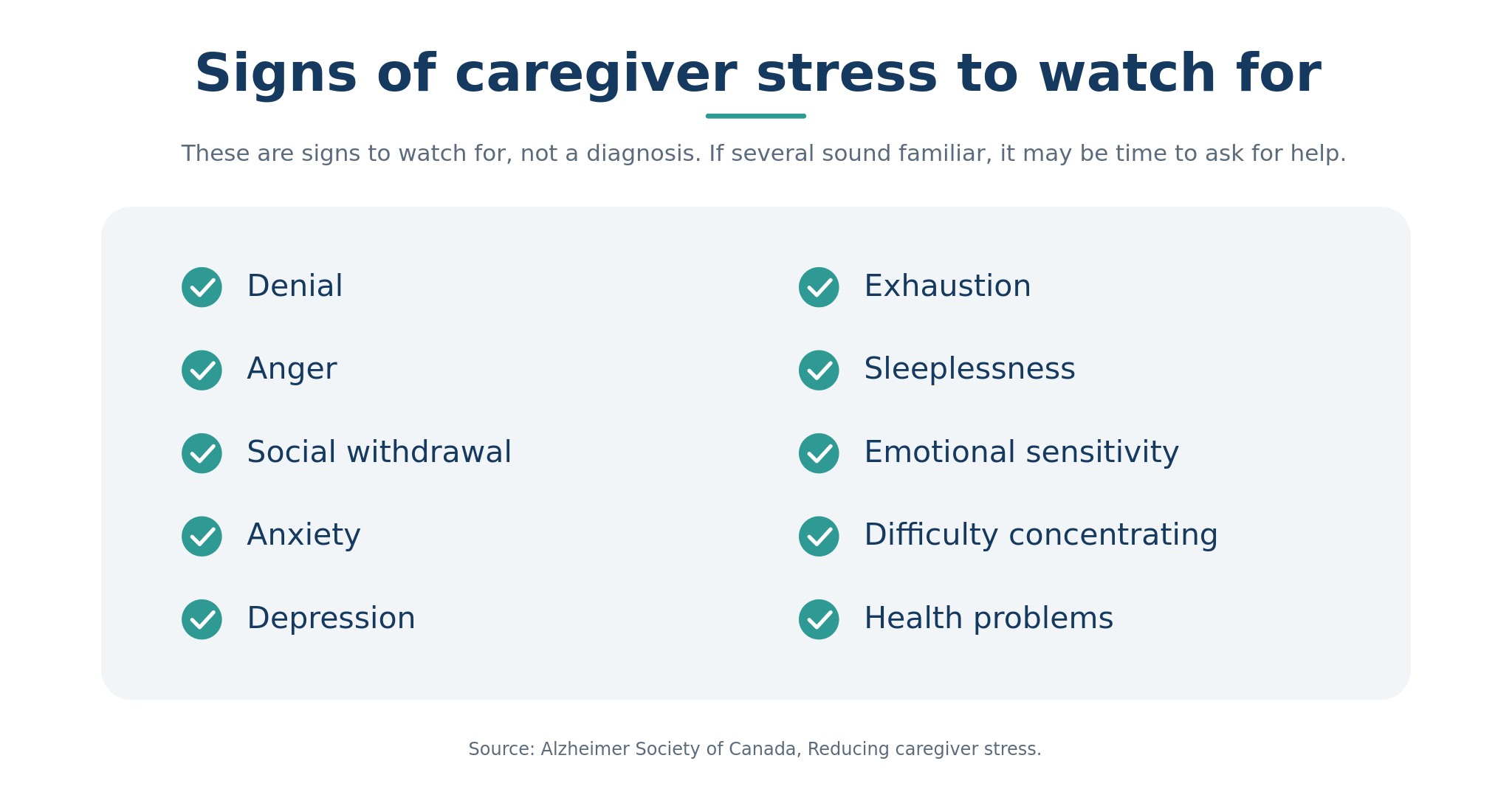
Respite care is the direct answer to that load. It is “a break, a chance to do something for yourself,” and “regular relief can help to rejuvenate your mind and body,” which as the Alzheimer Society of Canada notes can help you “be a better caregiver when you return.” Respite can be in-home, through an adult day program, or a short residential stay. The reason to arrange it early rather than late is that caregiver stress builds quietly, and the Society lists signs worth watching for, including exhaustion, sleeplessness, anxiety, social withdrawal, and health problems, in its guidance on reducing caregiver stress. You should not have to do it all alone, and bringing in help before a crisis is easier on everyone. Our respite care in Winnipeg is built exactly for this: a regular weekly break, or cover when you are unwell or away.
When Care Needs Become More Continuous
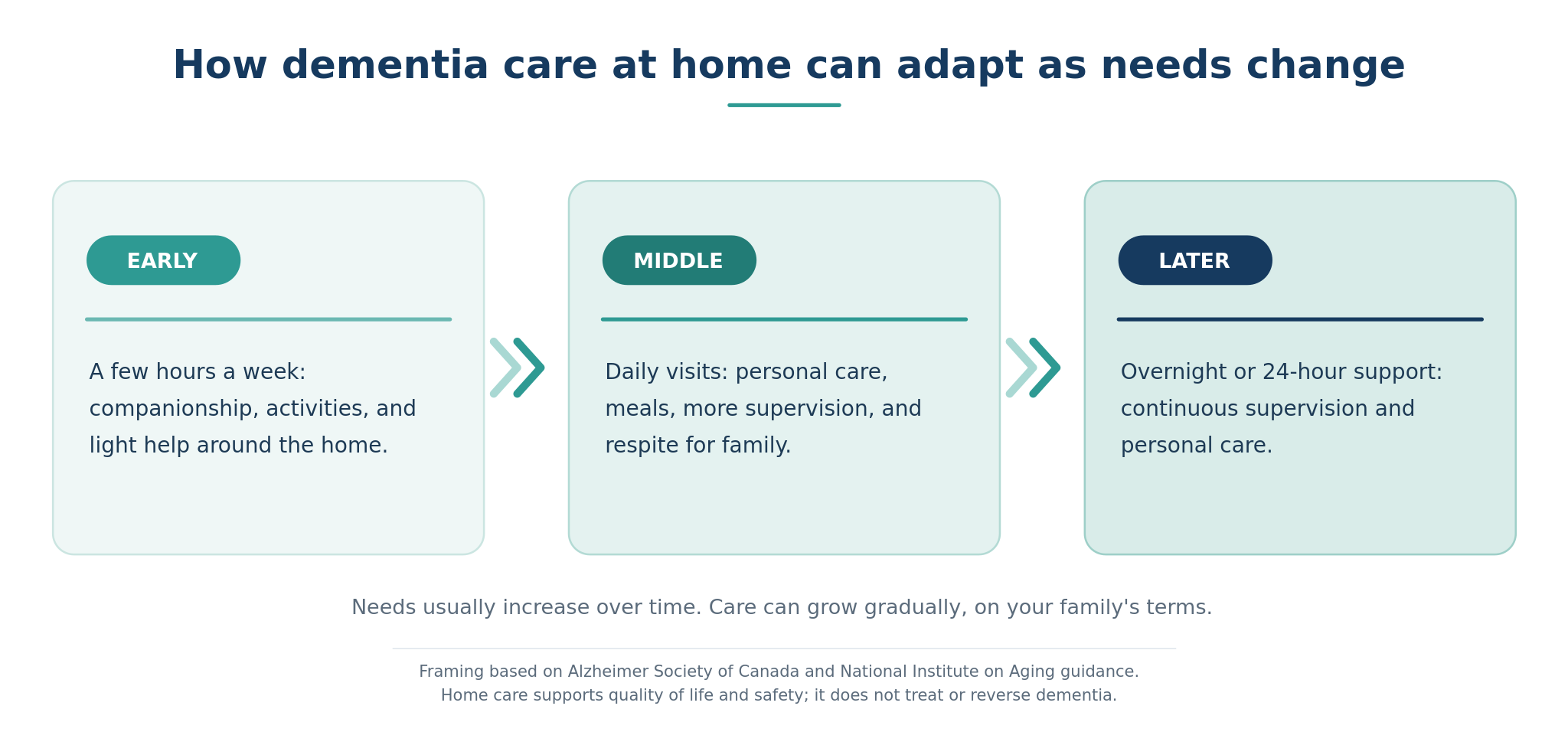
As dementia progresses, needs usually increase, and some families move from a few hours of help a week toward overnight or continuous support. It helps to know which way things tend to go, without treating it as a fixed timetable. There is currently no cure for Alzheimer’s disease, “nor can its progression be reversed,” as the Alzheimer Society of Canada states, so care is about supporting the person well at each stage, not changing the course of the disease.
Care needs tend to rise stage by stage. In the early stage a person “keeps many of their abilities and assistance may not be needed,” while in the later stage “care may be required 24 hours a day,” per the Alzheimer Society of Canada. The National Institute on Aging describes the middle stage as the point where “more intensive supervision and care become necessary.” Night-time is often what tips a family toward more hours, because restlessness and disorientation can happen in the evening and overnight, and added supervision can help keep those hours safer. Because our care is personalized, it can grow from a few hours a week to overnight or 24-hour home care in Winnipeg without the person having to change providers or start over with a stranger. The point is that support can grow with the need, gradually, and on your family’s terms.
Questions to Ask a Dementia Care Provider
Before choosing a provider, ask how they handle the things that matter most in dementia care: training, consistency, the care plan, how care scales, night-time safety, respite, backup, communication, and honesty about their limits. Good answers to these questions tell you far more than any brochure.
- Are your caregivers specifically trained in dementia care, including communication and responsive behaviours, rather than general senior care alone?
- Will the same one or two caregivers be assigned, so my loved one sees familiar faces, and how do you match them to personality and routine?
- Do you create a written, individual care plan, and how often is it reviewed and updated as needs change?
- As needs grow, can you add hours, overnight shifts, or continuous support without us switching providers?
- How do you handle night-time supervision, the risk of a person walking about, and home-safety concerns?
- Can you provide regular respite so the family gets scheduled breaks, and cover longer or emergency respite when needed?
- What happens if the assigned caregiver is unavailable, and how quickly is backup arranged?
- How will you keep us informed about changes in mood, appetite, sleep, or new behaviours between visits?
- Will you coordinate with our family, physician, Manitoba Home Care, and the Alzheimer Society of Manitoba?
- Since this is non-medical care, how do you recognize when needs go beyond what in-home care can safely provide, and help us plan the next step?
We are glad to answer every one of these about our own service, and we think you should ask them of anyone you consider.
Local Support for Winnipeg Families
Winnipeg families rarely rely on one source of help. Most combine several: publicly funded Manitoba Home Care delivered through the Winnipeg Regional Health Authority, the Alzheimer Society of Manitoba, private in-home care like ours, and, for eligible veterans, Veterans Affairs Canada. Knowing what each one offers makes the next call easier.
Manitoba’s Home Care Program is publicly funded, provided “based on assessed need,” and delivered through the regional health authorities, as described by the Government of Manitoba. In Winnipeg, you or a family member can start by calling the WRHA Home Care intake line at 204-788-8330 to request an assessment, per the Winnipeg Regional Health Authority. Public and private care can work together. The province’s Self/Family Managed Care option lets families receive funding to “purchase services or to employ staff,” as the WRHA explains, and many families use public support alongside privately arranged hours. Most services in an approved care plan are publicly funded, although specific services, including respite in another setting and adult day programs, may carry fees, per the provincial FAQ.
The Alzheimer Society of Manitoba is the local hub for dementia support. The First Link® Dementia Helpline is reachable at 204-943-6622 in Winnipeg or 1-800-378-6699 toll-free, connecting families to information, support groups, education, and Safely Home® registration, per the Alzheimer Society of Manitoba. Many of its supports are free, while some programs have a registration fee. The Society also runs Minds in Motion®, a program “connecting people living with early to moderate signs of dementia and their care partners through fitness, conversation and activity.” For veterans, the Veterans Independence Program from Veterans Affairs Canada provides “annual tax-free funding for services such as grounds maintenance, housekeeping, meal preparation, personal care, and professional health and support services.”
Table 3. Where Winnipeg families can turn
| Resource | What it offers | How to reach it |
| Manitoba Home Care (WRHA) | Publicly funded, assessed-need home care in Winnipeg | Home Care intake line 204-788-8330 |
| Alzheimer Society of Manitoba | Helpline, support groups, education, Safely Home (many supports free; some programs have a fee) | First Link Dementia Helpline 204-943-6622 or 1-800-378-6699 |
| Minds in Motion® | Fitness, conversation, and activity for people with dementia and care partners | Through the Alzheimer Society of Manitoba |
| Veterans Affairs Canada | Veterans Independence Program funding for home support | veterans.gc.ca |
| Comfort Keepers Winnipeg | Personalized non-medical in-home dementia care and respite | (204) 488-4600 |
Why Winnipeg Families Count on Comfort Keepers
Families choose us for dementia care at home for a few clear reasons: we are local and accountable, our care is personal, and it grows with your loved one without you ever having to start over with a stranger. We are here to be the steady part of the picture that ties the rest of your support together.
We are owned and operated right here in Winnipeg, led by owner Debbie Bell, who has been part of local home care since 2014. A real person and a local team stand behind the care, not a distant call centre, and that local accountability is something you can feel in how we show up.
Our caregivers are matched to your loved one’s personality and daily routine, and we work to keep the same familiar faces coming to the home. In dementia care, that consistency matters more than almost anything else, because a trusted, recognized caregiver brings calm that a rotating roster of strangers cannot. We build the day around the person through Interactive Caregiving, keeping them involved in the activities they still enjoy, and we adjust the plan as needs change, from a few hours a week to overnight or continuous support, all with one team.
We also work alongside the rest of your loved one’s support, your family, their physician, Manitoba Home Care, and the Alzheimer Society of Manitoba, so the pieces fit together rather than pull in different directions. You do not have to coordinate all of it on your own. And because dementia does not keep office hours, our Winnipeg team is reachable and our care can be arranged around the clock. When you want to talk it through, we are ready.
How to Start a Care Conversation
Start gently and early. Pick a calm, unhurried moment, focus on independence and safety rather than what is being lost, offer choices instead of instructions, and begin with a small amount of help rather than a big change all at once. A person is far more likely to accept a little support with something specific, a ride to an appointment or a hand with meals, than a wholesale handover of their day. If the first conversation does not go smoothly, that is normal, and it is worth returning to later rather than pushing.
When you are ready to look at in-home care, the practical next step is a conversation with a provider about what your loved one needs now and what may change. With us, that starts with a no-pressure talk about your family’s situation, and care that begins where it makes sense and grows only as needed. You can ask about dementia care at home any time, or reach our Winnipeg team at (204) 488-4600. We will walk you through the options at your pace, and when you are ready, we are here to help your loved one stay safe, engaged, and at home.
About the Author and Reviewer
This guide was written by the Comfort Keepers Winnipeg Editorial Team and reviewed for local service accuracy by Debbie Bell, Owner of Comfort Keepers Winnipeg, who has led the local office since 2014 and brings a background in health care to the Winnipeg team’s work. Debbie’s review confirms that the local service information here reflects how our Winnipeg team actually supports families. It is a local service-accuracy review, not a clinical or medical review. You can learn more on Debbie Bell’s profile page. This article provides general information and does not replace medical advice, diagnosis, or treatment.
Sources
Alzheimer Society of Canada. Dementia numbers in Canada (2025).
Alzheimer Society of Manitoba. Dementia by the numbers (2025).
Canadian Institute for Health Information. Dementia in home and community care (2015–2016 data).
Canadian Institute for Health Information. Dementia in Canada: Summary.
Public Health Agency of Canada. Dementia in Canada data blog (2020).
Public Health Agency of Canada. A Dementia Strategy for Canada: Together We Achieve, 2025 annual report (2025).
Public Health Agency of Canada. Surveillance report on falls among older adults in Canada (2024).
Public Health Agency of Canada. Seniors’ Falls in Canada: Second Report (2014).
Health Canada. Seniors and Aging: Preventing Falls in and around Your Home.
Public Health Agency of Canada. A Dementia Strategy for Canada: Together We Aspire (2019).
World Health Organization. Dementia fact sheet (2026).
World Health Organization. Dementia: Information for caregivers (2020).
National Institute on Aging. Adapting Activities for People With Alzheimer’s Disease (2024).
National Institute on Aging. Communicating With Someone Who Has Alzheimer’s Disease (2024).
National Institute on Aging. What Are the Signs of Alzheimer’s Disease?
Alzheimer Society of Canada. Living safely and independently.
Alzheimer Society of Canada. Setting routines and reminders.
Alzheimer Society of Canada. Providing day-to-day care.
Alzheimer Society of Canada. Meal time.
Alzheimer Society of Canada. Person-centred care of people with dementia.
Alzheimer Society of Canada. Making your environment safe.
Alzheimer Society of Canada. Disorientation and losing one’s way.
Alzheimer Society of Canada. MedicAlert® Safely Home®.
Alzheimer Society of Canada. Tracking devices.
Alzheimer Society of Canada. Driving with dementia.
Alzheimer Society of Canada. The stages of Alzheimer’s disease.
Alzheimer Society of Canada. What to expect as the person’s dementia progresses.
Alzheimer Society of Canada. Finding help.
Alzheimer Society of Canada. Reducing caregiver stress.
Government of Manitoba. Home Care Services in Manitoba and Your Guide to Home Care Services in Manitoba and Home Care FAQ.
Winnipeg Regional Health Authority. Home Care and Self and Family Managed Care.
Alzheimer Society of Manitoba. First Link and Minds in Motion.
Veterans Affairs Canada. Veterans Independence Program.
Frequently Asked Questions
Is dementia care at home covered by Manitoba Home Care, or do we pay privately?
It can be both, and the two are separate. Public Manitoba Home Care follows an assessed need and a set schedule, while private care like ours is arranged and paid for directly by the family, with no assessment needed to begin and more say over the caregiver, the hours, and the times of day. Many families start with a little private help while they wait for a public assessment, then keep the mix that works.
Do your dementia caregivers provide medical or nursing care?
Our dementia care at home is non-medical, and medication is a good example of the line. Our caregivers can remind a person to take what their doctor has already prescribed, but they do not prescribe, adjust, or administer treatment. When clinical care such as wound care or injections is needed, it is arranged with a qualified nurse or your physician, and we coordinate so nothing falls through the gap.
Does night-time restlessness mean our loved one has to move to a facility?
Usually not on its own. Overnight support at home can take different shapes, from a caregiver who stays awake through the night to a live-in arrangement, and the right choice depends on what is actually happening after dark. Matching the type of night support to the real need is often what lets someone stay home longer.
What if our parent refuses help?
This is very common, and it is usually about protecting independence and pride. When gentle first steps are not landing and you are worried about safety, it often helps to involve someone the person already trusts, such as their family doctor, and to keep the conversation on one specific concern rather than “help” in general. When refusal and a real safety risk start to collide, that is a good moment to talk it through with your physician or the Alzheimer Society of Manitoba.
How quickly can in-home care start in Winnipeg?
It depends on the level of support you need and current availability. The fastest way to get a clear answer for your situation is to call our Winnipeg team at (204) 488-4600, and we will walk you through timing and next steps.