



Home Support After a Hospital Stay: A Guide for Winnipeg Families
Written by the Comfort Keepers Winnipeg Editorial Team. Reviewed for local service accuracy by Debbie Bell, Owner (since 2014).
Published: September 2026. Last reviewed and updated: September 2026.
When an older parent or partner comes home from the hospital, the relief of getting back to their own bed often runs straight into a new list of worries. Who helps them to the bathroom at night? Are they eating? Did they take the right pills this morning? How will they get to the follow-up appointment? We are Comfort Keepers Winnipeg, and helping local families through exactly these moments is a large part of what we do.
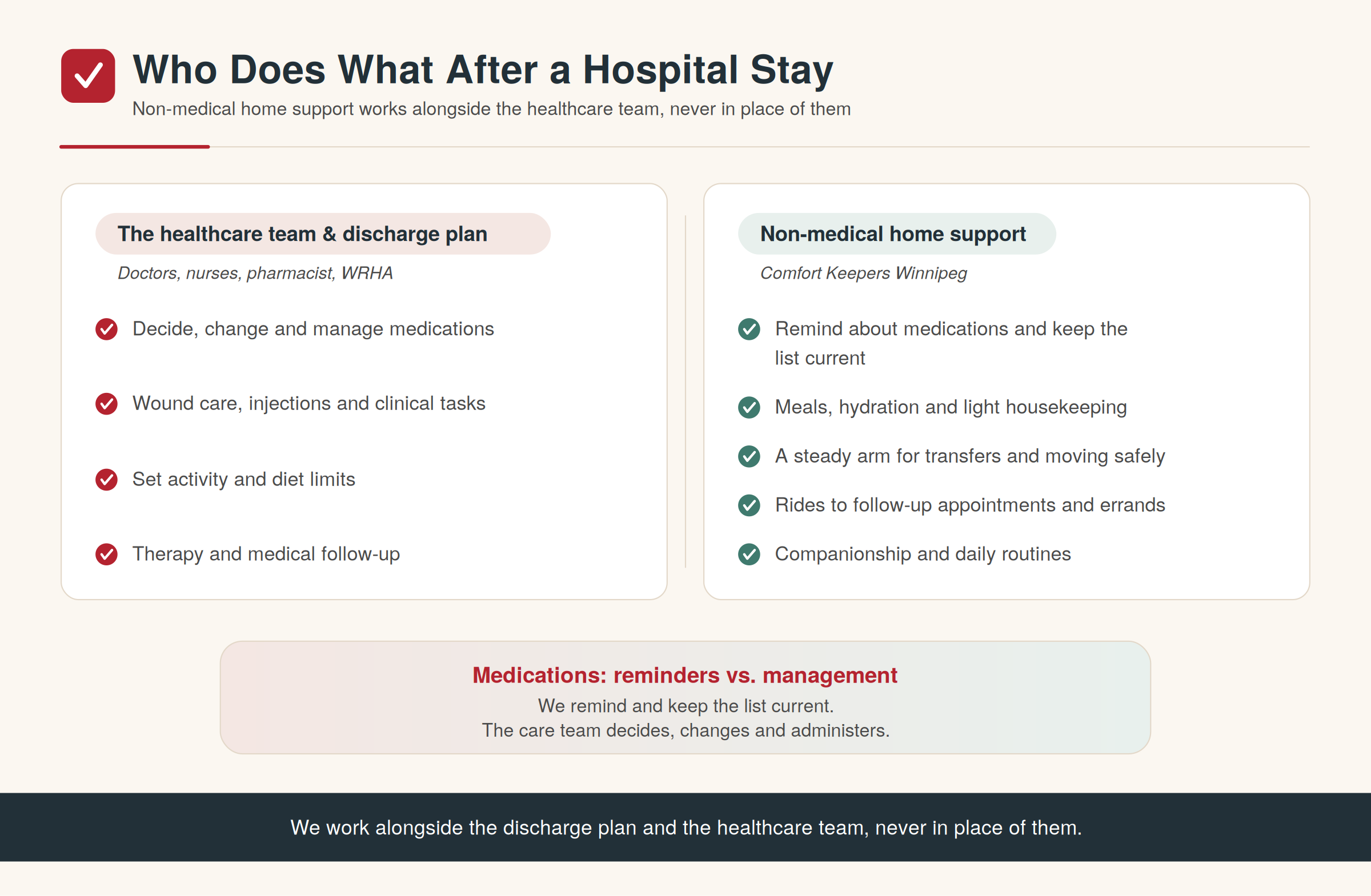
Home support after a hospital stay is practical, non-medical help with the everyday parts of recovery, things like meals, moving safely around the house, medication reminders, getting to appointments, and keeping daily routines going. It works alongside the discharge plan and the healthcare team, never in place of them, so your loved one can follow the advice they were given and settle back in at home.
A note on what this is, and what it is not.
The support we describe here is non-medical. It does not replace your discharge instructions, and it does not include nursing or clinical care. The doctors, nurses and pharmacist guide the medical side of recovery, including medications, wound care, therapy and how active your loved one can be. We help with the everyday things that make it easier to follow their advice at home. When a clinical need comes up, that belongs with the hospital or Winnipeg Regional Health Authority team, your physician, or our separate in-home nursing service.
Key Takeaways
- Home support after a hospital stay is non-medical help with meals, mobility, medication reminders, appointments and routines, working alongside the discharge plan.
- The Government of Canada calls care transitions “critical to the person’s recovery and quality of life,” so the first days home deserve a plan.
- Around 1 in 10 hospital patients expected to receive home care have their stay extended while supports are arranged (CIHI), so arrange help early.
- A caregiver can remind about medications and keep the list current, but only the care team manages, changes or administers them.
- Support is temporary and flexible: it can start with more hours right after discharge and step down as recovery progresses.
- Action step: confirm the discharge plan and arrange home support before your loved one leaves the hospital.
Why the First Days at Home Can Be Challenging

The first days home are demanding because recovery does not stop at the hospital doors. Your loved one is often weaker than usual, and mobility, meals, medications and appointments all need attention at the same time, sometimes before they feel ready for it.
Recovery Keeps Going After You Leave the Hospital
Getting discharged can feel like the end of the ordeal. In reality, the recovery is just moving home. The Government of Canada describes care transitions as critical to a person’s recovery and quality of life, and advises families to know the discharge plan and care options. In Winnipeg, that planning starts early. The Winnipeg Regional Health Authority notes that the healthcare team begins preparing for discharge almost as soon as a patient is admitted, and it treats family, friends and caregivers as Partners in Care. Sometimes the pieces need to be in place before it is safe to go home. The Canadian Institute for Health Information tracks this: around 1 in 10 hospital patients who are expected to receive home care have their hospital stay extended while home care services or supports are being arranged. The lesson we share with families is simple: the sooner support at home is arranged, the smoother the return tends to be.
Why Everyday Tasks Feel Harder at First
A hospital stay and a stretch of reduced activity can leave someone weaker and less steady on their feet than they were before. Standing up, getting to the bathroom, managing stairs and preparing a meal can all take more effort during recovery. U.S. National Library of Medicine guidance notes that in the first one or two weeks at home, a person may need help with bathing, using the toilet, cooking, running errands, shopping and getting to appointments. It doesn’t mean anything has gone wrong. The ordinary parts of the day just need a bit of backup while strength comes back.
Questions to Ask Before Discharge
Before your loved one leaves the hospital, confirm the discharge plan, the medication list, follow-up appointments, what activity and diet are allowed, the warning signs to watch for and who to call, any equipment needed, and whether the home is safe and help is arranged. A few clear questions now can prevent a scramble later.
You are entitled to be part of this conversation. The WRHA includes family as Partners in Care, and U.S. National Library of Medicine guidance is blunt about it: your caregiver should also read and understand the instructions. Here are the questions we encourage Winnipeg families to ask before the day of discharge.
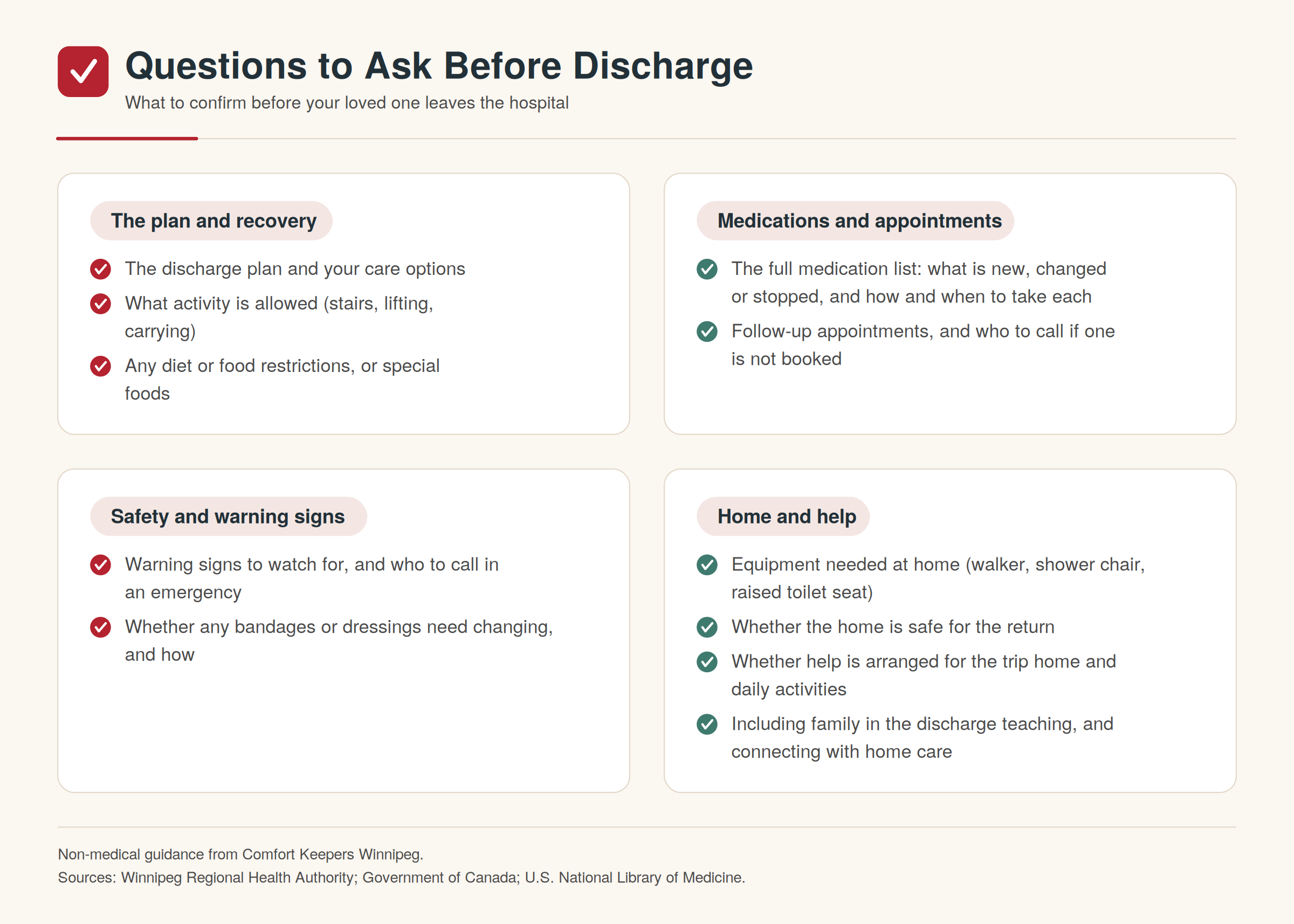
The plan and recovery
- What is the discharge plan, and what are our care options?
- What activity is allowed? Can they climb stairs, lift or carry things?
- Are there diet or food restrictions, or special foods needed?
Medications and appointments
- Can we go through the full medication list, what is new, changed or stopped, and how and when to take each one?
- What follow-up appointments are needed, when, and who do we call if one is not booked yet?
Safety and warning signs
- What warning signs should we watch for, and exactly who do we call for a problem or an emergency?
- Do any bandages or dressings need changing, and how?
Home and help
- What equipment or supplies are needed at home, such as a walker, shower chair or raised toilet seat, and how do we get them?
- Is the home safe for the return, and does anything need to be arranged or changed?
- Is help at home arranged, with someone available for the trip home and for daily activities?
- Can our family join the discharge teaching, and how do we connect with community supports like home care?
Keep the discharge information sheet, prescriptions and appointment details together in one place, so nothing gets lost in the first busy days at home.
Practical Support That May Help at Home
Non-medical home support covers the everyday parts of recovery, so your loved one can follow their discharge plan and rest while the healthcare team handles the medical side. Here is what that looks like day to day, and where the line sits.
What Non-Medical Home Support Can Help With
Our post-hospital and transition support is built around the ordinary moments that get harder during recovery. That can include help with bathing, dressing, grooming and moving safely around the house, which is the heart of our personal care service. It can also include preparing meals, light housekeeping and laundry, reminders to take medications on time, rides to follow-up appointments and the pharmacy, and simple company through the day. We follow the Comfort Keepers approach of Interactive Caregiving, which means doing things with your loved one where we can, a short walk, a familiar routine, a conversation over lunch, rather than simply doing everything for them. Recovery is easier when someone still feels part of their own day.
Where the Healthcare Team Leads and We Support
There is a clear line between the medical side of recovery and the everyday side, and we stay on our side of it. Your loved one’s nurse, prescriber and pharmacist decide what medications to take and manage any changes. Hospital discharge is a known high-risk moment for medication problems, which is exactly why those decisions belong with the clinical team. Our caregivers can remind your loved one to take medications as already prescribed and help keep the medication list current. We do not administer, adjust or manage medications. When a need is genuinely clinical, such as wound care or injections, that is for your physician or our separate in-home nursing service, which is staffed by nurses.
Meals, Mobility, Appointments and Daily Routines
Eating well, moving safely, getting to follow-up appointments and easing back into familiar routines are four everyday areas where a bit of regular help makes the first weeks smoother. The table below sums up how we help in each, and why it matters; the sections that follow add the detail.
| Everyday area | How we help (non-medical) | Why it helps |
| Meals and hydration | Shopping, preparing meals ahead, cooking, keeping fluids within reach, and company at mealtimes | Appetite and thirst can decline with age (Health Canada, Canada’s Food Guide) |
| Moving safely | Help with transfers and walking, plus setting up a safer home | Falls are the leading cause of injury-related hospitalizations for seniors; earlier data found about half happened at home (PHAC) |
| Appointments and getting around | Rides to follow-ups, pharmacy pickups, errands, and bringing the medication list along | Follow-up visits let the care team check recovery (WRHA) |
| Medications and routines | Reminders to take medications as prescribed, and support easing back into daily routines | Many patients miss a medication change in the weeks after discharge (ISMP Canada) |
Sources are linked at the relevant claim in the sections below and listed in full under Sources.
Meals and Staying Hydrated
Appetite, and even the sense of thirst, can fade with age, and recovery is a poor time to be skipping meals or fluids. Health Canada’s Canada’s Food Guide notes that older adults may not feel as hungry, and that the sense of thirst may decline while the need to drink regularly does not. Small, practical steps help: preparing meals ahead on higher-energy days, cooking once and eating twice, keeping water within reach, and sharing a meal, since eating with others may encourage a person to eat more of the foods they need. A caregiver can take care of the shopping, the cooking and the gentle reminders, so a good meal is one less thing to organise.
Moving Safely and a Safer Home
Falls are worth taking seriously, especially early in recovery. Falls remain the leading cause of injury-related hospitalizations among older Canadians. Earlier national data also found that about half of the falls resulting in hospitalization among seniors happened at home. A few changes may help reduce the risk: clearing tripping hazards and loose throw rugs, good lighting including a lit path to the bathroom, grab bars anchored firmly in the tub or shower, non-slip surfaces, and handrails on both sides of the stairs. The Alzheimer Society of Canada frames it the same careful way, that these steps may help reduce the risk of falls. Alongside the home setup, a caregiver can walk beside your loved one and help with transfers, so getting up and moving around feels safer while strength returns.
Getting to Follow-Up Appointments
Follow-up appointments are how the care team checks that recovery is on track. The WRHA explains that these visits let providers evaluate recovery and note any change in condition or medications, and that if an appointment was not booked before discharge, you may need to call in the first day or two. Getting there can be the hard part. Our caregivers can drive to appointments, handle pharmacy pickups, and manage errands and groceries, and can come along to lend a hand. We also remind families to bring the medication list to every visit.
Medications and Daily Routines
Keeping medications on schedule matters most in the weeks right after discharge. One Canadian study cited by ISMP Canada found that 44% of patients did not follow at least one medication change made at hospital discharge, and those patients had a higher risk of problems in the following 30 days. A non-medical reminder, a friendly “did you take your morning pills?”, can help your loved one stay on track with what the pharmacist and prescriber set up. Beyond medications, routine itself is part of healing. Returning gently to familiar activities supports recovery, and the Public Health Agency of Canada’s advice for older adults getting active again is to start slowly and listen to your body. Any return to activity should follow the limits in the discharge instructions. We encourage and support it; we do not set it.
How Family Caregivers Can Share Responsibilities
Sharing the load early protects everyone. Split the tasks, take turns, and bring in outside help where you can. The person recovering gets more consistent care, and no single family member ends up carrying all of it.
Dividing the Work So It Doesn’t Fall on One Person
Caregiving is heavier than it looks from the outside. Statistics Canada found that in 2022 many caregivers felt tired, worried or overwhelmed, and about a third reported disrupted sleep. National home-care data from the Canadian Institute for Health Information shows substantial caregiver strain: among the jurisdictions that report to its indicator, more than 2 in 5 unpaid caregivers of long-stay home-care clients experience distress. The practical answer is to spread the work. Decide together who handles meals, who drives to appointments, who checks in on medications, and who covers the nights. And take the Alzheimer Society of Canada at its word: ask family and friends for help, because asking for help is not a sign of inadequate caregiving.
Looking After the Caregiver Too
The family caregiver’s own health is part of the plan. Watch for the warning signs the Alzheimer Society describes, such as trouble sleeping, getting sick more often, or feeling irritable, and treat them as a signal to get relief rather than to push harder. Manitoba formally recognizes this. The province’s Caregiver Recognition Act sets out that caregivers should be acknowledged as individuals with their own needs within and beyond the caring role. Bringing in respite or companion support for a few hours is often what keeps a recovery at home from wearing the family down. Covering the overnight so a spouse can finally sleep is some of the most useful work we do.
When Care Needs Increase or Change
If recovery is slower than hoped or needs grow, support can scale up, with more hours, overnight, or continuous care, or connect with Manitoba’s public home care. If needs become clinical, that belongs with the care team, your physician, or in-home nursing. The table below compares the public and private options after a hospital stay in Winnipeg.
| Manitoba public home care (WRHA) | Comfort Keepers (private, non-medical) | |
| How to start | Referral and assessment through the WRHA Home Care intake line, 204-788-8330 | Call our local Winnipeg team; care is planned around your situation |
| Right after hospital | Priority Home, a short-term program of up to 90 days reached through the hospital case coordinator (it excludes 24-hour needs) | Support can start at or soon after discharge, then ease off week by week as they get stronger |
| Overnight and 24-hour | Not described as a standard service | Overnight and continuous 24-hour care with rotating awake shifts |
| Scope | Personal care, home support, and professional health services such as nursing and therapies | Non-medical everyday help; clinical needs go to our separate nursing service or your physician |
| Cost note | Not an insured benefit under the Canada Health Act | Private, personalized hours arranged with your family |
Sources: Government of Manitoba and WRHA home care pages, linked at the relevant claims below and under Sources.
Adjusting Private Support as Needs Change
Post-hospital support is meant to be temporary and flexible. It can start with more hours right after discharge and step down week by week as your loved one gets stronger, or stop altogether. If the nights become the worry, or safety cannot lapse at any hour, we can add overnight help or continuous 24-hour care, which we provide with rotating awake shifts so someone is always awake and ready. Because care is personalized, we review the plan as needs change and adjust the hours up or down without you having to start over with a new provider.
Manitoba’s Public Home Care and When to Loop It In
Comfort Keepers fills in around Manitoba’s public home care rather than replacing it. Publicly funded home care in Winnipeg runs through the WRHA, and a person can be referred for an assessment by calling the Home Care intake line at 204-788-8330. Eligibility is based on assessed need. For people coming out of hospital, the WRHA also runs Priority Home, a short-term transitional program of up to 90 days reached through the hospital case coordinator, though it excludes people who need very high hours such as 24-hour care. Families who want to direct their own support can ask about Self and Family Managed Care, where, after an assessment and a signed contract, they receive funding to purchase services or employ staff. Two honest notes: although Manitoba’s public home care provides eligible services without direct charges to the client, home care is not an insured benefit under the provisions of the Canada Health Act, and overnight or continuous 24-hour coverage is not described as a standard part of public home care, which is often where private support fills the gap.
When Needs Go Beyond Non-Medical Support
Knowing the limits of what we do is part of the job. Because our post-hospital support is non-medical, we watch for signs that a person needs more than everyday help, and we tell the family plainly when we see them. From there we help arrange the next step and stay in touch through the change, whether that is our separate in-home nursing service for clinical tasks, a call to the physician, or coordinating with WRHA home care. Being clear about what we do, and do not do, is part of keeping your loved one safe.
How Comfort Keepers Winnipeg Can Support the Return Home
Our Winnipeg team provides non-medical post-hospital support, shaped around your family’s situation and adjusted as recovery moves along.
Care can begin with just a few hours and grow or shrink from there, and through it all we follow Interactive Caregiving, keeping your loved one involved in their own routines, not just cared for.
If your family is preparing for a loved one’s return home from the hospital, we would be glad to help you plan support that fits. Reach our local Winnipeg team at (204) 488-4600, or visit our post-hospital home care page to plan support for the return home. We are based at 806 Osborne Street in Winnipeg and support families across the city.
About the Author
This guide was written by the Comfort Keepers Winnipeg Editorial Team and reviewed for local service accuracy by Debbie Bell, Owner of Comfort Keepers Winnipeg since 2014, who brings years of experience helping local families arrange in-home senior care. Our team specializes in non-medical home care across Winnipeg, including post-hospital and transition support, personal care, dementia care, respite, and 24-hour care. This is a local service-accuracy review, not a medical review.
Sources
Winnipeg Regional Health Authority. Hospital Stays and Discharge Planning (2026).
Winnipeg Regional Health Authority, Surgery Program. Appointments for Follow-Up.
U.S. National Library of Medicine, MedlinePlus. Aging changes in the bones, muscles and joints.
ISMP Canada. Facilitating Medication Safety at Transitions.
Public Health Agency of Canada. Surveillance report on falls among older adults in Canada (2024).
Public Health Agency of Canada. Seniors’ Falls in Canada: Second Report, infographic (2014).
Public Health Agency of Canada. The Safe Living Guide, A Guide to Home Safety for Seniors (2015).
Alzheimer Society of Canada. Living safely and independently.
Health Canada, Canada’s Food Guide. Healthy eating for seniors.
Public Health Agency of Canada. Physical activity tips for older adults (65 years and older) (2019).
Statistics Canada. Providing care in Canada, 2022 (released 2023).
Canadian Institute for Health Information. Caregiver Distress (indicator, updated 2026).
Alzheimer Society of Canada. Reducing caregiver stress (2022).
Government of Manitoba. The Caregiver Recognition Act, C.C.S.M. c. C24.
Winnipeg Regional Health Authority. Home Care.
Winnipeg Regional Health Authority. Priority Home, Frequently Asked Questions for Hospital Staff.
Winnipeg Regional Health Authority. Self and Family Managed Care.
Government of Manitoba. Frequently-Asked Questions about Home Care Services in Manitoba.
Frequently Asked Questions
How quickly can home support start after a hospital discharge?
Home support can sometimes begin at short notice, depending on care needs, caregiver availability and completion of the initial assessment. We recommend calling as soon as a discharge date is being discussed, so the team has as much time as possible to prepare. The earlier we talk, the more we can have ready for the return home.
Can you help if our loved one lives alone with no family nearby?
Yes. When there is no family close by, we can be the consistent presence, with more hours in the early days, regular check-ins, help with meals and medication reminders, and rides to appointments. With the family’s consent, we can keep family members and relevant care providers, such as the physician and WRHA home care, informed so everyone is working from the same information.
What if our loved one is reluctant to accept help at home?
This is common, and we expect it. We start small and familiar, often with one or two visits built around something the person already values, a good meal, a walk, a bit of company, and let trust grow from there. Because we do things with people instead of taking over, it tends to feel less like losing independence and more like getting a hand.
Do you support the family too, or only the person who was in the hospital?
Both. Families are part of every plan we make. We talk through what is working and what is not, keep you updated after visits, and adjust the schedule as your loved one improves, so you are never left guessing about how the return home is going. When the family caregiver can rest or get to work without worrying, the whole recovery holds together better.