


When Should Families Consider Respite Care?
Respite care is short-term support that gives a family caregiver time away while the person they care for continues to receive appropriate support. Most families consider it once the caring hours have quietly grown past what one person can manage alone. In Ontario, respite can take place at home, through an adult day program, or through an eligible short stay in a long-term care home. If you want to think through which of those fits your week, call our Toronto team at (416) 663-2930.
Key Takeaways
- Consider respite care as soon as caring becomes a fixed part of your week. Arranging it early is far easier than arranging it in a hurry.
- Ontario offers three main publicly supported respite routes: a personal support worker at home, an adult day program, or a short stay of up to 60 days in a long-term care home. Fees apply to some of them. Arranging privately is a fourth, with no government eligibility assessment and no waiting list.
- More than 2 in 5 unpaid caregivers of home care clients are distressed, and 2 in 3 of those say it is difficult to continue (CIHI, data to 2024).
- Ontario crisis placement gives a family 24 hours to accept a long-term care bed and five days to move in. Deciding earlier keeps that off your shoulders.
- Where a family member is critically ill or injured, or receiving end-of-life care, Ontario leave and federal EI caregiving benefits may help eligible workers take time away. If you are weighing that against arranging respite hours, call (416) 663-2930 and we can talk through both.
Quick Answer: What Respite Care Is and When to Consider It

Respite care is time away from caring, arranged so that the person you care for is still properly looked after. The World Health Organization defines it as “time away from the caring role to engage in other activities of choice, knowing the care recipient is happy and receiving quality care”. Ontario puts it more plainly on its own respite care page: “As a caregiver, you need a break from time to time.”
There is no single government cutoff that tells a family when it is time to arrange respite care, and we are not going to invent one here. The practical test we would offer is this: picture the current arrangement still running six months from now. Most families we speak to know the answer to that the first time somebody asks it out loud.
The other useful answer is that it does not have to be a big decision. An afternoon is respite. A week is respite. Families often start with the smaller version to see how it goes.
H3: What Respite Care Covers, and What It Does Not
Respite care with us is non-medical support. A caregiver helps with bathing and personal care, meals, light housekeeping, mobility around the house, medication reminders and company, built around your loved one’s own routine rather than a generic schedule.
It does not include clinical care. Our caregivers provide medication reminders but do not administer medication, and where a task belongs to a nurse we will tell you. Some families need both kinds of support at once, and the two work alongside each other perfectly well. If you are still working out which is which, our guide to home care services for seniors in Toronto sets out what everyday support covers.
Common Signs a Family Caregiver Needs Relief
What exists instead of a cutoff is more useful than one. Federal, provincial and territorial guidance for caregivers says plainly to be aware of times when you are feeling anxious, having trouble sleeping, not eating properly or feeling unwell. Ontario’s home care system goes further and formally assesses caregiver burden risk, using six specific inputs. And national surveys record what caregivers themselves report.
The scale is worth knowing before any of it. In CIHI’s current reporting, covering data to 2024, more than 2 in 5 unpaid caregivers of home care clients are distressed, and 2 in 3 of those caregivers say it is difficult to continue. If you have been wondering whether you are the only one finding this hard, you are emphatically not.
What a Caregiver Assessment Actually Looks At
This is the tool Ontario’s care coordinators use when they assess a household for publicly funded home care. It is not something you need to complete before calling anybody, including us, and it is worth knowing about because of what it measures. Caregiver strain here is not a matter of impression. It is measured with a tool CIHI describes as “a decision-support tool that can be used to assess the level of risk of caregiver burden in home care”, and it draws on six inputs.
Three of them are things you can observe about yourself this evening, without any clinical training: your relationship to the person you care for, whether you live with them, and how many hours of care and active monitoring you have provided in the last three days. The other three depend on an assessment: whether distress, anger or depression is being expressed, and two scored measures of the other person’s memory and mood. More on that first one shortly, because it is broader than most people expect.
Two of the six inputs are simply who you are to them and whether you are under the same roof, regardless of how well you are coping. The system already assumes that a spouse who lives with the person carries a different load than a daughter who visits on Saturdays, and it is right.
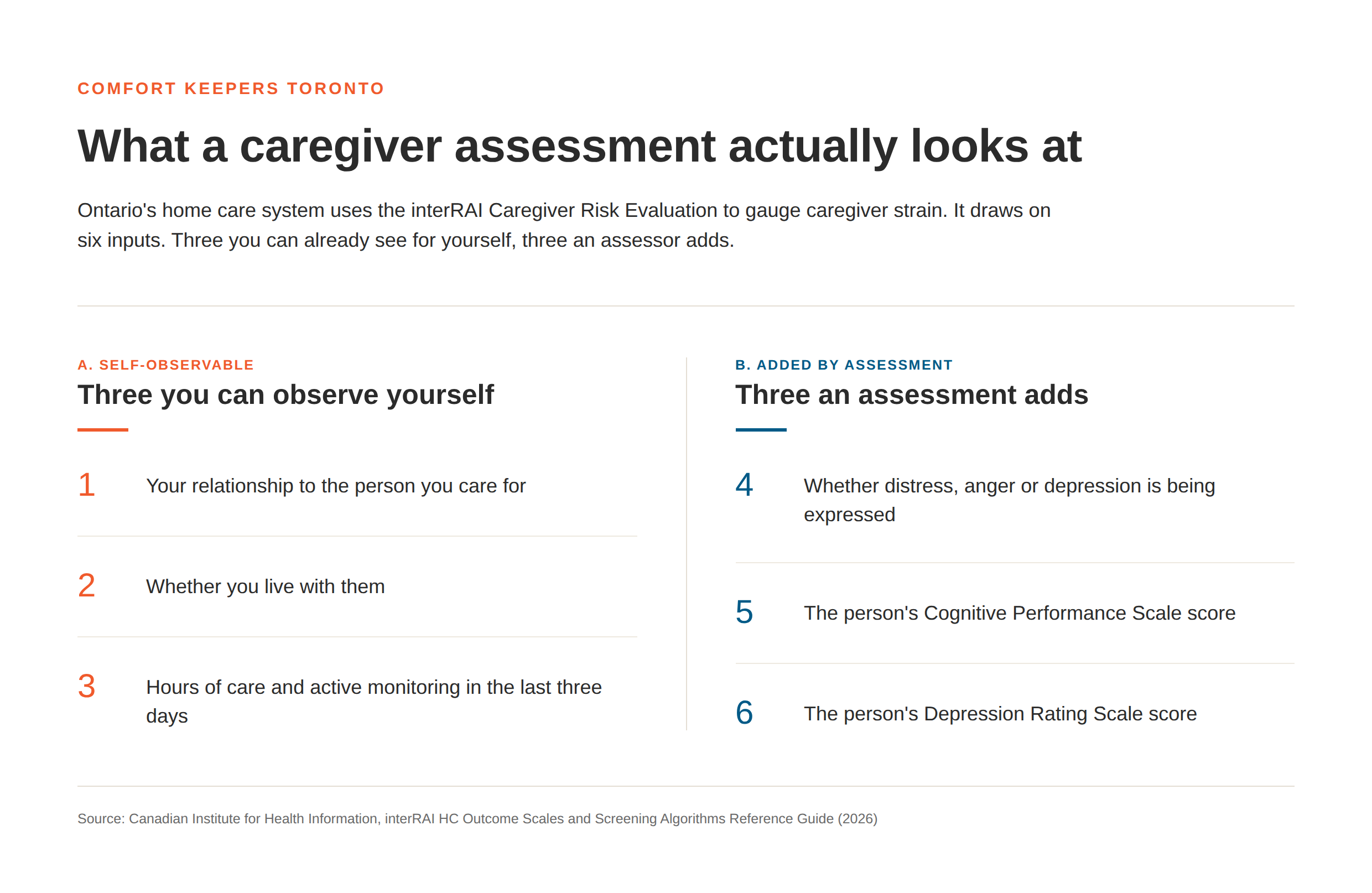
Figure 1. The six inputs Ontario’s caregiver risk assessment draws on. Three are things a family can observe for themselves: the relationship, whether they live with the person, and the hours of care and active monitoring in the last three days. The other three are added by an assessment.
The Hours Are Usually the First Thing to Change
Nobody decides to start caring twenty hours a week. It arrives one errand at a time.
Across Canada the median is 8 hours a week, but Statistics Canada’s 2022 caregiving survey found that “those caring for a spouse or partner or an adult child spent the most hours on care (20 hours per week)” in 2022. Looking at caregivers of care-dependent adults specifically, Statistics Canada reported an average of 21 hours a week, and found that people caring for an adult in their own household spend about 18 more hours a week than those caring for someone who lives elsewhere. Both of those are true at once. Eight is the median across everybody who provides care of any kind, and 21 is the average among people caring for an adult, which is the situation most readers of this page are in.
CIHI puts the top end simply. In its current reporting, caregivers in distress spend the equivalent of a full-time job providing care.
If you have never added your own week up, it is worth doing at some point. Most people are surprised, and a written week is much harder to argue with than a feeling. It is not something you need to have ready before you call us. Most people find it easier to talk it through first.
What Caregivers Themselves Report
Table 1. What caregivers report, and what that can look like at home
| What the research found | What that can look like at home |
| 56% of unpaid caregivers reported feeling tired, and 62% of women did (Statistics Canada, 2022) | Tiredness that sleep does not fix, because the listening never quite stops |
| 44% felt worried or anxious and 37% felt overwhelmed (Statistics Canada, 2022) | Checking the phone during meetings. Running the next three days in your head at 2am |
| 3 in 10 reported their sleep was disturbed (Statistics Canada, 2022) | Waking at the sound of a door, or sleeping with one ear open by habit |
| 16% adjusted their work schedule, 7% reduced their weekly hours, 5% could not hold a paid job (Statistics Canada, 2022) | The quiet career cost nobody counts, usually absorbed without being discussed |
| Among caregivers aged 65 and over, 33% found caregiving stressful or very stressful. Among senior women providing 20 or more hours a week, 59% did (Statistics Canada, 2020, 2018 data) | An older spouse doing the caring is carrying two sets of needs, including their own |
| More than 1 in 4 senior caregivers said their overall health had suffered, rising to 46% among women providing 20 or more hours a week (Statistics Canada, 2020, 2018 data) | The appointments you keep cancelling are your own |
Sources for this table: Statistics Canada, Caregiving in Canada, 2022; Statistics Canada, The experiences and needs of older caregivers in Canada (2020). The first four rows cover all unpaid caregivers in Canada, whether they care for children, adults, or both. The last two rows cover caregivers aged 65 and over, and the 20-hour figures within them are for women.
The Question Nobody Asks a Family Caregiver
Here is the finding that changed how we talk about this. Among Canadians aged 65 and over who were caregivers, Statistics Canada’s study of older caregivers found that “more than 6 in 10 (63%) reported that they had no choice but to take on their caregiving responsibilities.” Among that group, 41% described caregiving as stressful or very stressful, against 19% of those who felt they had a choice.
Most people did not decide to become a caregiver. They looked up one day and were one. Which means asking for help is not backing out of a commitment you made. There was no moment where you made it.
The formal wording is broader than people expect, which is the part worth carrying away. CIHI counts a caregiver as distressed where they are a primary caregiver who expresses feelings of distress, anger or depression, or any caregiver who is unable to continue in their caring activities. Anger sits on that list alongside distress. Snapping at someone you love and then feeling awful about it is one of the things the measure is actually picking up, treated as a sign the load has grown too heavy rather than as a flaw in the person carrying it.
Why Respite Is Useful Before a Crisis
Arranging a break while things are steady is a completely different experience from arranging care in an emergency, because in a crisis the clock belongs to somebody else.
What a Crisis Decision Actually Looks Like in Ontario
Ontario runs long-term care placement in categories, and Category 1 covers “people who need immediate admission to long-term care and cannot have their needs met at home”. Families in that category are exempt from the usual limit of five home choices, because at that point the priority is securing a bed rather than choosing between them.
Then the timing takes over. Ontario Health atHome states that “you must make the decision to accept or refuse the bed within 24 hours of receiving the bed offer”, and that if you accept, “you must move in within five (5) days.” If you refuse, the file is closed and you come off the waiting list for every home you chose, and you cannot reapply for 12 weeks unless the person’s condition or circumstances change.
Those timelines exist so that beds are used well, and they are reasonable ones. The point is simply that they are not yours to set. Arranging support earlier preserves more time to consider the options, which is the strongest practical argument we know for starting the conversation while nothing is forcing your hand.
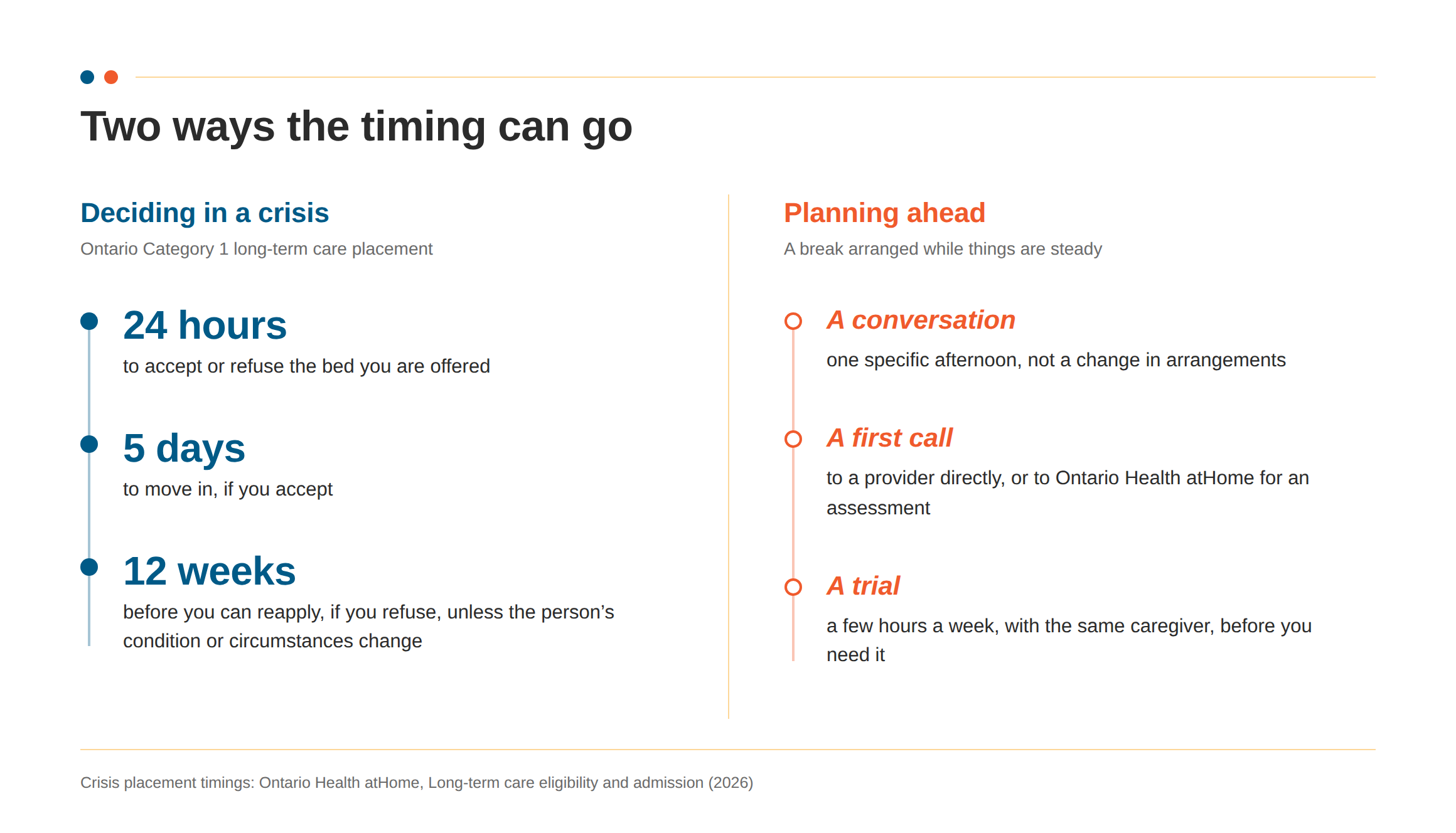
Figure 2. The same decision on two different clocks. In Ontario’s crisis placement category a family has 24 hours to accept or refuse a bed, five days to move in, and 12 weeks before reapplying if they refuse, unless the person’s condition or circumstances change. Planned instead, the sequence is a conversation, a first call to a provider or to Ontario Health atHome, and a trial run of a few hours a week. None of it has a deadline attached, and arranging privately does not require a government eligibility assessment first.
Support Takes Time to Put in Place
Publicly funded support is scheduled rather than instant. One narrow measure of that comes from hospital discharge: CIHI’s summary figures show that around 10% of hospital patients wait for home care services or supports before they can be discharged, that half of those wait 8 days or less, and that 1 in 10 wait 41 days or more. Those figures describe people leaving hospital. They are not respite wait times, and they are not a guide to how long anything will take in Toronto.
CIHI also reports that around 1 in 10 new long-term care residents had a clinical profile similar to that of clients cared for at home with formal supports in place, and that more of them live alone. That is a comparison of clinical profiles, not a statement about why any particular person moved.
What a Break Actually Does
We would rather tell you plainly what a break does than promise more than it can deliver.
It covers hours that currently have only one person in them. It keeps the routine going, so the day your loved one has is recognizably their own day. It gives you hours you are not spending on standby. And it means somebody besides you knows the household, the routine and where things are kept.
In our experience that is usually enough to change how the month feels.
What Respite Care Can Look Like

Ontario offers three main publicly supported respite routes, and arranging support privately is a fourth. Most families assume respite means their loved one has to go somewhere. Usually it does not. One thing worth knowing up front: publicly supported does not always mean free. Adult day programs usually charge a fee, and a short stay in a long-term care home carries a daily accommodation co-payment.
The province is direct about it. Ontario’s guide to programs and services for seniors states that respite services “aim to give caregivers a break or rest,” delivered “through: an adult day program, a personal support worker visit at home, a short stay in a long-term care home.”
Table 2. Four ways a break can be arranged
| Option | Where care happens | Who arranges it | What it suits | What it costs |
| A caregiver at home | The person’s own home | Ontario Health atHome after an assessment, or privately | Keeping routines intact. Regular blocks of time. A parent who will not leave home | Publicly funded where eligible, based on assessed need. Private hours are paid by the family |
| An adult day program | A community group setting, part or full day | Ontario Health atHome, or the program directly | Company for your loved one, and predictable hours for you | A fee usually applies. The City notes subsidies may be available |
| A short stay in a long-term care home | A long-term care home, up to 60 days at a time | Ontario Health atHome, after an assessment | A longer break. A caregiver travelling, in hospital, or unwell | $45.31 per day co-payment, effective 1 July 2026 |
| Private support arranged directly | Your loved one’s own home | You, by contacting a provider | A flexible start, from a few hours, with no government eligibility assessment | Paid privately, priced to the hours you need. Call (416) 663-2930 for a clear figure |
Sources for this table: Government of Ontario, Guide to programs and services for seniors; Ontario Health atHome, Short-Stay; Government of Ontario, Paying for long-term care; City of Toronto, Senior Caregiver Supports. Private pricing depends on the number of hours, the timing and the support required, which is why a single hourly figure on a web page tells you very little. Tell us the schedule you are trying to cover and our Toronto team will explain the applicable cost before you decide anything.
A Caregiver Comes to the Home
For families who want their loved one to stay at home, this is often the most flexible option. A caregiver arrives for an agreed block of time and carries the parts of the day you normally carry: the bathing, the meal, the laundry, the company, the watching. Nothing about the house changes. Your loved one stays in their chair, in their kitchen, with their own tea.
It is also the easiest thing to start small with. A weekday afternoon, every week, is a real break and a low-stakes way to find out whether the arrangement works. If that is the need, our respite care service in Toronto is built around exactly this, and you can call (416) 663-2930 to talk through what a week might look like.
An Adult Day Program
Adult day programs may be less familiar to some families, but they can be a useful option when time out of the house is welcome. Ontario Health atHome describes them as “a partial or full day of supervised programming in a community group setting, outside the home for adults who are living in the community,” where participants “benefit from recreational and social activities, meals, personal care and basic health care services.” The same page says directly that these programs “offer respite for families and caregivers to avoid caregiver burden and enjoy a break.”
To take part, a person needs to be 18 or over, hold a valid Ontario health card, be living at home with difficulty managing daily activities independently, and not pose a risk to themselves or others. A fee usually applies, and the City of Toronto notes that subsidies may be available.
The added benefit here is a change of scene and other company for your loved one. For someone whose world has narrowed to one room and one person, a morning with other people can be the better half of the deal. A caregiver at home does a different job, keeping the familiar routine intact, and plenty of families use both.
A Short Stay in a Long-Term Care Home
For a longer break, Ontario offers short-stay respite beds. The province sets the limit at 60 days per stay, stating that “while you are away, the person you care for can stay for up to 60 days in a long-term care home” and “cannot be admitted for more than 90 days in a calendar year.” Ontario Health atHome describes the stream as one that allows “caregivers to take a break from their daily responsibilities to rest, rejuvenate, attend family functions or enjoy a vacation.”
Arranging one involves two steps: an eligibility assessment from Ontario Health atHome, and a separate health assessment from a doctor, nurse practitioner or other primary care provider. Together they confirm that the person meets long-term care eligibility requirements, which can include needing nursing care available around the clock, frequent help with activities of daily living, or frequent on-site supervision or monitoring for safety and well-being. There is also a daily co-payment, $45.31 as of 1 July 2026, and some homes ask for it in full at check-in.
None of that rules it out. It is simply what to expect going in. A short-stay bed may be worth considering when a caregiver is going into hospital, travelling, or needs a longer break, and the main thing to weigh is that your loved one leaves home for that period.
Arranging Support Privately
Private support is the fourth route, and its practical difference is that you arrange it directly with a provider. There is no Ontario Health atHome eligibility assessment to complete first and no government waiting list to join, and it can be as small as a few hours a week rather than a defined program. Before support begins, a provider will plan the care with you, which is how the hours get matched to the week you actually have rather than forced into a template. That conversation is also what tells us how soon we can start.
Plenty of families use both. They request an Ontario Health atHome assessment and arrange private hours in the meantime, then keep whichever combination works. Requesting an assessment does not stop you putting help in place now, and any publicly funded care plan that follows will still be based on Ontario Health atHome’s own assessment of needs and eligibility. None of that has to hold up the private hours. Call us and we can get those arranged while the rest plays out.
Respite for Dementia Caregivers
If you are caring for someone living with dementia, the case for planning a break earlier is stronger. This is the group where caring takes the most hours and is hardest to hand over at short notice.
Why the Numbers Are Different
The current national figure comes from the Public Health Agency of Canada’s 2025 annual report on the national dementia strategy. It reports that distress among caregivers of people living with dementia fell slightly from 37.1% in 2019 to 2020 to 35.3% in 2023 to 2024, and that this has stayed at about double the rate among caregivers of people without dementia, which was 19.2% in 2023 to 2024.
Roughly twice the rate, and it has sat there for years. The hours behind that gap are the part families feel. CIHI’s 2024 analysis of home care records found that caregivers of people living with dementia provided 24.5 hours of care per week on average, compared with 19.7 hours provided by caregivers of people without dementia. Nearly 25 hours is most of a working week, on top of whatever else the week already holds. In CIHI’s earlier 2015 to 2016 data, 21% of caregivers of seniors with dementia felt unable to continue their caring activities, against 12% of caregivers of other seniors.
One more finding from that older CIHI work is worth naming, because families rarely say it out loud. Caregivers of seniors with dementia had 1.6 times higher odds of reporting distress where the person receiving care displayed verbal or physical aggression. If that is happening in your house, it is a recognized part of the picture and not a private failure.
What Changes Day to Day
Dementia caregiving wears people down for a second reason beyond the sheer number of hours. It is unpredictable.
CIHI’s 2015 to 2016 comparison of home care clients found responsive behaviours in 25% of clients with dementia against 4% of those without, dependence in daily activities in 28% against 15%, and wandering in the last three days in 10%, against essentially none of the clients without dementia.
Read that as a description of a week rather than a clinical profile. It means the day has fewer fixed points, help is needed at hours that do not appear on any schedule, and leaving the house is a decision rather than a default. Which is exactly why a break is both harder to arrange and more necessary.
Planning a Break Around Familiarity
The practical advice we give families here is about sequencing, not services. Familiar faces and familiar routines carry a lot of weight, so respite tends to work better when it is introduced gradually and while things are calm: the same caregiver, the same day, starting short.
Dropping a new person into the house during a crisis asks everybody to adjust at the worst possible moment. Starting three months earlier, with a Tuesday afternoon, means that by the time you actually need to lean on it, you are not introducing a stranger. You are calling someone who already knows how your father takes his coffee.
For the fuller picture of what non-medical support looks like at each stage, see our guide to dementia care at home in Toronto or our dementia and Alzheimer’s care page.
How to Start the Conversation
Start with something small and specific. A discussion about care in general has nowhere to land. “I am going to have someone come on Tuesday afternoons for a few weeks” lands very differently from “we need to talk about getting you some help.”
Talking to the Person You Care For
Two things make this easier. Name an actual afternoon rather than a change in arrangements, because a specific, limited trial is easier to discuss than an open-ended change in care. And frame it around your own need for a break, which has the advantage of being true. Some people respond far better to “I need a few hours on Tuesdays” than to any sentence about what they can no longer manage.
Initial hesitation is understandable and very common. If the person is comfortable carrying on, a short trial with the same caregiver helps everyone work out whether the arrangement feels right, and opinions often shift once the person coming has a name and a face. If they are not comfortable, that matters, and it is worth returning to later rather than pressing. In the meantime it is worth a conversation with us anyway, about how to raise it again, or about whether something smaller, like a ride to one appointment, is an easier place to start than someone in the house.
Talking to the Rest of the Family
Bring the week you wrote down. It tends to end the debate about whether help is needed and start the useful conversation about who is paying and who is arranging.
It also protects whoever is doing the most. Families often do not realize how much one person has been carrying until that person needs to step back.
Time Off Work, If You Need Longer Than a Few Hours
If the break you need means stepping away from work, two separate systems may help, and both are worth checking early because each turns on a medical certificate.
Ontario’s Employment Standards Act provides unpaid, job-protected leave: Family Caregiver Leave of up to 8 weeks per calendar year for each specified family member, Family Medical Leave of up to 28 weeks in a 52-week period, and Critical Illness Leave of up to 17 weeks for an adult or 37 weeks for a minor child. Each has its own certificate requirement, and all three are unpaid.
Separately, Employment Insurance offers three caregiving benefits. These are not general respite funding. They apply where the person being cared for is critically ill, critically injured, or receiving end-of-life care, and they pay 55% of earnings up to a maximum of $729 a week for 2026.
The two systems have separate eligibility tests, so a leave and a benefit do not automatically come as a pair. This is general information rather than legal or benefits advice, and the rules change, so confirm the current requirements before you plan around them.
If working out which of them applies feels like a project of its own on top of everything else, that is a perfectly normal reason to call. We cannot advise you on a leave or a benefit, but we can put respite hours in place while you sort it out.
What to Ask Before the First Visit
These are worth asking any provider in Toronto, including us. A provider who knows their own answers will give you specifics.
- Who exactly is coming, and in what role? Ask for the title.
- Who supervises the caregiver, and who does the family call if something is wrong at eight in the evening?
- What happens when the regular caregiver is sick or away? Ask how a replacement is briefed, not just whether one exists.
- What screening was done before this person came into the home?
- If a task moves from something a caregiver can do to something they cannot, who notices, and who tells the family?
Toronto Resources and Next Steps
Plenty of households here are working through the same question. In the 2021 Census, 476,990 Toronto residents were 65 or over, 17.1% of the city, and since 2016 Toronto has had more people aged 65 or older than people under 15. The City expects over 719,000 adults aged 65 and older by 2041.
Where to Start in Toronto
- To arrange a private caregiver, on its own or alongside any of the public routes below, call our Toronto team at (416) 663-2930. There is no government referral or eligibility assessment to complete first. We will talk through what the week needs and plan the care with you, and we can help you work out which of the routes below is worth pursuing at the same time.
- For publicly funded respite, an assessment is the way in, and you do not have to wait for it before arranging support privately. Ontario Health atHome confirms that anyone can make a referral, and that Ontario residents with a valid OHIP card are eligible for an assessment completed by a care coordinator. Call 1-833-515-1234. The Toronto Central office is at 250 Dundas Street West, Suite 305.
- For an adult day program, the City of Toronto runs three of them at its own long-term care homes: Bendale Acres in Scarborough at 416-397-7020, Cummer Lodge in North York at 416-392-9502, and Kipling Acres in Etobicoke at 416-392-2299. Worth knowing: one of the City’s own eligibility criteria is a “caregiver assessed and in need for regular periods of respite”.
- For a longer stay, at least one City home runs a short-stay respite program. Kipling Acres publishes a short-stay admission program for families seeking respite from the caregiver role.
- To find services and community supports, the Toronto Seniors Helpline is 416-217-2077. The City also runs Homemakers and Nurses Services at 416-392-8579 for light housekeeping, laundry, shopping and meal preparation, which is income-tested.
- For caregiver support, the City of Toronto lists the Ontario Caregiver Helpline at 1-833-416-2273 on its Senior Caregiver Supports page.
Help With the Cost
This is general information rather than tax advice, thresholds change from year to year, and it is worth confirming the current rules or asking your tax preparer.
- The Ontario Seniors Care at Home Tax Credit, currently listed as active, is refundable and “provides up to 25% of claimable medical expenses up to $6,000, for a maximum credit of $1,500,” reduced by 5% of family net income over $35,000 and fully phased out by at most $65,000. You or your spouse must have turned 70 or older in the year and you must be resident in Ontario at year end. Attendant care is among the eligible expenses, with certification required.
- The Canada Caregiver Credit may apply if you support a spouse or a dependant with a physical or mental impairment. For the 2025 tax year the amounts are $2,687 and up to $8,601 depending on who you are claiming for.
- Certain attendant care expenses may be claimable federally. CRA’s guidance allows a claim of up to $10,000 a year, or $20,000 in the year a person dies, alongside the disability tax credit, and sets out when the two cannot be combined. Ask what receipts you will get, and keep them.
Talk to Our Toronto Team
If you are somewhere in the middle of this and not sure which part to solve first, that is the most common call we get, and it is a fine reason to pick up the phone.
- If you need regular hours covered, start with respite care in Toronto.
- If you are not sure what kind of support the week actually needs, look through our Toronto services or read more in our Information Centre.
- If you would rather just talk it through, contact our Toronto team or call (416) 663-2930.
We are Comfort Keepers Toronto, based at 245 Fairview Mall Drive, Suite 401 in North York, and we provide non-medical home care across Toronto and North York.
Whatever you decide to do next, do not wait for permission to be tired. Arranging a few hours of help is a normal thing to do, and it is much easier to set up now than in the middle of a bad week.
About the Author and Reviewer
This guide was written by the Comfort Keepers Canada Editorial Team. [HOLD until the review has taken place: It was reviewed for local service accuracy by Susan Uno, Franchise Administrator of Comfort Keepers Toronto.] It is a local service-accuracy review, not a clinical or medical review. You can learn more about our team on the Comfort Keepers Toronto team page. This article explains when families tend to consider respite care and how it is arranged in Ontario. It does not replace medical advice, diagnosis or treatment, and it is not advice about any particular person’s care.
Published September 2026 · Last reviewed September 2026
Sources
Canadian Institute for Health Information. Caregiver Distress, indicator (2026).
Government of Ontario. Respite care (accessed September 2026).
Government of Ontario. Paying for long-term care (accessed September 2026).
Government of Ontario. Ontario Seniors Care at Home Tax Credit (accessed September 2026).
Ontario Health atHome. Getting started (accessed September 2026).
Ontario Health atHome. Long-term care, eligibility and admission (accessed September 2026).
Ontario Health atHome. Long-term care, short-stay (accessed September 2026).
Ontario Health atHome. Adult day programs (accessed September 2026).
Ontario Health atHome. Toronto Central area (accessed September 2026).
Government of Canada. EI caregiving benefits (accessed September 2026).
Government of Canada. EI caregiving benefits, how much you could get (accessed September 2026).
Canada Revenue Agency. Canada caregiver credit (accessed September 2026).
Canada Revenue Agency. Guide RC4065, Medical Expenses, attendant care and care in a facility (2025).
City of Toronto. Adult Day Programs (accessed September 2026).
City of Toronto. Senior Caregiver Supports (accessed September 2026).
City of Toronto. Seniors Health and Home Care Services (accessed September 2026).
City of Toronto. Homemakers and Nurses Services (accessed September 2026).
City of Toronto. Kipling Acres long-term care home (accessed September 2026).
City of Toronto. A plan to develop the third Toronto Seniors Strategy, Council backgrounder (2024).
Frequently Asked Questions
How far ahead should I arrange a break for a planned trip?
Further ahead than feels necessary, particularly if you want the same caregiver each time. Booking early buys you room for a couple of short trial visits first, so by the time you actually go, the person arriving is already familiar. For anything arranged through Ontario Health atHome, the assessment sits ahead of the service, so allow time for that step as well. If the dates are tight, arranging privately skips that step, and a call to (416) 663-2930 will tell you what is realistic for the time you have.
Will my parent think I am giving up on them?
Often, at first. A specific person tends to do more to change that than any argument will, because once there is a caregiver with a name who arrives on a set day, the idea stops being abstract. It also helps to be honest that the break is for you. Some people respond better when the conversation is framed around the family caregiver’s need for a break rather than around what the older adult can no longer manage.
What if the first caregiver is not the right fit?
Say so, early and plainly. Personality matters more in this work than almost anything else, and a mismatch is a normal thing to raise rather than a complaint you need to justify. Any provider should be able to tell you how they handle a change, how quickly, and what the new person is told about your loved one before their first shift. We would far rather hear it in week one than have you quietly stop calling.
What if my parent refuses to have anyone in the house?
Be concrete about the help being proposed. Instead of leading with a broad label, explain the actual tasks: transport to an appointment, help with the shopping, company while you are out. Be clear about who the caregiver is and why they are coming, because the arrangement should never be something happening behind their back. Keep the first visits short, keep the same person coming, and be present for the first one so they can meet the person with you there.
I live in another city. Can I still arrange this?
You can, and a fair number of the families we speak to are doing exactly that. Anyone can make a referral to Ontario Health atHome, so a distant adult child can start that process, and private support can be arranged and paid for from anywhere. The part that needs thought is who the caregiver reports to, and how you will hear about changes. Agree that before the first visit rather than after the first worry.
Is there anything I should have ready before I call?
Nothing at all, and you should not put the call off to get organised first. That said, three things make the conversation more useful if you happen to have them. A rough sense of the week, showing when help is actually needed, which matters more than the total hours. A short list of what your loved one can still do independently, because good care works around that rather than over it. And a sense of what has already been tried, including anything that went badly. None of it needs to be tidy, and we can work it out on the phone with you.

