
24-Hour Care vs Short-Term Live-In vs Overnight Care in Toronto
By the Comfort Keepers Canada Editorial Team. Reviewed for local service accuracy by Susan Uno, Franchise Administrator, Comfort Keepers Toronto.
Published: October 2026 | Last reviewed: October 2026
When families compare 24-hour care vs live-in care in Toronto, the main difference is how coverage is structured through the day and night. With 24-hour care, a rotating team of our caregivers works in shifts so someone is on duty at all times. With short-term live-in care, a caregiver stays in the home during each 12-hour shift, combining planned hands-on support with on-call presence between care needs. Overnight care covers the night, from getting to bed through to the morning. All three are non-medical care from our Toronto team, and nursing can be arranged when clinical care is needed.
This guide covers how each option works at Comfort Keepers Toronto, the questions that usually decide between them, and how families combine private care with Ontario’s public programs and tax credits.
Key Takeaways
- 24-hour care vs short-term live-in care in Toronto: the deciding question is whether someone needs to be on duty at every hour, including overnight.
- 12-hour shifts are typical for our short-term live-in caregivers, who stay in the home and combine planned hands-on support with on-call presence.
- Overnight care covers getting to bed, night-time needs and the morning, and can be combined with daytime visits as needs grow.
- 3 in 10 unpaid caregivers in Canada reported disturbed sleep in 2022 (Statistics Canada, 2022), so plan rest for the family, not only care hours.
- One week of notes on night-time needs is worth bringing to your complimentary in-home assessment. Call (416) 663-2930.
Quick Comparison
Here is how the three options compare side by side.
Table 1. 24-hour, short-term live-in and overnight care at Comfort Keepers Toronto
| At a glance | 24-hour care | Short-term live-in care | Overnight care |
| Who is in the home | A rotating team of Comfort Keepers caregivers | A caregiver who stays in the home during each shift, with a private area to rest | A caregiver who stays through the night |
| How coverage works | Caregivers work in shifts, so someone is on duty at all times | Typically 12-hour shifts, combining planned hands-on support with on-call presence in the home between care needs | From getting to bed, through night-time needs, to the morning |
| At night | A caregiver on duty through the night | A caregiver in the home for reassurance, on call during each shift | A caregiver present through the night |
| Often suits | Someone who should not be alone for long, is at risk of falls, or needs help day and night | Someone who needs daytime help and the reassurance of a caregiver nearby | Someone who mainly needs help at bedtime, through the night and in the morning |
| Length | Planned around your family’s needs, for a hard stretch or longer | A defined period: a few days, a few weeks, or until things settle | Planned with you at the in-home assessment |
| Type of support | Non-medical care; nursing can be arranged if needed | Non-medical care; nursing can be arranged if needed | Non-medical care; nursing can be arranged if needed |
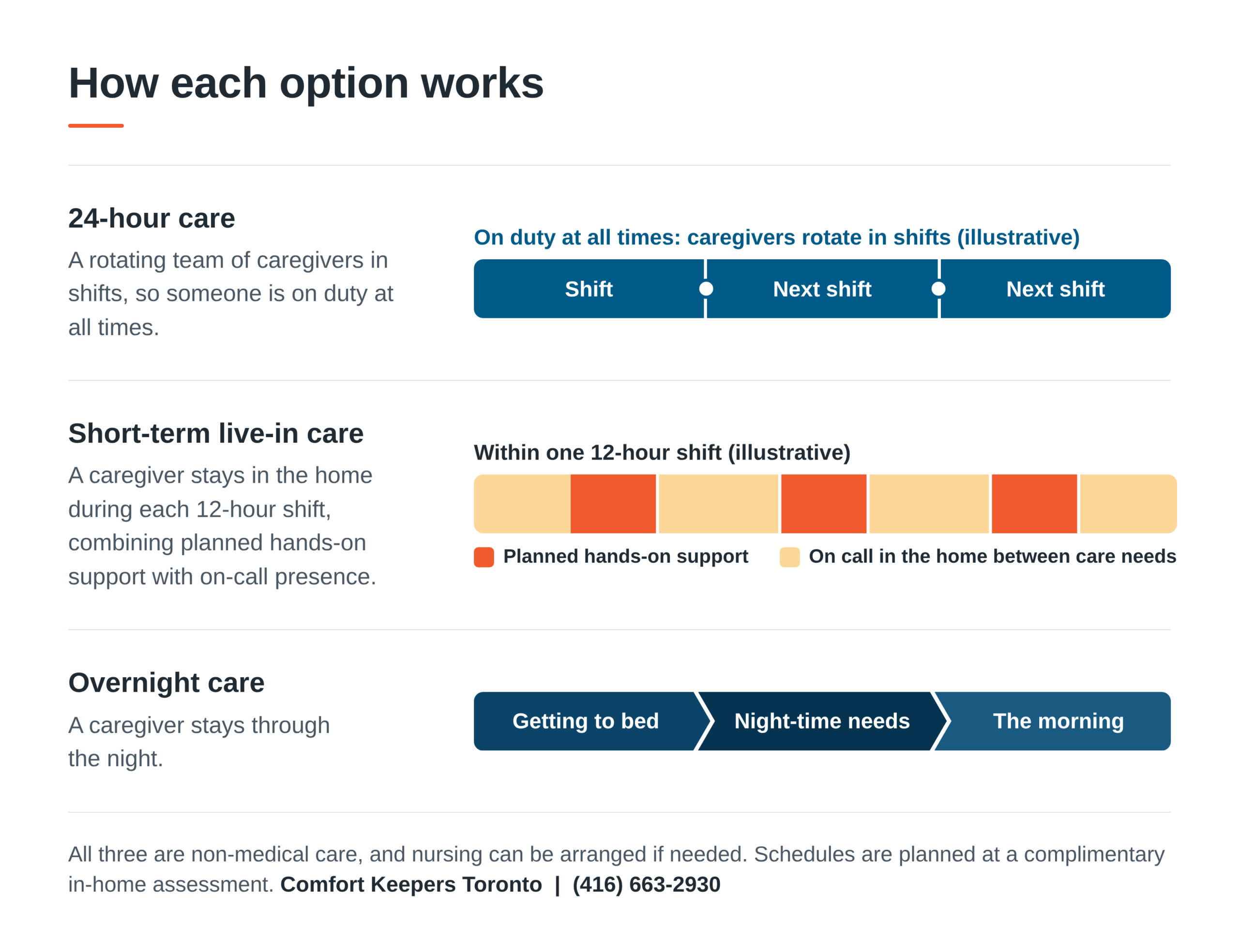
Figure 1. How each option works
What 24-Hour Care Means
Comfort Keepers Toronto’s 24-hour care uses rotating caregivers working in shifts so a caregiver is on duty at all times, day and night.
Many families start looking at 24-hour care in Toronto when a parent or spouse should not be alone for long stretches, is at risk of falls, or needs help through the night as well as during the day. Falls are worth planning for: they cause 89% of injury-related hospitalizations among Canadians aged 65 and older (Public Health Agency of Canada, Falls among older adults in Canada, 2025). Help with mobility, transfers and night-time trips to the bathroom is a practical way to plan for that.
Around the clock, a Comfort Keeper can help with personal care, mobility and transfers, meals, light housekeeping, companionship and getting to appointments. Our caregivers are screened, trained and matched to your loved one.
What Short-Term Live-In Care Means
Comfort Keepers Toronto’s short-term live-in care typically uses 12-hour shifts and combines planned hands-on support with on-call presence in the home. Short-term live-in care places a caregiver in your loved one’s home for a defined period, so they can stay safe and comfortable through a recovery, a family caregiver’s absence or another temporary need. The caregiver stays in the home, works set shifts and has a private area where they can rest.
Shifts typically run 12 hours. Hands-on care is planned around your loved one’s routine, with the caregiver remaining in the home and available between care tasks. A typical shift includes about four hours of active care, although the care plan is built around the individual’s needs and schedule. Short-term live-in care suits someone who needs help through the day and the reassurance of a caregiver close by. When hands-on help is needed at every hour, 24-hour care covers that with a team working in shifts.
Families often choose short-term live-in care when:
- a family caregiver needs a break or is travelling
- an older adult is recovering from surgery or illness
- a loved one is waiting for a home and community care placement
- a difficult period has disrupted daily routines
- support is needed during a transition, such as a move to assisted living
It can last a few days, a few weeks, or just until things settle.
What Overnight Care Means
Comfort Keepers Toronto’s overnight care focuses on support from bedtime, through the night and into the morning: a caregiver stays through the night to help with getting to bed, night-time needs and the morning. It suits families whose days are covered, whether by family, our daytime visits or other support, but who find the nights hardest to manage.
Nights can be especially hard to cover when memory changes are involved. Close to 487,000 Canadians aged 65 and older were living with diagnosed dementia in 2022-2023 (Public Health Agency of Canada, Dementia: Overview, 2025). Dementia can disrupt normal sleep-wake patterns, sometimes leading to wakefulness, restlessness or wandering during the night, which can affect the caregiver’s sleep as well (Public Health Agency of Canada, Dementia: Symptoms and treatment, 2022; Alzheimer Society of Canada, Sleep, 2023). Even without memory changes, night-time trips to the bathroom are worth planning for, and federal home-safety guidance asks whether there is a clear path from the bed to the bathroom (Public Health Agency of Canada, The Safe Living Guide).
Family members lose sleep as well. In 2022, 3 in 10 unpaid caregivers in Canada reported that their sleep was disturbed (Statistics Canada, The Daily, November 8, 2022). Overnight support can reduce the amount of night-time care the family has to manage, helping family caregivers protect their own rest. For families living with memory changes, overnight support can sit alongside our dementia care at home.
Which Questions Help Determine Fit

Two things usually point the way: how often your loved one needs hands-on help at night, and how long that need is expected to last. Use this table as a starting point when you talk with us.
Table 2. Matching the situation to the option to discuss first
| If this sounds like your situation | Option to discuss first | Why |
| Help is needed at unpredictable times, day and night, and your loved one should not be alone for long | 24-hour care | Someone is on duty at every hour |
| Help is needed mostly through the day, and having a caregiver in the home brings reassurance | Short-term live-in care | Planned hands-on support within each 12-hour shift, with the caregiver in the home between care needs |
| The need is temporary: a recovery, a family caregiver travelling, or waiting for a placement | Short-term live-in care, or 24-hour care if nights are busy | Both can cover a defined period |
| Days are covered by family or other support, but nights are hard | Overnight care | Covers getting to bed, night-time needs and the morning |
| You are not sure yet | A complimentary in-home assessment | We suggest a schedule after meeting your loved one |
Questions to ask about nights
- How many times a week does your loved one need hands-on help between bedtime and morning?
- Can they recognize when they need help and call for it?
- Do they get up confused, seem restless or try to leave the home at night?
- Is the family member covering nights getting enough sleep to stay well?
- Is the need tied to a recovery or event with an end date, or is it ongoing?
- Who covers the daytime now, and can that continue?
Bring your answers to the in-home assessment. They shape the schedule we suggest.
When your loved one needs clinical care
Across all three options, our caregivers provide non-medical support, including medication reminders. Some clinical procedures, including administering certain medications by injection or inhalation, are controlled acts under Ontario’s Regulated Health Professions Act, which sets out who is authorized to perform them (Regulated Health Professions Act, 1991, Government of Ontario). If your loved one’s care includes clinical tasks, tell us during the assessment so nursing support can be planned alongside their home care. We can arrange nursing or work alongside your medical providers.
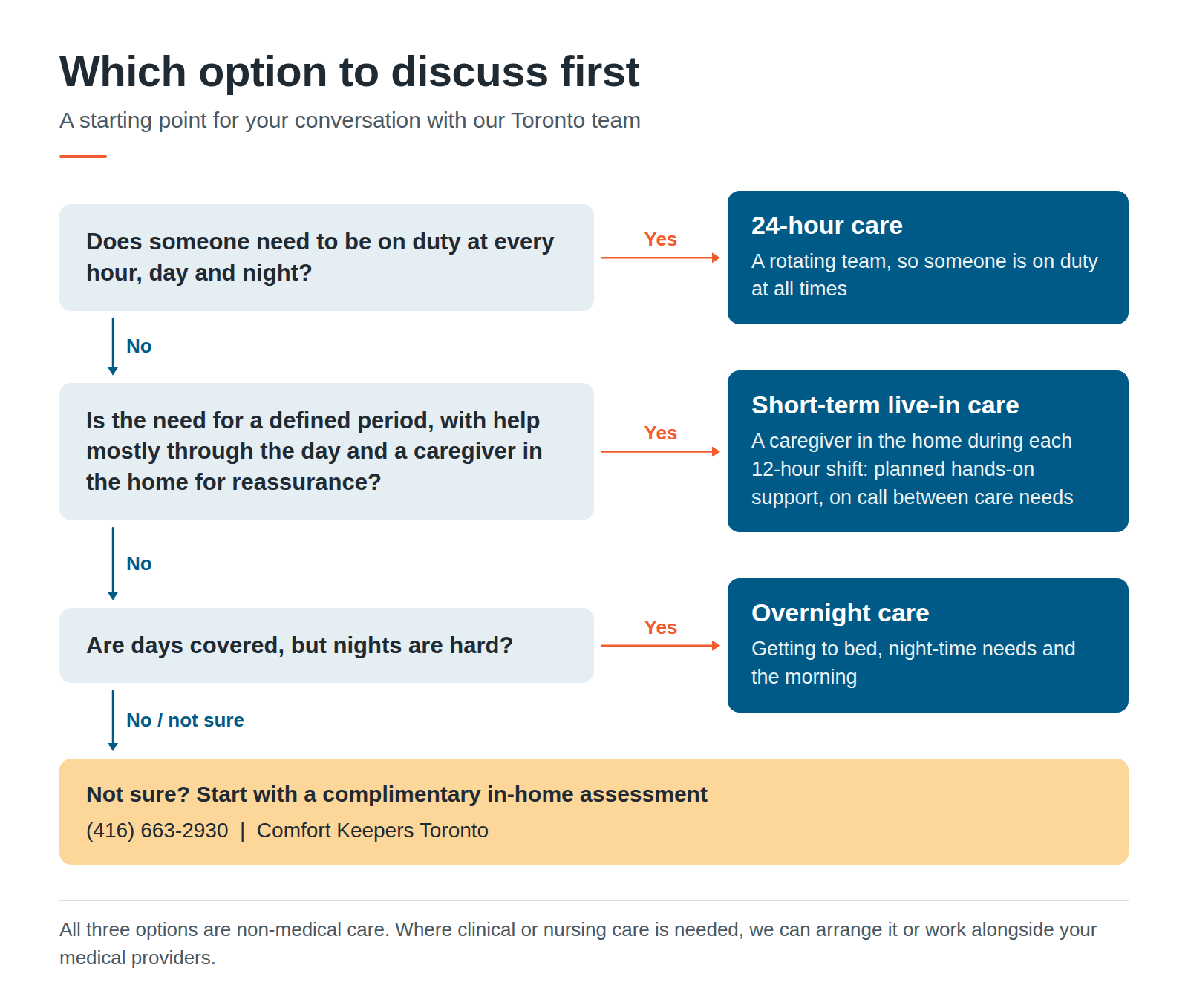
Figure 2. Which option to discuss first
How to Plan Coverage
Plan coverage around the hours when help is needed, then build in breaks for whoever covers the remaining hours. Family caregivers carry a lot: in the provinces and territories that report to CIHI, more than 2 in 5 unpaid caregivers of home care clients experience distress, and 2 in 3 of them say it is difficult to continue (Canadian Institute for Health Information, Caregiver Distress indicator, data updated March 2026). Building regular rest into the schedule from the start helps the whole arrangement last.
Keep a one-week log before the assessment
Before we meet, we suggest keeping simple notes for seven days and nights. The log answers the questions above with real detail, and it does not need to be clinical. Note:
- the time your loved one went to bed and got up
- each time they woke and needed help, and what with (the bathroom, reassurance, getting back to bed)
- which daytime tasks took the most time or were skipped
A week of notes shows patterns that are easy to miss in the moment, such as help needed at the same hour most nights. It lets us base the schedule on what actually happens at home.
Combine private care with Ontario’s public programs
Private care and publicly funded care can work side by side. In Ontario, publicly funded home care is arranged through Ontario Health atHome, and anyone can make a referral with the person’s consent, including a family member or the person themselves (Ontario Health atHome, Making a Referral, n.d.). A case manager or care coordinator assesses needs and eligibility and works with the person, and anyone they choose to involve, on a care plan, and the province’s home care page refers to “scheduled visits typically through Ontario Health atHome” (Government of Ontario, Home and community care, 2026). Families who need someone present overnight or around the clock may add private care around those visits.
For planned breaks, Ontario also offers short-stay respite in a long-term care home, for up to 60 days and no more than 90 days in a calendar year, with accommodation costs such as room and board paid privately (Government of Ontario, Respite care, 2026). If your loved one would rather stay in familiar surroundings, short-term live-in care or our respite care in Toronto gives the family caregiver a break while routines at home carry on.
Tax credits may help with some home care costs
Some paid attendant care expenses may qualify as medical expenses for tax purposes, depending on the person’s circumstances and eligibility (Canada Revenue Agency, Medical Expenses 2025, Guide RC4065). Ontario also offers a refundable Seniors Care at Home Tax Credit for qualifying seniors.
Tax rules vary depending on the type of care, disability eligibility, income and who pays the expense. See our guide to home care and caregiver tax credits in Canada [HOLD: link to the tax-credit guide once published], and confirm your individual situation with the Canada Revenue Agency or a tax professional.
Talk with our Toronto team
Every plan starts with a complimentary in-home assessment, so we can understand your loved one’s needs, wants and wishes. From there, we match them with trained caregivers and build a schedule around their routine: nights only, a short-term live-in stay or a team around the clock. Call us at (416) 663-2930 or contact our Toronto team. Our office is at 245 Fairview Mall Dr #401, North York, ON M2J 4T1.
About the Author
This guide was written by the Comfort Keepers Canada Editorial Team, which prepares our Information Centre guides for families comparing care options. Comfort Keepers began in Canada in 2004, and our Toronto team supports families across Toronto and North York from our office on Fairview Mall Drive.
Reviewed for local service accuracy by Susan Uno, Franchise Administrator, Comfort Keepers Toronto, who joined Comfort Keepers in 2010 after caring for her own mother and father. Read more on our Toronto executive bios page.
References
Frequently Asked Questions
Can we move from overnight care to 24-hour care if needs change?
Yes. If night-time help becomes more frequent, or less needed, we review the plan with you and adjust the schedule, which can include moving to 24-hour care.
What happens if our regular caregiver is sick or on vacation?
Your loved one’s care carries on. Our Client Care Coordinator arranges another caregiver and keeps you informed about the change.
What does a short-term live-in caregiver need in the home?
A private area where they can rest. It gives your loved one and the caregiver their own space during a stay that may last days or weeks. We can talk through the practical set-up during the in-home assessment.
Does an overnight caregiver stay awake all night?
Overnight care is planned around your loved one’s night. At the in-home assessment, we agree with you on how the caregiver’s night is structured, based on how often help is needed between bedtime and morning. If your loved one needs someone on duty at every hour, day and night, 24-hour care provides that with a rotating team working in shifts.
Can 24-hour care be arranged for the first weeks after a hospital stay?
Yes. Coming home from hospital is one of the hard stretches 24-hour care can help with, and we adjust the schedule as your loved one settles. If most of the need is help getting routines back on track after discharge, our hospital-to-home transition support may be the better starting point.