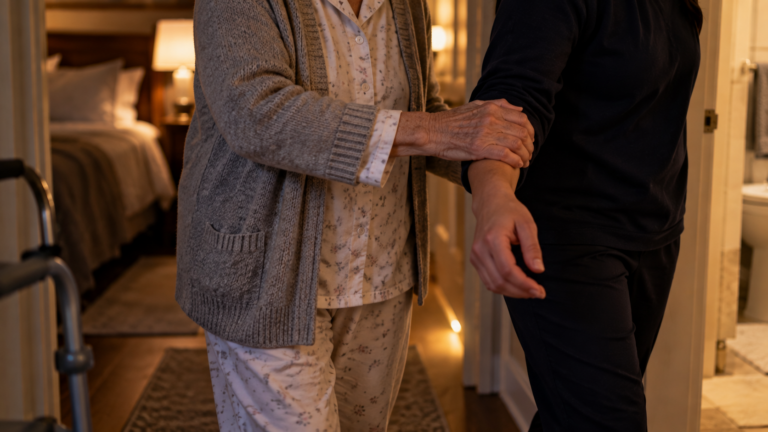
Home Care vs Private Nursing in Toronto
Non-medical home care and private nursing are two different services. Home care supports everyday life at home: personal care, meals, mobility, companionship and safety. Private nursing is clinical care from a nurse registered with the College of Nurses of Ontario, for tasks Ontario law reserves for regulated professionals. Home care does not diagnose, prescribe or provide clinical treatment. Some Toronto families use both. Call our Toronto team at (416) 663-2930 to talk it through.
Key Takeaways
- Home care vs private nursing in Toronto: caregivers support daily life, and nurses perform clinical acts Ontario restricts to regulated professionals.
- Most of what families need day to day is non-medical home care: bathing, dressing, meals, mobility, company and supervision.
- Ontario’s controlled acts rules set the legal boundary. Training, the care setting and the provider’s own policies decide the rest.
- Personal support work is not a regulated profession in Ontario, so ask a provider directly how it screens, trains and supervises its caregivers.
- Publicly funded and private care work alongside each other, and arranging private support does not mean waiting. Call our Toronto team at (416) 663-2930.
Quick Answer: What Separates Home Care From Private Nursing
A caregiver can spend four hours helping your mother bathe, dress, eat and get to an appointment. A caregiver generally cannot give her an injection, unless the task falls within a legal exception or has been formally delegated. A nurse can, where the required authorization, order and practice conditions are in place. Which task belongs to which depends on Ontario’s rules about restricted acts, and on training, the care setting and employer policy.
Table 1. Home care and private nursing at a glance
| Non-medical home care | Private nursing | Why the difference exists | |
| What it covers | Bathing, dressing, grooming, toileting, transfers and mobility. Meals, laundry, shopping, errands. Company and supervision at home. | Clinical care such as assessing a complex or non-healing wound, injections, and clinical follow-up after surgery. | Ontario reserves a defined set of clinical acts for regulated professionals. Everyday support is not among them. |
| Who provides it | Personal support workers (PSWs) and caregivers. Not a regulated health profession in Ontario. | Registered Nurses (RNs), Registered Practical Nurses (RPNs) and Nurse Practitioners (NPs), registered with the College of Nurses of Ontario (CNO). | Nursing is one of Ontario’s 27 regulated health professions. Personal support work is not on that list. |
| Where the limits are | Cannot diagnose, prescribe, or perform a restricted clinical act without a formal exception or delegation. | Does not replace the everyday support a person may also need. What is provided, and for how long, follows assessed need. | The restricted acts are set out in law. How the rest of the day is covered is a practical choice. |
| Who they answer to | Their employer, which sets and enforces its own screening, training and supervision standards, and, for those who register voluntarily, Ontario’s oversight authority, which records complaints and disciplinary action. | The College of Nurses of Ontario, whose public register shows practice restrictions, hearing results, cautions and findings. | Nursing has a college behind it. Non-medical care is governed by the provider’s own standards, and by the oversight authority where a worker has registered. |
Sources for this table: Government of Ontario list of regulated health professions; College of Nurses of Ontario, Scope of Practice practice standard; College of Nurses of Ontario guideline on working with unregulated care providers.
The Line Ontario Actually Draws
The boundary is written into Ontario law, in a set of restricted activities called controlled acts. Ontario regulates 27 health professions, each with its own legislation, and nursing is one of them (Government of Ontario list of regulated health professions). Controlled acts may be performed only by authorized regulated health professionals. The College of Nurses of Ontario, or CNO, adds that they are considered potentially harmful if performed by someone without the required knowledge, skill and judgment (College of Nurses of Ontario, Scope of Practice practice standard).
Three come up constantly in care at home: performing a prescribed procedure below the dermis or a mucous membrane, administering a substance by injection or inhalation, and putting an instrument, hand or finger past certain body openings. Legal authority is only part of the picture. Training, competence, the care setting and employer policy all bear on who does what.
Between the two sides sits a narrow middle ground, where the law lets someone who is not a regulated professional perform certain restricted acts. It is where most of the confusion lives, and we come back to it below.

Figure 1. Where the line falls. On one side, everyday support that needs no authorization. On the other, controlled acts reserved for regulated professionals. Between them, the narrow middle ground where the exceptions and delegation operate.
What Non-Medical Home Care Helps With
Home care covers the parts of a day a person can no longer manage alone, for as many hours as the family needs. Ontario groups it into personal support and homemaking (Government of Ontario guide to support services at home and in the community).
Personal Care, Meals and the Household
Personal support covers dressing and undressing, eating, getting in and out of chairs, vehicles or bed, hair, mouth and skin care, toileting, washing and bathing, and getting to appointments. Homemaking covers laundry, housecleaning, meals, shopping, banking and bills.
Written down it sounds like a checklist. In a home it is a morning, and the difference between a good one and a bad one is usually whether the person doing it knows how your mother likes her tea and which side she leans on when she stands.
That is the part of care nobody writes into a plan, and it is where our Toronto team spends its time. If that is the need, call (416) 663-2930 and we can talk through what a week might look like.
What Help With Medication Covers
This is the area families ask about most, and the rules are narrower than people expect in one direction and wider in the other. Ontario’s program standard for personal support workers describes assisting with medication following the care plan, and where it is a delegated act, under the supervision of a regulated health professional, or by exception under the most accountable person (Ontario’s Personal Support Worker Program Standard). Ontario’s older training standard gives the familiar examples of physical assistance: opening the container, providing a glass of water, placing the pack in the person’s hand (Ontario’s Personal Support Worker Training Standard).
Those examples are a description of assistance, not a legal ceiling. Giving an oral medication is not a controlled act at all: CNO’s medication standard treats oral and topical routes as medication practices that do not involve one (College of Nurses of Ontario, Medication practice standard), and CNO answers directly that a nurse in the community can teach a support worker to administer oral medications, subject to the nurse’s own competence to teach, a judgment about risk and predictability, evidence that the worker can do it safely, and employer policy (the College of Nurses of Ontario uses exactly this example).
The firm line is the route, not the task. Administering a substance by injection or inhalation is a controlled act, so it belongs to a nurse or to someone acting under an exception or delegation. So ask a provider two things: what its own policy allows, and who taught and assessed the person doing it.
What Private Nursing Is For
Nursing covers the clinical side of care at home: assessing what is happening, performing restricted procedures, and managing a health condition. CNO sets out the practice of nursing as the promotion of health and the assessment of, provision of care for, and treatment of health conditions, in order to attain or maintain optimal function (College of Nurses of Ontario, An Introduction to the Nursing Act, 1991). At home that can be a scheduled visit or a longer period of care, depending on what the person needs.
Who Counts as a Nurse in Ontario
Ontario has three nursing titles: Registered Nurse (RN), Registered Practical Nurse (RPN) and Nurse Practitioner (NP). RNs and RPNs are authorized to perform the same five controlled acts, on an order, or where the regulation allows a nurse to initiate one, and as authorized in their practice setting (College of Nurses of Ontario, Scope of Practice practice standard). The entry requirement differs: a baccalaureate nursing degree for an RN, a practical nursing diploma for an RPN. RNs who complete CNO’s approved education can additionally prescribe certain medications. NPs can do more still, including communicating a diagnosis, prescribing, and ordering diagnostic tests (College of Nurses of Ontario, Nurse Practitioner practice standard).
Older material sorts RNs and RPNs by how complex or unpredictable the client is. CNO replaced that framework in 2023, so some material still describes the distinction that way.
One local detail matters, because it turns up on Ontario care websites fairly often. LPN, or Licensed Practical Nurse, is not the Ontario designation. Practical nurses registered to practise here use the title Registered Practical Nurse, or RPN (Ontario registers practical nurses as RPNs). So if you see LPN on an Ontario care website, it is usually wording carried over from another province rather than a different qualification. The Ontario title to look for is RPN.
The titles are protected. Only CNO members may call themselves a nurse, a Registered Nurse, a Registered Practical Nurse or a Nurse Practitioner, in any language or abbreviation. Asked whether a personal support worker can use the title nurse, the College of Nurses of Ontario answers this directly. The answer is no. Ontario nurses are registered rather than licensed, so “licensed nursing” is loose wording.
How to Check That Someone Is Actually a Nurse
You can check in about a minute, and we think every family should. Find a Nurse, the College’s public register lets anyone look up a nurse by name. It shows membership status, class of registration, any current practice restrictions, and the results of past College hearings, cautions, charges and findings of guilt. If someone coming to your parent’s home is described as a nurse, they should be in that register. If you cannot find them, ask why before the first visit. Physiotherapists and occupational therapists keep public registers too.
Table 2. Who answers to whom
| Role | Regulated by | Public register | What it tells you |
| Registered Nurse, Registered Practical Nurse, Nurse Practitioner | College of Nurses of Ontario | Yes, and it is open to anyone | Membership status, class of registration, practice restrictions, hearing results, cautions, charges, findings of guilt |
| Personal support worker | Not a health regulatory college. The Health and Supportive Care Providers Oversight Authority (HSCPOA) oversees those who register with it | Yes, but registration is voluntary, so not everyone appears | For those who register: status, languages spoken, complaints and disciplinary actions |
| Physiotherapist | College of Physiotherapists of Ontario | Yes | Searchable by name, registration number, clinic, city, discipline history, language, and the controlled acts they can perform |
| Occupational therapist | College of Occupational Therapists of Ontario | Yes | The College is required to maintain it, and anyone may view the listed details |
Sources for this table: Find a Nurse, the College’s public register; public register of registered personal support workers; College of Physiotherapists of Ontario; College of Occupational Therapists of Ontario.
The second row is the one that changes how families think. Personal support workers are not members of an Ontario health regulatory college, and CNO notes that unregulated care providers are accountable to their employers (College of Nurses of Ontario guideline on working with unregulated care providers). That is no longer the whole picture: HSCPOA maintains a public register of registered personal support workers and began registering personal support workers in December 2024. Registration is voluntary, so a good support worker may simply not be on it (the Health and Supportive Care Providers Oversight Authority), though the oversight authority notes that many employers require it as a condition of employment. A registered worker is subject to HSCPOA oversight. An unregistered one is accountable mainly through their employer. Either way, how a provider screens, trains and supervises its people is worth asking about directly. Ask us. We would rather answer that on the phone than have you take it on trust from a website.
Situations That May Require a Nurse
A nurse is needed when the task is a restricted clinical act, or when it calls for clinical judgment rather than a steady routine. The test is not how serious the situation feels, but whether the task crosses one of the lines Ontario draws.
Table 3. Common situations and who they usually point to
| The situation | Usually points to | Why |
| Help with bathing, dressing and moving around the house | Caregiver | Everyday personal support. No restricted act involved |
| Meals, laundry, shopping, rides to appointments | Caregiver | Ontario lists these as homemaking and personal support services |
| Reminders, opening the container, handing over the pack | Caregiver | Assisting with medication, as Ontario’s standards describe it |
| Giving an oral medication | Caregiver, where taught, assessed and permitted | Oral administration is not a controlled act. Training, employer policy and the care plan govern it |
| Routine ostomy appliance and skin care | Caregiver, where trained and permitted by the care plan and employer policy | Emptying or changing an appliance does not by itself involve a restricted act |
| A complex or non-healing wound that needs assessing and a care plan | Nurse | Wound assessment and planning is specialized nursing work |
| A dressing change | Depends on the procedure | A simple surface dressing is not a controlled act. A prescribed procedure below the dermis or a mucous membrane is |
| Injections, including insulin | Nurse. A caregiver only where a formal exception or documented delegation applies, and the provider’s policy and care plan permit it | Administering a substance by injection is a controlled act |
| Inserting a urinary catheter past the urethral opening | Nurse. A caregiver only under a formal exception or documented delegation, where policy and the care plan permit it | Putting an instrument, hand or finger past a specified body opening is a controlled act |
| Inserting an instrument or finger into a stoma | Nurse. A caregiver only under a formal exception or documented delegation, where policy and the care plan permit it | An artificial opening is one of the specified openings |
| The first weeks home after surgery | Often both | Clinical follow-up on one side, daily support and supervision on the other |
Sources for this table: College of Nurses of Ontario, Scope of Practice practice standard; College of Nurses of Ontario guideline on working with unregulated care providers; Ontario’s Personal Support Worker Training Standard; Ontario Health atHome describes wound care. This table describes how Ontario draws the line in general. It is not advice about a particular person’s care. Comfort Keepers Toronto provides non-medical home care, and where a task falls on the clinical side of this line we will say so.
Wound care is the one families most often flatten into a single thing. Changing a simple surface dressing is not a controlled act. Working out why a wound is not healing is different work: Ontario Health atHome describes wound care as assessing and diagnosing the wound type and determining what else is affecting healing. A wound that is not improving is a reason to call someone clinical.
When a Caregiver Can Do It Anyway
Which leaves a fair question: why can the caregiver not just do it, when the family can?
Ontario law contains exceptions that let someone who is not a regulated health professional perform certain controlled acts. Two matter at home, and they are not the same size (College of Nurses of Ontario guideline on working with unregulated care providers).
- A member of the household may perform the injection and body-opening acts in any circumstance. That is why a wife can give her husband his insulin.
- A paid care provider may perform those same two acts only where they count as assisting with a routine activity of living. Anything beyond that needs delegation.
- Neither exception covers procedures below the skin or a mucous membrane. For family and paid caregivers alike, that always needs formal delegation from someone authorized to perform it.
The routine activity test has a defined meaning: a procedure counts when its need, response and outcome have been established over time and are predictable. A settled, long-standing routine can fall inside it. Something new, or something where the dose or the response keeps shifting, does not.
Insulin is CNO’s own worked example, and it shows how fine the line is. Where a client receives a regular, same-dose daily injection and their condition is predictable, the College of Nurses of Ontario uses exactly this example: a support worker can be taught to give it as a routine activity of living. Where it does not meet that test, the same injection needs delegation, and sliding scale insulin needs delegation rather than falling within the exception.
Delegation is a formal transfer of authority, not a favour. A nurse who delegates has to be authorized and competent to perform the act, confirm the person receiving it can do it safely, stop it if safety is in question, and document it. Being shown how to do something is not the same as being allowed to: the College of Nurses of Ontario is explicit that teaching is not the same as delegating.
It also explains why an answer can change. CNO expects a mechanism to monitor whether a task still meets the routine test, so a task that is fine one month can need a nurse the next. A provider that flags that change is doing what the rules require.

Figure 2. A decision path for working out which side of the line a task sits on, set out in words in the paragraph below.
The same path in words: everyday support goes to a caregiver. If a task is not everyday support and is not one of the three restricted acts, confirm it with the provider, because other clinical requirements may apply. Of the three, a prescribed procedure below the dermis or a mucous membrane is covered by neither the household nor the routine activities exception, so it needs a nurse or a formal delegation. An injection or inhalation, or an instrument, hand or finger past a body opening, may fall within the routine activities exception where it is established and predictable for a paid caregiver, and otherwise needs a nurse or delegation. A member of the household sits outside that last question altogether.
When Families Use Both
Some families use both services, with nursing addressing defined clinical needs and non-medical home care supporting daily routines. The caregiver holds the routine, the meals and the company. The nurse comes for the clinical work.
The everyday hours matter because someone is already doing them, usually unpaid, and usually an adult child or a spouse. The Canadian Institute for Health Information’s caregiver distress indicator reports that 95 percent of home care clients in the reporting jurisdictions, Ontario among them, have an unpaid caregiver, and that more than two in five of those caregivers are distressed. Both figures are published as CIHI, 2024.
Coming home from hospital is where the timing gets tight. According to the Canadian Institute for Health Information’s indicator on hospital stays extended while home care is arranged, published as CIHI, 2024, around one in ten hospital patients wait for home care services or supports. Half of them wait eight days or less, and one in ten wait 41 days or more. Private non-medical care can cover the everyday hours in that gap, and it is not subject to that queue. It does not replace nursing or clinical care.
How Private Care Fits With Ontario Health atHome
Publicly funded home care in Ontario is coordinated by Ontario Health atHome, which arranges care coordination, nursing, physiotherapy, occupational therapy, speech therapy, social work, nutritional counselling, personal support, and medical supplies and equipment. Anyone can make a referral, and Ontario residents with a valid Ontario Health Insurance Plan (OHIP) card are eligible for an assessment by a care coordinator (how to get started with Ontario Health atHome). If you qualify, the Ontario government pays for home care, and the same page notes you can also pay for your own care through private companies (Government of Ontario page on home and community care).
What you receive is based on your assessed needs and on the services available locally, so the amount comes out of the assessment. Assessments are requested through Ontario Health atHome, and its Toronto Central office serves the city. Many families request one and arrange private support in the meantime rather than waiting.
Questions to Ask Before Arranging Care

These are worth asking any provider in Toronto, including us. A provider that knows its own answers will give you specifics.
Questions About the People Coming Into the Home
- Who exactly is coming, and in what role? Ask for the title, and whether that person is a regulated health professional.
- If they are described as a nurse, ask for their class of registration, then confirm it yourself in the College register.
- Which type of police record check was done? Ontario defines three, and the vulnerable sector check is the one designed for people in a position of trust over vulnerable persons.
- Who supervises the caregiver, and who does the family call if something is wrong at eight in the evening?
- What happens when the regular caregiver is sick or on holiday? Ask how a replacement is briefed, not just whether one exists.
A vulnerable sector check adds findings a standard criminal record check leaves out, and requires the consent of the person being checked (Government of Ontario guidance on police record checks).
Questions About What Happens When Needs Change
- If a task moves from something the caregiver can do to something they cannot, who notices, and who tells the family?
- If a task is being done under a delegation, who delegated it, and what happens if that person is no longer involved?
- How do you decide when a task has moved beyond what a caregiver can do, and how quickly is the family told?
Questions About Cost and Paperwork
We do not publish rates here, because a number without hours, timing and needs behind it is misleading. Tell us the shape of the week you are trying to cover and we will give you a real figure: (416) 663-2930. What we can point to here is money that already exists and often goes unclaimed. This is general information rather than tax advice, and thresholds change from year to year, so confirm the current rules or ask your tax preparer.
- Ask whether you qualify for the Ontario Seniors Care at Home Tax Credit, which is refundable: up to 25 percent of claimable medical expenses up to $6,000, for a maximum credit of $1,500, reduced by 5 percent of family net income over $35,000 and fully phased out by at most $65,000. You or your spouse must have turned 70 or older in the year, and you must be resident in Ontario at year end.
- Ask what receipts you will get. Certain attendant care expenses may also be claimable federally. For attendant care at home, CRA requires that you either be eligible for the disability tax credit or have written certification from a medical practitioner that the services are necessary (CRA Guide RC4065 on attendant care). The general Canada Revenue Agency rules on eligible medical expenses set out the thresholds for each tax year.
- Some families consider hiring a caregiver directly. It is worth understanding first that this can make you their employer, with payroll, insurance and coverage obligations an agency otherwise carries. See Canada Revenue Agency guidance on payments to caregivers and domestic workers and the Workplace Safety and Insurance Board’s policy on domestic workers.
Toronto Next Steps
Plenty of households here are working through the same question. In the 2021 Census, 476,990 Toronto residents were 65 or over, and since 2016 the city has had more people 65 and over than under 15 (2021 Census figures published by the City of Toronto).
- If the need is daily life, start with our home care services for seniors in Toronto.
- If the need may be clinical, call us. We will help you work out which parts of the week need a nurse and which are everyday support, and we will be straight about what we do and do not provide. You can also read about in-home nursing.
- If you are not sure which it is, that is the most common call we get. You can also look through our Toronto services.
Call our Toronto team at (416) 663-2930. We are Comfort Keepers Toronto, based at 245 Fairview Mall Drive, Suite 401 in North York, and we provide non-medical home care across Toronto and North York.
About the Author and Reviewer
This guide was written by the Comfort Keepers Canada Editorial Team. That is a local service-accuracy review, not a clinical or medical review. You can learn more about our team on the Comfort Keepers Toronto team page. This article explains how Ontario distinguishes non-medical home care from nursing. It does not replace medical advice, diagnosis or treatment, and it is not advice about any particular person’s care.
Published September 2026 · Last reviewed September 2026
Sources
College of Nurses of Ontario. Scope of Practice, practice standard (2025).
College of Nurses of Ontario. Working With Unregulated Care Providers, practice guideline (2025).
College of Nurses of Ontario. An Introduction to the Nursing Act, 1991, fact sheet (2025).
College of Nurses of Ontario. Medication, practice standard (2025).
College of Nurses of Ontario. Nurse Practitioner, practice standard (2026).
College of Nurses of Ontario. Sliding scale insulin, Ask Practice (accessed September 2026).
College of Nurses of Ontario. REx-PN frequently asked questions (accessed September 2026).
College of Nurses of Ontario. Find a Nurse, public register (accessed September 2026).
College of Physiotherapists of Ontario. Public register (accessed September 2026).
Government of Ontario, Ministry of Health. Regulated health professions (accessed September 2026).
Government of Ontario. Home and community care (accessed September 2026).
Government of Ontario. Police record checks (accessed September 2026).
Government of Ontario. Ontario Seniors Care at Home Tax Credit (accessed September 2026).
Ontario Ministry of Colleges and Universities. Personal Support Worker Program Standard (2022).
Ontario Health atHome. Home care (accessed September 2026).
Ontario Health atHome. Getting started (accessed September 2026).
Ontario Health atHome. Wound care, specialized services (accessed September 2026).
Ontario Health atHome. Toronto Central area (accessed September 2026).
Canadian Institute for Health Information. Caregiver distress, indicator (2026).
Canada Revenue Agency. Guide RC4065, Medical Expenses, attendant care and care in a facility (2025).
Frequently Asked Questions
Can a caregiver give my mother her insulin?
It depends on her regimen, on the caregiver’s training and assessed competence, and on the provider’s policies. CNO uses this exact situation as its example. Where a client gets a regular, same-dose daily injection and their condition is predictable, that can qualify as a routine activity of living, and a support worker can be taught to give it. Where the dose changes in response to readings, sliding scale insulin needs formal delegation instead. The household exception is worded around members of the same household, which is not automatically the same as being a relative, and it is not a reason for anyone to give an injection without proper instruction.
Is a private nurse better than a caregiver?
They are not two grades of the same thing. They hold different authority, different training and different roles. For most families most of the time the need is the everyday hours, and that is not a lesser version of nursing. It is a different job with its own skill. Which one a person needs depends on their assessed needs, and many people need both. A practical way in is to work out which specific tasks in a week require a nurse, and what kind of support the rest of the week needs.
How do I find out how many different caregivers will come?
Ask about the mechanics rather than the philosophy. A typical number of caregivers in a month. Who decides the match, and what happens if it is wrong. Whether a replacement reads anything about the person before their first shift. Any provider should be able to answer those in concrete terms, ours included.
What do I do if I think something has gone wrong?
Where you take it depends on who was involved. If it concerns a nurse, CNO handles complaints about its members, and past hearing results, cautions, charges and findings of guilt appear on Find a Nurse, the College’s public register. If it concerns a personal support worker registered with HSCPOA, complaints and disciplinary actions are recorded on its public register of registered personal support workers. If the person is not registered anywhere, the employer is the usual first route. Other channels may apply depending on what happened and where care was delivered.
Can I use publicly funded home care and private care together?
Yes. The two are not alternatives, and many families combine them. What the province covers is established through an assessment by a care coordinator, which also identifies what is available locally, and families arrange private services for what falls outside that. If support is needed now, arrange it now. Requesting an assessment does not prevent you from putting help in place in the meantime, and it does not have to come first.